U.S. Homeowners: Check Local TTHM, 80 ppb Explained and Next Steps

Trihalomethanes (THMs) in tap water are disinfection byproducts, mainly chloroform, bromodichloromethane, dibromochloromethane, and bromoform, and the EPA caps total trihalomethanes (TTHM) at 80 ppb as a running annual average. Long-term exposure, not a single high reading, is the real health concern. Check your utility’s latest results, run the bathroom fan when you shower, and if you want extra assurance, a certified activated carbon or reverse osmosis filter cuts your intake.
TL;DR:
- Most health risks from trihalomethanes stem from long-term exposure exceeding an annual average of 80 ppb rather than isolated high readings.
- Volatile THMs can be inhaled during hot showers, making ventilation and shorter, cooler showers effective ways to reduce inhalation exposure.
- Water quality reports show quarterly tests with averages, so a single elevated result does not constitute a violation unless the yearly average surpasses 80 ppb.
- Home filtration options like activated carbon and reverse osmosis can significantly decrease THM levels, especially when certified for VOC removal.
- Utility treatment methods focus on removing organic precursors and switching disinfectants, but each approach involves trade-offs between chemical byproducts and microbial safety.
Table of Contents
- What Are Trihalomethanes and How Do They Form?
- Are Trihalomethanes Harmful? What the Health Data Shows
- How Are You Actually Exposed to THMs?
- How Do Utilities Measure and Report TTHM Levels?
- What Actually Reduces Trihalomethanes at Home?
- How Do Water Utilities Lower THMs, and What Do They Trade Off?
- How to Check Your Local TTHM Levels
- Weighing Disinfection Benefits Against Long-Term DBP Risk
- Find Your TTHM Numbers Before You Guess at a Fix
- Sources
What Are Trihalomethanes and How Do They Form?
Trihalomethanes are chemical byproducts created when chlorine or other disinfectants react with natural organic matter, decaying leaves, algae, tiny bits of soil, already dissolved in the source water. The four regulated species are chloroform, bromodichloromethane, dibromochloromethane, and bromoform, with chloroform typically occurring in the highest concentration of the group.
Several factors push formation higher:
- Organic matter load: rivers and lakes with more decaying plant material generate more THM precursors than deep groundwater.
- Bromide content: source water with natural bromide shifts the mix toward brominated species like bromoform.
- Temperature and pH: warm water and higher pH accelerate the chemical reaction between chlorine and organics.
- Water age: water sitting longer in pipes or storage tanks keeps reacting, so THM levels climb the farther water travels from the treatment plant.
THMs are also volatile, meaning they evaporate readily out of water into air. That single property explains why breathing them in during a hot shower matters just as much as drinking them.
Are Trihalomethanes Harmful? What the Health Data Shows
The health evidence on trihalomethanes comes mostly from animal studies and a smaller body of human epidemiology, and it points toward increased cancer risk and possible reproductive effects at high, sustained exposure levels rather than from a single glass of water. Researchers have also flagged associations with liver and kidney effects in long-term animal testing.
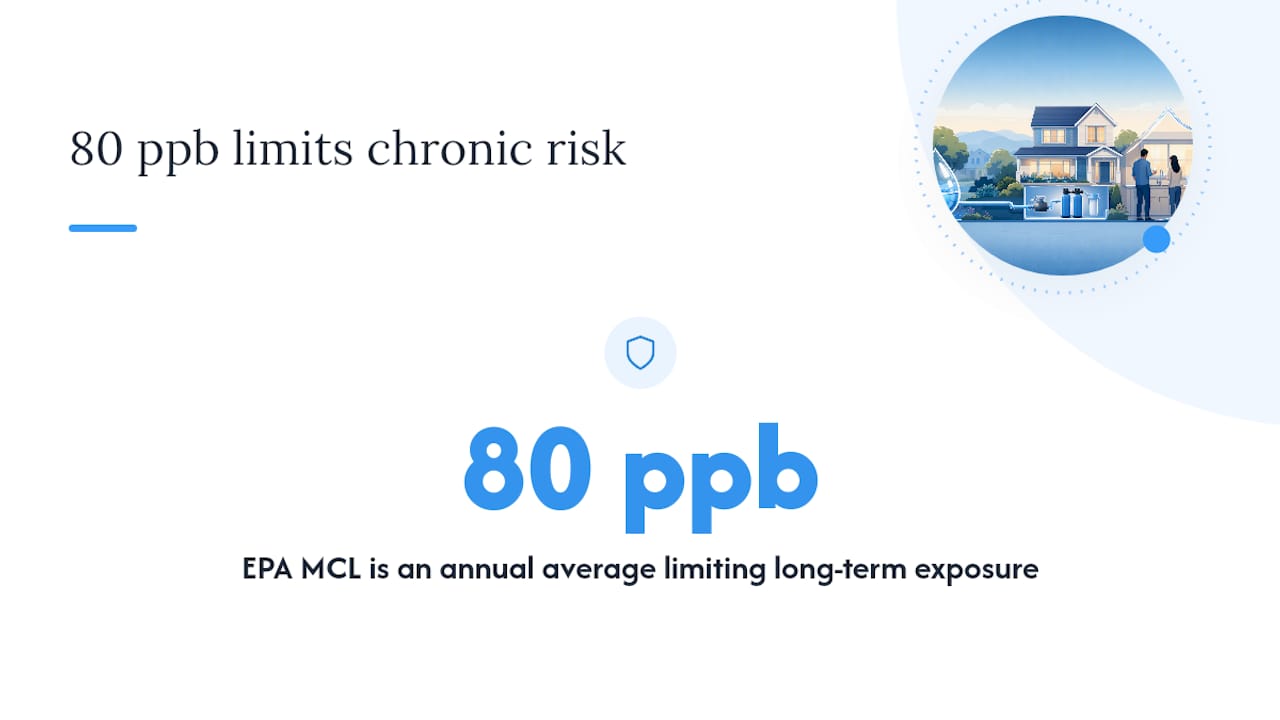
The regulatory benchmark: the EPA’s maximum contaminant level for total trihalomethanes is 80 micrograms per liter, or 80 ppb, calculated as an annual average rather than a single sample.
That averaging matters. The MCL isn’t designed to catch a one-day spike, it’s built around limiting chronic, years-long exposure, which is where the epidemiological concern actually lives. A utility reading 95 ppb in one quarter isn’t automatically in violation; a utility averaging above 80 ppb across a year is.
Pregnant people and infants get extra attention in public health guidance because some studies have examined THM exposure alongside pregnancy outcomes, though the data remains limited and not fully conclusive. If you’re pregnant, nursing, or have young children at home, it’s reasonable to be more cautious about long-term exposure even though the acute risk from typical tap water is low.
How Are You Actually Exposed to THMs?
Drinking tap water is only part of the picture. Because THMs are volatile, inhalation during showering can contribute substantially to total intake, sometimes rivaling or exceeding what you’d absorb by drinking the same water. Dermal absorption through skin during bathing adds a third pathway, though it’s generally the smallest contributor of the three.
Hot water speeds this up. Heat and agitation, think shower spray hitting your skin versus a still glass of water, both increase how fast THMs volatilize out of water and into the air you breathe.
Simple adjustments lower your exposure without any equipment:
- Run the bathroom exhaust fan or crack a window during and after showers.
- Shorten shower time, especially with very hot water.
- Lower your water heater temperature slightly if you shower frequently.
- Avoid lingering in a closed, steamy bathroom after the water’s off.
Pro Tip: A five-minute cooler shower with the fan running removes more of your inhalation exposure than switching to bottled water for drinking alone.
How Do Utilities Measure and Report TTHM Levels?
Public water systems don’t test once and call it done. TTHM monitoring runs on a quarterly schedule, and here’s how the numbers get turned into a compliance decision:
- Quarterly samples are collected at designated points in the distribution system, often the locations most likely to show elevated levels due to water age.
- Those four quarterly results get averaged into a locational running annual average (LRAA) for each sample site, a method that accounts for how TTHM levels vary across a distribution system.
- If any site’s LRAA exceeds 80 ppb, the utility has a violation and must notify customers, typically through a public notice or an entry in the annual Consumer Confidence Report.
When you pull up your utility’s report, look for the individual sample value, the LRAA next to it, and any violation language. A single high quarterly number without an LRAA above 80 ppb usually isn’t a regulatory violation, it’s a data point the running average will absorb. Federal drinking water rules require this notification structure precisely so short-term spikes don’t get buried.
What Actually Reduces Trihalomethanes at Home?
Not every filter marketed as a “water purifier” touches THMs, and boiling water, despite the intuitive appeal, is the wrong move: it concentrates non-volatile contaminants while doing little to remove compounds that are already inclined to evaporate on their own.
What does work, roughly in order of practicality:
- Granular activated carbon (GAC): pitcher filters, faucet-mount units, and under-sink systems adsorb THMs effectively when the cartridge is fresh; effectiveness drops sharply once the carbon saturates, so follow the replacement schedule.
- Reverse osmosis (RO): point-of-use RO systems, usually paired with a carbon pre-filter, remove a broad range of contaminants including THMs and are a solid choice if you want one system handling multiple contaminant categories at once.
- Whole-house carbon filtration: addresses THMs at the point of entry, which also cuts your shower and bathing inhalation exposure, not just drinking water.
- Aeration: letting a pitcher of water sit uncovered overnight lets some THMs off gas naturally, a low-cost but limited-capacity option.
Look for NSF/ANSI Standard 53 certification specifically for VOC or THM reduction claims, not just general filtration marketing. Certification numbers confirm the product was independently tested against the specific contaminant, not just assumed to work because it contains carbon.
How Do Water Utilities Lower THMs, and What Do They Trade Off?
Utilities can’t just cut disinfectant dosing to chase a lower TTHM number, that would trade a chemical risk for a microbial one, and waterborne disease is the faster, more dangerous threat. Instead, treatment plants attack the problem upstream:
- Precursor removal: enhanced coagulation and filtration strip out the organic matter before chlorine ever touches it, reducing the raw material for THM formation.
- Granular activated carbon treatment: full-scale GAC filtration at the plant level removes precursors and some formed THMs before water leaves the facility.
- Alternative disinfectants: switching to chloramines, ozone, or chlorine dioxide produces fewer THMs, but each swap introduces its own disinfection byproduct profile that then needs its own monitoring.
- Air stripping: aerating treated water at the plant lets volatile THMs escape before distribution.
The tradeoff is real: chloramines lower TTHM but raise nitrification risk in distribution pipes and can increase other regulated byproducts like haloacetic acids. There’s no disinfectant that eliminates the byproduct question entirely, only different balances between microbial safety and chemical byproducts.
How to Check Your Local TTHM Levels
Your utility’s Consumer Confidence Report is the primary public document, usually mailed annually or posted online, listing sample values and LRAAs by contaminant. State environmental agencies also publish lab data, and EPA’s national database backs the whole system.
- Search your city, ZIP code, or utility name on TapWaterIndex’s TTHM contaminant page to see EPA monitoring data without digging through PDF reports.
- Compare your results against neighboring utilities and other states to get context on whether your reading is typical.
- If a number looks concerning, contact your utility directly, watch for advisory language in your next report, and consider point-of-use filtration in the meantime.
| What to look for | Why it matters |
|---|---|
| Sample value vs. LRAA | A single high sample isn’t a violation; an LRAA above 80 ppb is |
| Violation notice language | Utilities must notify customers when the annual average is exceeded |
| Trend over multiple years | One-off spikes matter less than a rising multi-year pattern |
Weighing Disinfection Benefits Against Long-Term DBP Risk
Chlorination is one of the reasons waterborne diseases stopped being a routine American health crisis, and that protection operates on a different timescale than THM risk. Acute microbial contamination can sicken people within days; chemical byproduct concerns build over years of exposure.
The proportionate response isn’t panic, it’s checking your actual local numbers, improving shower ventilation, and using a certified filter if you want extra margin. Skip the disinfectant altogether and you’ve traded a manageable, well-studied chemical risk for a much less predictable microbial one.
— Sergey
Find Your TTHM Numbers Before You Guess at a Fix
Guessing whether your tap water has a THM problem wastes money on filters you might not need, or worse, leaves you without one you do. Some platforms pull official EPA monitoring data into searchable formats organized by city, ZIP code, or water supplier, enabling users to view their actual TTHM sample values and compare them to the 80 ppb limit instead of relying on a national average that says nothing about their pipes.
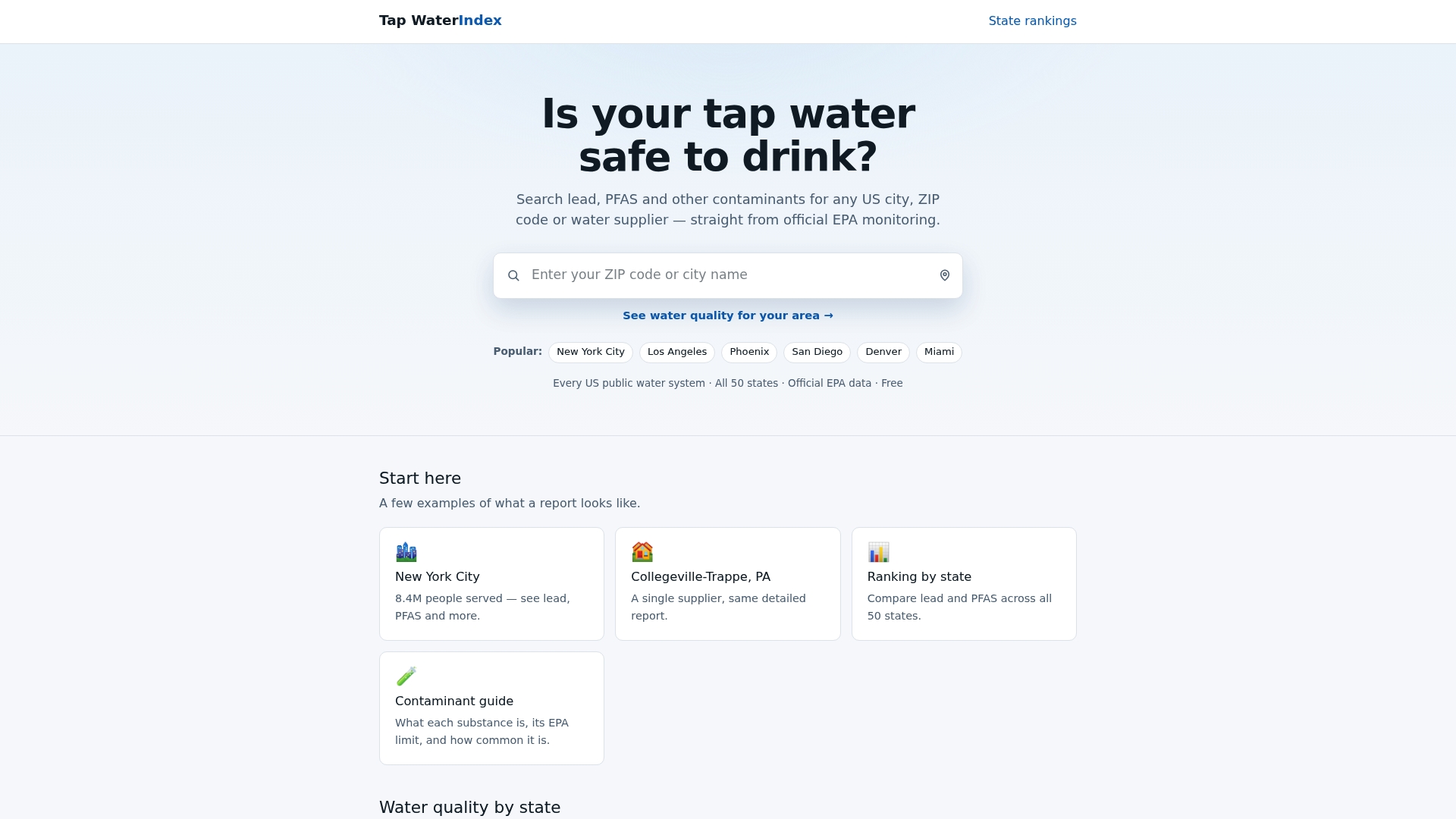
Start with Tapwaterindex’s TTHM contaminant page to see EPA limit context and occurrence data, then search your own address on the Tapwaterindex home page to pull your utility’s specific numbers. If you want the bigger picture, the state-by-state water quality rankings show how your area stacks up against the rest of the country before you decide whether a filter is worth the investment.
This article is general information, not a substitute for advice from a qualified doctor. Consult a qualified healthcare professional about your own circumstances before acting on anything here.
Sources
- Total Trihalomethane In Drinking Water Information for Consumers — Massachusetts Department of Environmental Protection
- Tap Water and Trihalomethanes: Flow of Concerns Continues — Ernie Hood (Environmental Health Perspectives, PMC)
- Trhalomethanes — WHO chemical fact sheet (Guidelines for drinking-water quality references)