Safe Drinking Water Act: What U.S. Residents Need to Know
The Safe Drinking Water Act (42 U.S.C. §300f et seq.), signed into law on December 16, 1974, gives the EPA authority to set National Primary Drinking Water Regulations (NPDWRs) that are legally enforceable for every public water system in the country. Those regulations now cover more than 90 contaminants, and the EPA reports that a large majority of Americans served by community water systems receive water that consistently meets all health-based standards.
Here is what that means for you right now:
- Statutory basis: The law is codified at 42 U.S.C. §300f et seq. and applies to any public water system serving at least 25 people or 15 service connections.
- EPA as regulator: The EPA writes the national standards; states, territories, and tribes enforce them once they receive “primacy.”
- Core tools: Standards take the form of Maximum Contaminant Levels (MCLs), Maximum Contaminant Level Goals (MCLGs), or Treatment Techniques (TTs) when a numeric limit is not feasible.
- Local data: Tapwaterindex lets you search by city, ZIP code, or water supplier to see how your system performs against those EPA limits.
Key Takeaways
The Safe Drinking Water Act gives EPA authority to set enforceable national standards for public water systems, but its protections depend on state primacy, infrastructure condition, and whether your household uses a public system at all.
| Point | Details |
|---|---|
| SDWA scope and limits | The law covers public water systems serving 25+ people; private wells serving fewer than 25 people have no federal protection. |
| EPA sets the floor | NPDWRs define MCLs and MCLGs for 90+ contaminants; states may adopt stricter standards and often do. |
| PFAS is the current frontier | EPA’s 2024 PFAS rule set the first-ever federal MCLs for PFOA and PFOS at 4 parts per trillion; systems must comply by 2029. |
| CCR is your annual baseline | Read your Consumer Confidence Report every year and compare detected levels against MCLs, not MCLGs. |
| Act fast on Tier 1 notices | A Tier 1 public notice means an acute health risk — use bottled water immediately, especially for infants, and contact your supplier the same day. |
| Tapwaterindex for local context | Search by city, ZIP, or supplier on Tapwaterindex to see EPA monitoring data in a readable format alongside state comparisons. |
Table of Contents
- What the Safe Drinking Water Act covers: scope and key definitions
- History and major amendments: 1974, 1986, 1996, and the PFAS era
- How drinking-water standards are made: MCLG, MCL, and treatment techniques
- Who enforces the SDWA and how state primacy works
- Major rules and example contaminants: lead, arsenic, disinfection byproducts, and PFAS
- Monitoring, reporting, and the public’s right to know
- What the SDWA doesn’t cover and real-world challenges
- Practical steps: how to check your water and respond to a violation
- Authoritative data sources and tools: EPA portals, state pages, and Tapwaterindex
- The SDWA as a local consumer: what the law actually means for your household
- Your local water quality report, searchable in seconds
- Sources
What the Safe Drinking Water Act covers: scope and key definitions
The SDWA regulates public water systems, defined as systems that provide piped water for human consumption to at least 25 people or 15 service connections for at least 60 days per year. This includes many public water systems nationwide, ranging from large municipal utilities to small community systems at schools and mobile home parks.
What the law does NOT cover: private wells serving fewer than 25 people fall entirely outside SDWA jurisdiction. If your household relies on a private well, no federal drinking-water standard applies to your tap.
The primary regulatory instruments you will encounter:
- NPDWRs (National Primary Drinking Water Regulations): Legally enforceable standards for contaminants that may pose a health risk. Found at 40 CFR Part 141.
- MCLG (Maximum Contaminant Level Goal): A nonenforceable, health-based target set at the level where no known or anticipated adverse health effects occur. Often zero for carcinogens.
- MCL (Maximum Contaminant Level): The enforceable limit, set as close to the MCLG as technology and cost allow.
- Treatment Technique (TT): A required process or operational standard used when measuring a contaminant at the tap is not technically or economically feasible.
- CCL (Candidate Contaminant List): A list of unregulated contaminants EPA evaluates every five years as candidates for future regulation.
- UCMR (Unregulated Contaminant Monitoring Rule): Requires water systems to monitor for contaminants not yet regulated, generating occurrence data that informs future rulemaking.
- CCR (Consumer Confidence Report): An annual water quality report that community water systems must deliver to customers by July 1 each year.
Pro Tip: Your water system’s name and ID number appear on your water bill. Keep that ID handy — you will need it to pull up your system’s CCR and violation history on the EPA’s Safe Drinking Water Information System (SDWIS) or on Tapwaterindex.
History and major amendments: 1974, 1986, 1996, and the PFAS era
The SDWA did not arrive fully formed. Each major amendment reshaped what EPA could regulate, how fast it had to act, and what tools states could use.
- 1974 — Enactment (Pub. L. 93-523): Congress passed the original law in response to documented contamination in public water supplies. EPA gained authority to set interim and revised national standards and to regulate underground injection of waste.
- 1986 — Amendments: Congress grew impatient with slow rulemaking and mandated that EPA regulate 83 specific contaminants within three years and set standards for 25 more every three years thereafter. The amendments also banned lead solder and flux in public water systems and service lines.
- 1996 — Amendments: The most structurally significant overhaul. Key changes included:
- Required EPA to use the best available, peer-reviewed science when developing new standards.
- Mandated comprehensive risk-and-cost assessments for every new NPDWR.
- Created the CCL and UCMR as formal tools for identifying and monitoring emerging contaminants.
- Established the Drinking Water State Revolving Fund (SRF) to finance infrastructure upgrades.
- Required EPA to review each existing standard at least once every six years.
- Added right-to-know provisions, including the annual CCR requirement.
- 2011–present — Emerging contaminants: PFAS (per- and polyfluoroalkyl substances) became the defining regulatory challenge of this era. EPA added PFAS compounds to the UCMR monitoring program and, in April 2024, finalized the first-ever National Primary Drinking Water Regulation for PFAS, setting MCLs for PFOA and PFOS at 4 parts per trillion and establishing limits for four additional PFAS compounds.
By the numbers: The EPA’s PFAS rule is projected to reduce PFAS exposure for roughly 100 million people. Systems have until 2029 to comply with the new MCLs, making 2024–2029 the most consequential rulemaking window since 1996.
The PFAS rulemaking illustrates a persistent tension in the law: the gap between when a contaminant is identified as a health concern and when an enforceable standard takes effect can span decades. PFAS were in widespread industrial use by the 1950s; the first federal MCL arrived in 2024.
How drinking-water standards are made: MCLG, MCL, and treatment techniques
The path from “this chemical might be dangerous” to “here is the enforceable limit” follows a defined statutory process under 42 U.S.C. §300g-1. It is slower than most people expect, and understanding why helps explain both the law’s strengths and its gaps.
Step 1 — Identify the contaminant. EPA evaluates contaminants on the CCL for regulatory priority. A contaminant must meet three criteria: it may have an adverse health effect, it occurs or is likely to occur in public water systems, and regulation presents a meaningful opportunity to reduce health risk.
Step 2 — Set the MCLG. EPA publishes a nonenforceable health goal based purely on toxicology and epidemiology, with no consideration of cost or technology. For known or probable carcinogens, the MCLG is typically zero.
Step 3 — Set the MCL or Treatment Technique. EPA then sets the enforceable standard as close to the MCLG as is “feasible,” meaning achievable using the best technology, treatment techniques, or other means that are available, taking cost into account. When measuring a contaminant at the tap is not technically or economically feasible, EPA requires a Treatment Technique instead.
The table below shows how these three tools differ in practice:
| Standard type | Legally enforceable? | Basis for setting | Example |
|---|---|---|---|
| MCLG | No | Health only (toxicology, epidemiology) | Lead: 0 mg/L |
| MCL | Yes | Feasibility + cost + health | Lead: action level 0.015 mg/L |
| Treatment Technique | Yes | Required process when MCL not feasible | Surface Water Treatment Rule (turbidity, filtration) |
The NPDWRs also require EPA to publish a regulatory impact analysis for each new standard, covering benefits, costs, and risk-reduction estimates. Public comment periods are mandatory before any final rule takes effect.
The CCL and UCMR feed this process continuously. The CCL, published every five years, lists contaminants under active consideration. The UCMR requires large systems (and a statistical sample of smaller ones) to monitor for specific unregulated contaminants, generating the occurrence data EPA needs to decide whether regulation is warranted. PFAS compounds appeared on UCMR monitoring lists years before the 2024 MCL was finalized.
Who enforces the SDWA and how state primacy works
The EPA writes the rules, but it does not usually knock on your water utility’s door. That job belongs to state primacy agencies, and the distinction matters for how consistently the law is applied across the country.
Primacy means a state, territory, or tribe has received EPA authorization to be the primary enforcement authority for public water systems within its borders. To qualify, a jurisdiction must:
- Adopt drinking-water regulations at least as stringent as EPA’s NPDWRs.
- Maintain an inventory of public water systems and conduct regular sanitary surveys.
- Have adequate legal authority to compel compliance, including the ability to issue administrative orders and assess fines.
- Report violations and enforcement actions to EPA on a defined schedule.
Most states hold primacy, along with several territories and the Navajo Nation. Wyoming and the District of Columbia are among the jurisdictions where EPA retains direct primacy, meaning EPA itself acts as the enforcement authority. If you live in one of those places, your complaints and inquiries go directly to an EPA regional office rather than a state agency.
When a system violates an NPDWR, the primacy agency can issue administrative compliance orders, assess civil penalties, pursue injunctive relief through federal or state courts, or, in serious cases, refer the matter to the U.S. Department of Justice. The severity of the response generally tracks the health risk: a Tier 1 violation (acute risk) triggers faster and more aggressive action than a monitoring reporting lapse.
The Drinking Water State Revolving Fund (SRF) is the SDWA’s primary financing mechanism. States receive annual capitalization grants from EPA and use them to make low-interest loans to water systems for infrastructure projects: replacing lead service lines, upgrading treatment plants, and building capacity in small systems. The Infrastructure Investment and Jobs Act of 2021 added $15 billion specifically for lead service line replacement and $10 billion for PFAS and emerging contaminant treatment, channeled largely through the SRF.

Major rules and example contaminants: lead, arsenic, disinfection byproducts, and PFAS
The SDWA’s 90-plus standards are not equally visible to the public. A handful of rules dominate public health discussions, media coverage, and household concern.
- Lead and Copper Rule (LCR): Lead has an MCLG of zero and an action level of 0.015 mg/L (15 parts per billion). When more than 10% of tap samples at high-risk sites exceed that level, the system must take corrosion control measures, notify customers, and replace lead service lines. Copper’s action level is 1.3 mg/L. The 2021 Lead and Copper Rule Revisions tightened requirements further, including mandatory service line inventories.
- Arsenic Rule: The MCL for arsenic is set at a low level, finalized after years of debate over balancing cancer risk against compliance costs for small systems. Naturally occurring arsenic is a particular concern in some regions like the Southwest and parts of New England.
- Surface Water Treatment Rules: Systems drawing from rivers, lakes, or reservoirs must filter and disinfect. Turbidity limits apply to ensure water clarity meets regulatory standards most of the time.
- Disinfection Byproducts (DBP) Rules: Chlorine and other disinfectants react with organic matter to form byproducts like trihalomethanes (THMs) and haloacetic acids (HAAs). The Stage 2 DBP Rule sets MCLs and requires locational running annual averages to prevent hot spots within a distribution system.
- PFAS National Primary Drinking Water Regulation (2024): EPA set very low MCLs for several PFAS compounds. Systems have a multi-year timeline to complete initial monitoring and achieve compliance.
Scale check: The EPA estimates that a notable share of public water systems will need to take action to meet the new PFAS MCLs. For a contaminant that was entirely unregulated at the federal level until 2024, that represents a significant regulatory and compliance challenge.
You can check EPA contaminant limits and how common each contaminant is across U.S. systems on Tapwaterindex, which pulls directly from EPA monitoring data.
Monitoring, reporting, and the public’s right to know
Knowing a standard exists is not the same as knowing whether your water meets it. The SDWA’s monitoring and reporting framework is what converts rules on paper into information you can act on.

Monitoring requirements vary by contaminant, system size, and source water type. Large surface water systems test for microbial contaminants daily; some chemical contaminants require quarterly or annual sampling. All samples must be analyzed by state-certified laboratories. The UCMR adds a layer on top: every five years, EPA selects a set of unregulated contaminants and requires large systems (serving more than 10,000 people) and a nationally representative sample of smaller systems to monitor for them.
Consumer Confidence Reports (CCRs) are the public-facing output of this monitoring. Community water systems must deliver a CCR to every customer by July 1 each year, covering the previous calendar year’s data. The CCR must include:
- The source of the water (groundwater, surface water, purchased).
- All detected contaminants and their measured levels.
- Any violations that occurred during the year and what the system did about them.
- Health effects language for any contaminant detected above its MCL.
- Contact information for the system and the primacy agency.
Public notice tiers determine how fast a system must tell you about a problem:
- Tier 1: Acute health risk (e.g., E. coli detection, nitrate above MCL). Notice required within 24 hours by direct delivery or broadcast media.
- Tier 2: Serious but not immediately acute violation. Notice required within 30 days.
- Tier 3: Monitoring or reporting violation with no direct health risk. Notice required in the next annual CCR.
Pro Tip: When you read your CCR, go straight to the detected contaminants table. Compare each detected level against the MCL column, not the MCLG — the MCL is the enforceable limit. If a contaminant shows up above its MCL, the system is in violation and must have notified you separately. Cross-reference that data with your system’s entry on Tapwaterindex to see how your utility’s results compare to others in your state.
Right-to-know provisions are designed to empower communities, but CCRs can be dense and technical without a tool that translates regulatory language into plain-language local context.
What the SDWA doesn’t cover and real-world challenges
The law is genuinely strong in what it does. The gaps are just as important to understand.
Statutory exclusions:
- Private wells serving fewer than 25 people are entirely outside SDWA jurisdiction. Roughly 43 million Americans rely on private wells, with no federal testing or treatment requirements.
- Bottled water is regulated by the FDA under different standards, not the SDWA.
- Water used for irrigation, industrial processes, or non-consumption purposes is not covered.
Operational and structural challenges:
- Aging infrastructure: Millions of lead service lines remain in the ground nationwide, most installed before 1986.
- Small-system capacity: Systems serving fewer than 500 people often lack the technical, financial, and managerial capacity to meet all monitoring and treatment requirements. Compliance rates for small systems consistently lag behind large ones.
- Regulatory lag: The time from identifying a contaminant as a health concern to finalizing an MCL can span 10–20 years. PFAS is the most prominent recent example, but 1,4-dioxane, microplastics, and other emerging contaminants are still in earlier stages of the regulatory pipeline.
- Primacy patchwork: Because states can adopt standards more stringent than EPA’s, and because enforcement resources vary widely, the practical level of protection you receive depends partly on where you live. State-by-state rankings on Tapwaterindex reflect these real differences in contaminant prevalence and compliance history.
The MCLG-versus-MCL gap is worth naming plainly: for lead, the health-based goal is zero, but the enforceable action level is 15 parts per billion. That gap exists because of detection and treatment feasibility, not because any level of lead in drinking water is considered safe. Consumers in older housing stock, particularly those with children under six, should treat any detected lead as a concern regardless of whether the system is technically in compliance.
Practical steps: how to check your water and respond to a violation
You do not need a chemistry degree to use the SDWA’s public-information tools effectively. Here is a direct sequence.
- Find your public water system. Your water bill lists the system name and often a system ID. Use that to pull up your system on the EPA’s SDWIS portal or search by ZIP code on Tapwaterindex.
- Read your most recent CCR. Look for the detected contaminants table, any violations listed, and the source water description. If you cannot find it, call your utility directly — they are legally required to provide it.
- Check UCMR and EPA monitoring data. For PFAS and other recently monitored contaminants, UCMR data is publicly available on EPA’s website. Tapwaterindex consolidates this alongside CCR data so you can see both in one place.
- Contact your primacy agency or water supplier if you have concerns. Ask specifically: What contaminants were detected in the most recent monitoring period? Where are the sampling points? What is the remediation plan if a violation occurred? When is the next scheduled monitoring?
- Consider point-of-use treatment for acute situations. If your system has an active Tier 1 violation or a confirmed lead exceedance, use bottled water for drinking and cooking — especially for infants and young children — until the system resolves the issue. For ongoing PFAS or lead concerns, look for pitcher filters or under-sink units certified by NSF International to NSF/ANSI Standard 53 (lead) or NSF/ANSI Standard 58 (reverse osmosis, effective for PFAS).
Pro Tip: If you receive a Tier 1 public notice, do not wait for a follow-up letter. Call your water supplier the same day and ask for the specific contaminant, the measured level, the affected area, and the expected timeline for resolution. Document the conversation. Then check whether your state primacy agency has issued any enforcement action by searching the agency’s public violation database.
For state-specific lead data, Tapwaterindex has supplier-level breakdowns for states including Massachusetts and Florida, which show how individual utilities compare against the 15 ppb action level.
Authoritative data sources and tools: EPA portals, state pages, and Tapwaterindex
No single source gives you everything. Here is how the main resources divide the work.
Federal sources:
- EPA SDWA overview page: — Current rules, rulemaking updates, and links to every NPDWR. Start here for regulatory status on any contaminant.
- 40 CFR Part 141: — The Code of Federal Regulations text for NPDWRs. Use this when you need the exact regulatory language, not a summary.
State primacy agency pages: Most state environmental or health agencies publish their own violation databases, enforcement orders, and sometimes stricter state-specific standards. California, for example, has adopted MCLs for several contaminants below EPA’s federal limits. Checking your state agency’s page is the only way to know whether stricter local rules apply to your system.
Tapwaterindex consolidates EPA monitoring data into searchable, user-friendly reports organized by city, ZIP code, and water supplier. Where EPA portals require navigating multiple databases, Tapwaterindex surfaces contaminant-specific results, CCR cross-references, and state comparisons in one place. It is best used as a first-look tool and a way to contextualize your CCR data, with EPA and state sources as the authoritative verification layer.
| Use case | Best primary source | Tapwaterindex role |
|---|---|---|
| Check current MCL for a contaminant | EPA NPDWR page | Contaminant explainer with EPA limit |
| Find your system’s violation history | EPA SDWIS | Quick local summary with system search |
| Compare PFAS results across utilities | EPA UCMR data portal | Consolidated state and utility view |
| Interpret your CCR | CCR from your utility | Side-by-side context and peer comparison |
The SDWA as a local consumer: what the law actually means for your household
The Safe Drinking Water Act is a genuinely consequential piece of legislation. It created the infrastructure for national drinking-water protection that did not exist before 1974, and the 1996 amendments gave it scientific rigor it previously lacked. The 2024 PFAS rule is the most significant expansion of that framework in a generation.
However, the law’s reach is not uniform, and its protections are not automatic. The gap between an MCLG of zero for lead and an action level of 15 parts per billion is not a technicality — it is a policy choice that leaves room for measurable exposure. The exclusion of private wells affects tens of millions of Americans who have no federal backstop at all. And the time it takes to move a contaminant from the CCL to a final MCL means that what is in your water today may not be regulated for years.
The practical implication is straightforward: compliance with federal standards is a floor, not a ceiling. A system that meets every NPDWR is doing what the law requires. Whether that is sufficient for your household depends on your source water, your pipes, your family’s health profile, and the specific contaminants present at your tap. Reading your CCR, checking Tapwaterindex for local context, and knowing your primacy agency’s contact information are the three habits that convert a federal law into a personal protection strategy.
Your local water quality report, searchable in seconds
Tapwaterindex gives you something the EPA’s own portals do not: a single search by city, ZIP code, or water supplier that pulls together PFAS, lead, and other contaminant data from official EPA monitoring records into a readable, comparable report.
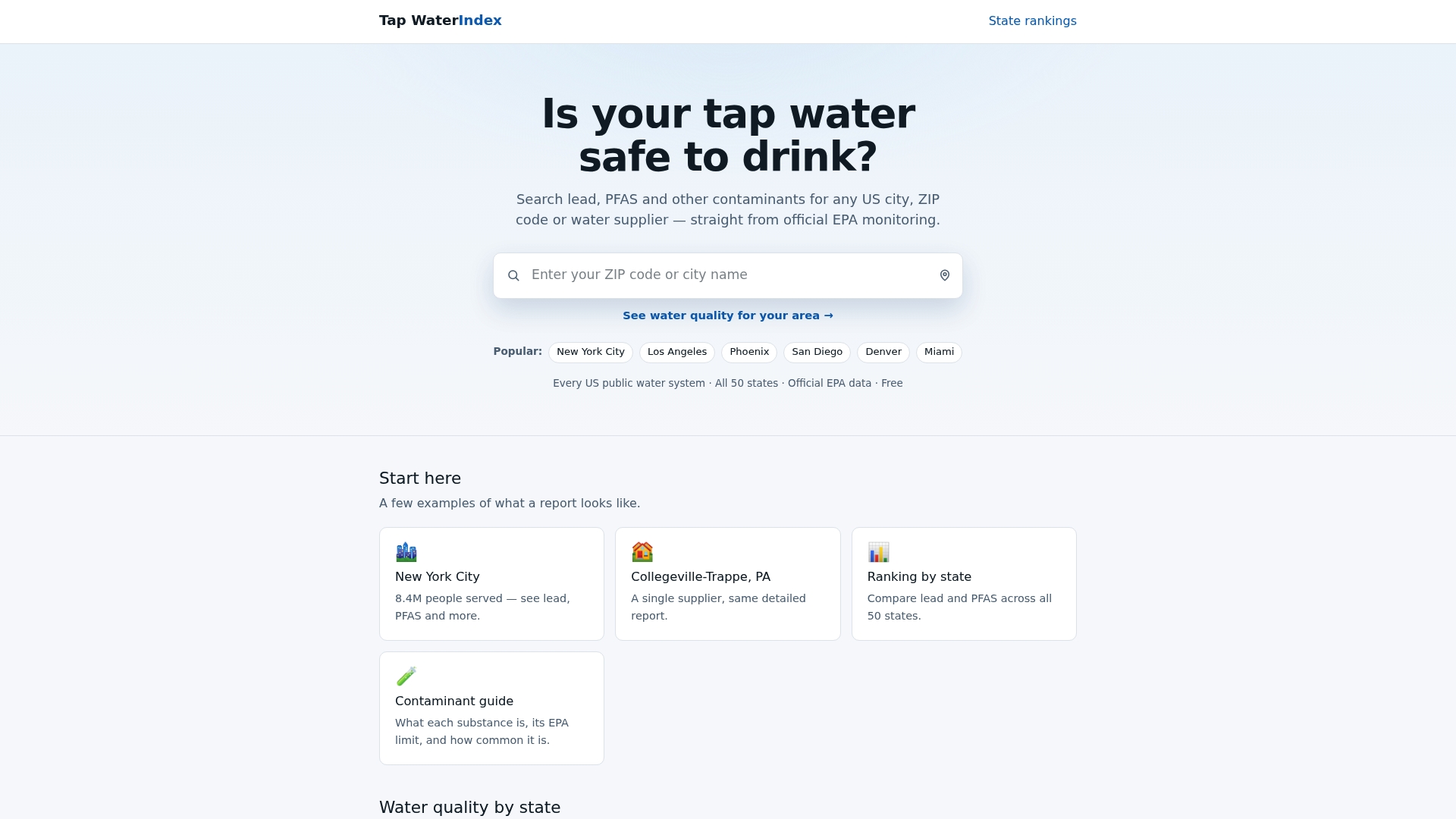
Search your ZIP code or utility name on Tapwaterindex to see detected contaminant levels, how your system compares to others in your state, and which EPA limits apply to your water. The data comes directly from EPA monitoring records, so you are looking at the same numbers your primacy agency uses, presented without the database navigation. For regulatory decisions and formal violations, always verify with your state primacy agency or the EPA directly. Start with your state’s water quality ranking to see where your utility stands before you dig into the details.
Sources
The sources below are the primary legal and agency documents to consult when you need the original text, current rulemaking status, or formal regulatory guidance.
- Summary of the Safe Drinking Water Act | US EPA
- Safe Drinking Water Act (SDWA) | US EPA
- 42 U.S. Code § 300g–1 - National drinking water regulations | Cornell Law
This article is general information, not a substitute for advice from a qualified doctor. Consult a qualified healthcare professional about your own circumstances before acting on anything here.