How to Test Tap Water for Lead Using Official EPA Data

The fastest way to test tap water for lead is to pull your public water system’s Lead & Copper monitoring results, not to buy a kit first. Many U.S. utilities report this data to the EPA. You can check it in SDWIS, ECHO, or Envirofacts, or search by ZIP code or city on Tapwaterindex to skip the database hunting.
The number that matters is the system’s 90th percentile (P90) lead result, measured against the Lead and Copper Rule action level of 15 µg/L (15 ppb). If your utility’s P90 sits below that line, most sampled taps came back clean. If it’s above, more than 10% of tested homes exceeded the threshold.
- Find your utility name or PWSID on your water bill.
- Search that name in SDWIS, ECHO, or Envirofacts, or type your ZIP or city into Tapwaterindex.
- Check the P90 result against 15 µg/L and note any listed violations.
Pro Tip: Your PWSID is usually a 7 character code starting with your two letter state abbreviation, printed in small type near the utility name on your bill or your city’s water quality report.
Key Takeaways
Checking your water system’s 90th-percentile lead result against the 15 µg/L action level tells you more about your tap water than any single home test kit ever could.
| Point | Details |
|---|---|
| Start with your PWSID | Find it on your water bill, then search SDWIS, ECHO, or Envirofacts directly. |
| Watch the P90, not just violations | A P90 above 15 µg/L means more than 10% of sampled taps exceeded the action level. |
| Separate violation types | Monitoring violations are often paperwork issues, health-based ones mean an actual exceedance. |
| Confirm your own service line | System-wide data doesn’t certify your specific home’s plumbing is lead-free. |
| Use Tapwaterindex for a faster answer | It converts EPA SDWIS and ECHO data into searchable ZIP and city results with P90 and violation history. |
Table of Contents
- How to Find Your Public Water System’s Lead Results
- What Do the 90th Percentile and Action Level Actually Mean?
- Why Utility Data Doesn’t Guarantee Your Tap Is Lead-Free
- What Should You Do If Your Water System Shows a Violation?
- What I’ve Learned Digging Through EPA Water Data
- Get Your Local Lead Results Without the Database Hunt
- Frequently Asked Questions
- Sources
How to Find Your Public Water System’s Lead Results
Federal drinking water data lives in three overlapping EPA systems, and none of them are built to search by ZIP code alone. Knowing which one to open first saves you a lot of clicking.
1. Get your utility name or PWSID first. This is the single step that determines how smooth the rest goes. Your PWSID appears on your water bill, your city or county water department’s website, or your annual Consumer Confidence Report. Without it, you’re guessing across databases that were designed for water engineers, not homeowners.
2. Search SDWIS or ECHO by PWS name or PWSID. The SDWIS Search User Guide walks through pulling up a system’s violation history and sample data. Once you find your utility, look for the Lead and Copper Rule section and request the “Lead samples” or “Lead & Copper report” view. This shows the sampling period, number of sites tested, and the calculated P90 result.
3. Try Envirofacts when you only know your address or city. Envirofacts offers geographic search by address, ZIP, city, or county, plus a data service API for anyone comfortable pulling structured results. It’s the closest thing federal tools have to a ZIP-based lookup, though it still routes back to PWS-level records underneath.
4. Use Tapwaterindex if you want the answer without the database detour. Because official EPA data organizes everything by PWS name or PWSID rather than ZIP code, most people waste time before they even find the right system. Tapwaterindex ingests SDWIS and ECHO data and lets you search directly by city, ZIP, or supplier name, then hands you the P90 result and violation history without the extra steps.
A few practical notes once you’re in any of these tools: pick the most recent monitoring period first, then scroll back if you want a trend. Lead sample downloads typically arrive as CSV files with columns like PWSID, sample date, and result value, usually a few hundred rows for a mid-sized system covering a single six-month or annual cycle.
Pro Tip: If SDWIS or ECHO returns zero results, double-check you’re searching the exact legal PWS name, not the brand name on your bill. A city might operate under a name like “City of Springfield Water Works” that differs from what’s printed on your statement.
What Do the 90th Percentile and Action Level Actually Mean?
The 90th percentile, or P90, is the value below which 90% of a utility’s sampled tap results fall. Regulators use it instead of a simple average because it weights toward the worst-performing taps rather than smoothing out a whole system’s results, which matters when the goal is catching pipe corrosion problems before they spread.
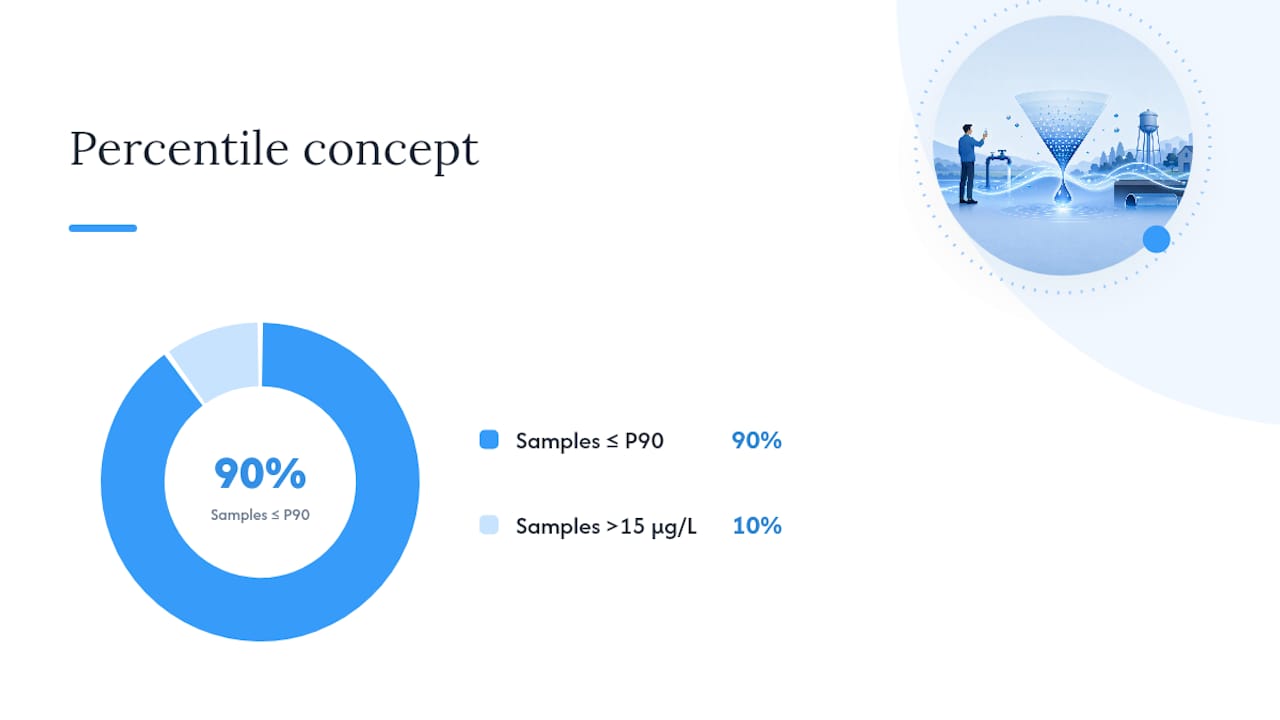
15 µg/L (0.015 mg/L) is the number to remember. That’s the Lead and Copper Rule action level, and it kicks in specifically when more than 10% of sampled taps exceed it. Cross that line, and the utility must notify the public and take corrective action, typically ramping up corrosion control treatment.
Not every red flag in a violation table means contaminated water. SDWIS separates monitoring/reporting violations from health-based violations, and the distinction matters a lot for how worried you should be. A monitoring violation often just means a utility missed a sampling deadline or filed paperwork late. A health-based violation means an actual exceedance occurred. Regulatory analysts at Harvard’s Environmental & Energy Law Program note that the LCR is fundamentally a treatment technique rule focused on system-wide corrosion control, so a single elevated household sample and a system-wide P90 can tell fairly different stories.
There’s also a newer term worth knowing: the trigger level, set between 10 and 15 µg/L under recent Lead and Copper Rule Improvements. Hitting the trigger level doesn’t require the full corrective-action response an action-level exceedance does, but it does require utilities to start planning ahead, including faster identification of lead service lines and earlier public communication.
- P90 below 15 µg/L: system meets the action level.
- P90 above 15 µg/L with more than 10% of samples exceeding it: action level triggered.
- Monitoring violation: usually a paperwork or deadline issue, not proof of contamination.
- Health-based violation: an actual exceedance requiring corrective response.
Pro Tip: If you see a monitoring violation and nothing else, call your utility and ask directly what caused it. Often it is an administrative issue rather than contamination.
Why Utility Data Doesn’t Guarantee Your Tap Is Lead-Free
Here’s the part most people miss: SDWIS and the Lead and Copper Rule sample selected taps, not every home in a system. Utilities are required to prioritize sites known or suspected to have lead service lines, so the program is built to detect system-wide risk, not to certify that any individual household is clear.
ZIP-code searches compound the confusion. Public water system boundaries almost never line up neatly with ZIP codes. A single ZIP can span two or three different utilities, and a single utility can serve parts of a dozen ZIP codes. That mismatch is exactly why federal databases organize everything around PWS name or PWSID instead of postal geography.
Recent Lead and Copper Rule Improvements push utilities to build full lead service line (LSL) inventories, which is genuinely useful for homeowners. Some systems publish these inventories online, sometimes as searchable maps or address lookups, which can provide more specific information than system-wide P90 results.
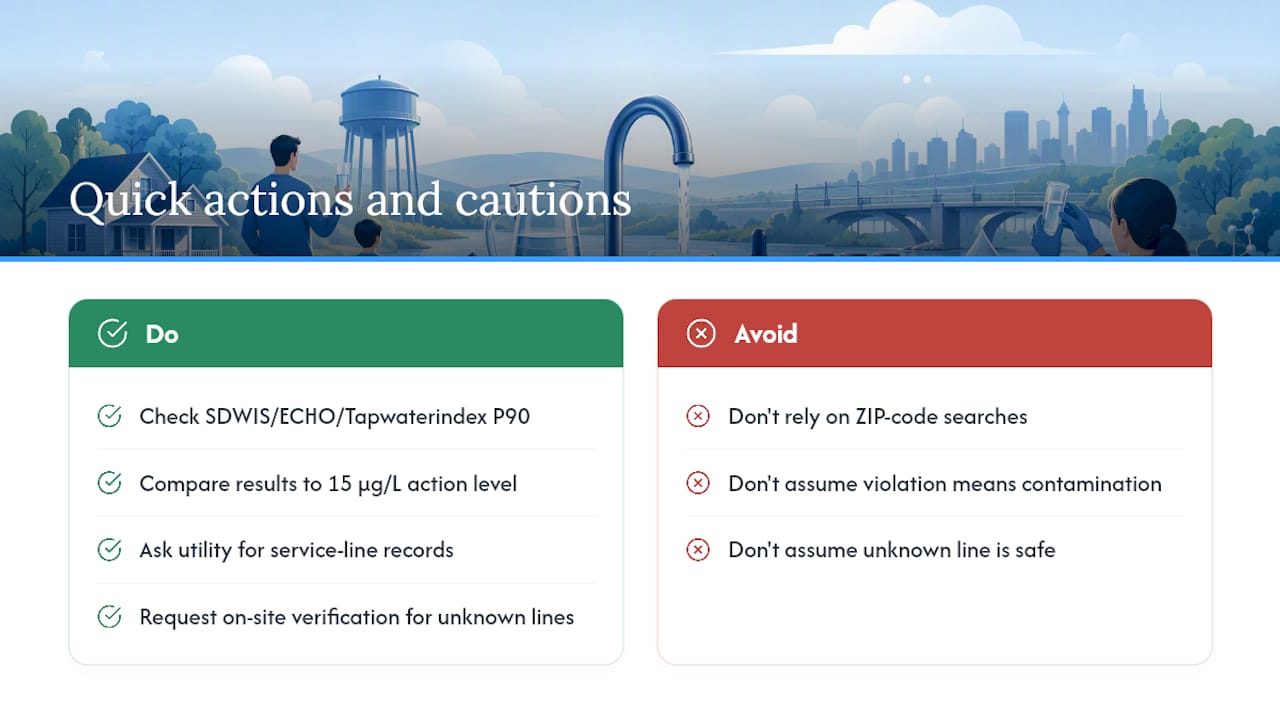
- Ask your utility directly for service-line material records tied to your address.
- Check whether your city has published an LSL inventory map under the newer LCR requirements.
- Request a written confirmation or an on-site verification if records are unclear.
- Don’t assume “no exceedance” on the system level means your specific plumbing is lead-free.
Pro Tip: Homes built before 1986 are more likely to have lead solder or lead service lines. If your utility’s LSL inventory lists your line as “unknown,” push for a physical inspection rather than accepting the ambiguity.
What Should You Do If Your Water System Shows a Violation?
Finding an elevated P90 or a violation on your utility’s record doesn’t mean panic, it means a specific set of next moves.
- Confirm what kind of finding it is. Check the sample date and determine whether it’s a P90 action-level exceedance or a monitoring/reporting violation.
- Call your utility with pointed questions: What’s our PWSID? Which sites were sampled? Is my address on a known lead service line? When is the next round of corrosion control or line replacement scheduled?
- If the utility can’t answer clearly, escalate to your state’s primacy agency, the state body responsible for enforcing the LCR, or your local health department.
- Request your current Consumer Confidence Report and any published LSL inventory data for your address.
Utilities responding to a real exceedance may offer consumer sampling, temporary bottled water programs, or targeted public education campaigns. Under updated LCR notification timelines, residents served by known or suspected lead lines must now be notified faster than under the old rule, and some systems are required to offer to sample a consumer’s own tap on request.
- Get the sample date and violation type first.
- Ask specific, PWSID-anchored questions, not vague ones.
- Escalate to the state agency if answers are unsatisfying.
- Request the CCR and LSL inventory in writing.
What I’ve Learned Digging Through EPA Water Data
Federal drinking water data is some of the most transparent public health information the government publishes, and almost nobody reads it. That’s not a knock on homeowners. SDWIS was built for state regulators cross-referencing PWSIDs, not for a parent trying to figure out if their kid’s bottle water is safe. The gap between “the data exists” and “the data is usable” is the whole problem.
What Tapwaterindex adds isn’t new information, it’s translation. Taking SDWIS and ECHO records and letting someone search by ZIP or city instead of decoding a seven-character system ID closes a real usability gap, and that’s worth more than it sounds like on paper.
Get Your Local Lead Results Without the Database Hunt
Digging through SDWIS, ECHO, and Envirofacts manually works, but it takes patience most homeowners don’t have on a random Tuesday night. Tapwaterindex pulls the same official EPA monitoring data and lets you search by city, ZIP, or supplier name directly, no PWSID memorization required.
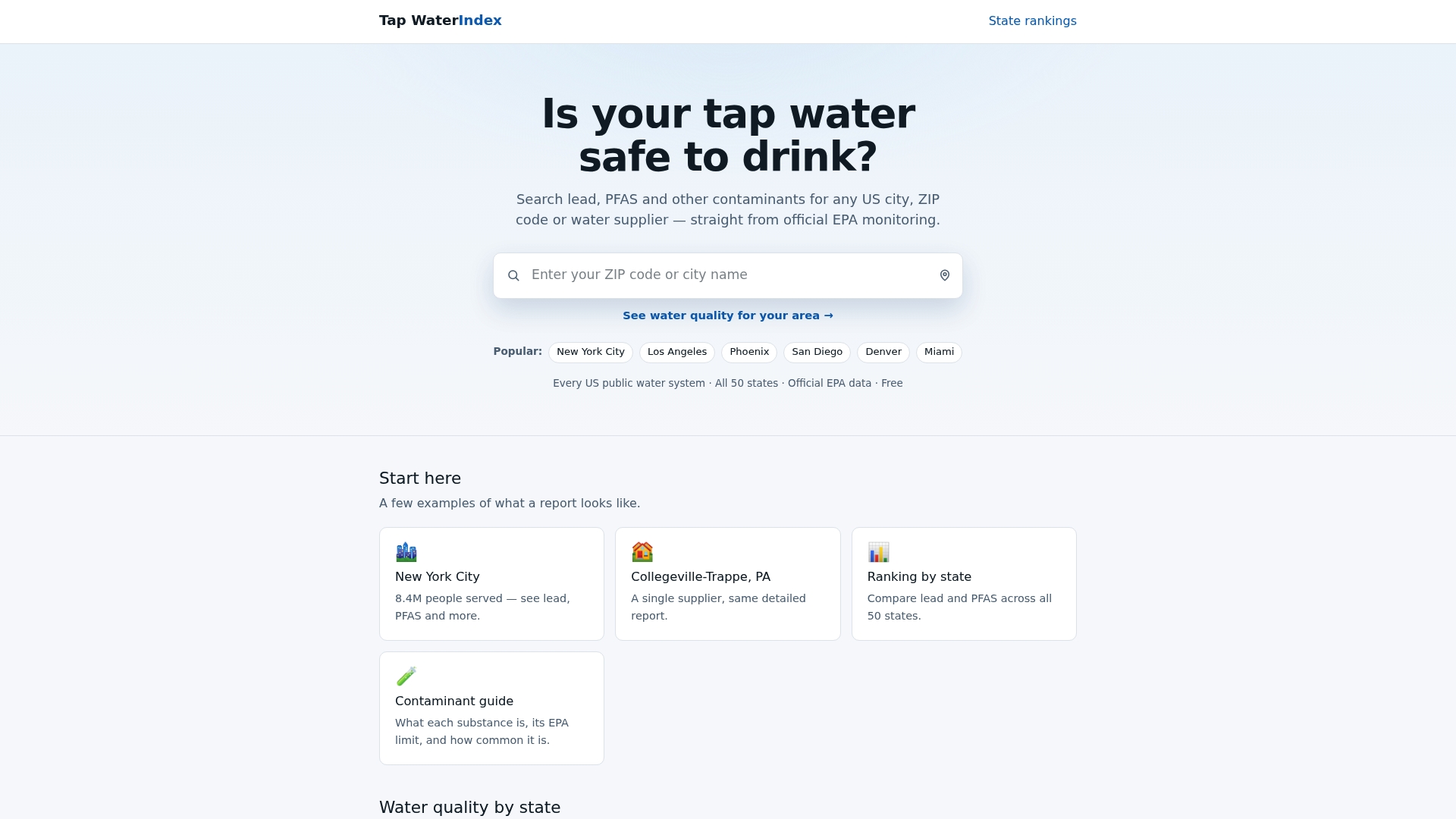
The site maps SDWIS and ECHO records to plain-language local pages, showing your utility’s P90 lead result and violation history side by side, along with other contaminants worth knowing about. That’s the exact usability gap federal tools leave open. Readers who want a broader comparison can also check the U.S. tap water quality rankings by state before drilling into their own utility.
Search your ZIP or city on Tapwaterindex now to see your local lead results in plain terms.
Frequently Asked Questions
Can I test tap water for lead without buying a kit? Yes. Every public water system already reports Lead & Copper monitoring results to the EPA. Checking your system’s P90 result in SDWIS, ECHO, or on Tapwaterindex shows you the same regulatory data utilities are required to collect and report.
What lead level is considered unsafe in tap water? The Lead and Copper Rule action level is 15 µg/L (15 ppb). If more than 10% of a utility’s sampled taps exceed that level, the system must notify the public and take corrective action.
Why can’t I just search my ZIP code for lead levels? Public water system boundaries rarely match ZIP code boundaries, and federal databases organize records by PWS name or PWSID rather than postal geography. A single ZIP can include multiple utilities, which is why tools like Envirofacts and Tapwaterindex build in geographic matching on top of the raw PWS data.
Does a monitoring violation mean my water has lead in it? Not necessarily. SDWIS separates monitoring/reporting violations from health-based violations. A monitoring violation often reflects a missed sampling deadline or paperwork lapse. Calling your utility directly is the fastest way to find out which type you’re looking at.
How do I find out if my home has a lead service line? Ask your utility for service-line material records tied to your address, or check whether your city has published a lead service line inventory as required under recent LCR updates. If records list your line as unknown, request an on-site verification rather than assuming it’s safe.
This article is general information, not a substitute for advice from a qualified doctor. Consult a qualified healthcare professional about your own circumstances before acting on anything here.