MCL vs MCLG: Check U.S. Utility Health Goal Gaps on TapWaterIndex
The MCLG is the health goal EPA wishes your water could hit; the MCL is the legal limit your water utility actually has to meet. They’re often different numbers, and that gap is written into federal law on purpose. The Safe Drinking Water Act lets the EPA enforce only the MCL, so a system can pass every inspection while sitting above the MCLG. Some websites exist to show you both numbers for your own utility, not just the one that lets a system claim compliance.
TL;DR:
- Most MCLGs are set at zero for carcinogens, but the corresponding MCLs are often higher due to technological and cost constraints.
- Small rural water systems face more difficulty achieving near-zero MCLGs because of their limited infrastructure and budget.
- If a water report shows contaminant levels above the MCLG but below the MCL, it indicates a guaranteed no-risk threshold is not met, but the risk is minimized within practical limits.
- Consumers should verify both MCL and MCLG in their water reports and consider direct testing for pipe-related contaminants like lead.
Table of Contents
- MCL vs MCLG: The Practical Differences
- How EPA Turns Health Science Into a Legal Number
- Real Contaminant Numbers: MCLG vs MCL Side by Side
- What It Means When You’re Above the MCLG But Under the MCL
- What to Do If Your Water Report Raises Questions
- Why This Distinction Actually Matters to Me
- Check Your Own Water’s MCL and MCLG Numbers
- Sources
MCL vs MCLG: The Practical Differences
MCLG stands for Maximum Contaminant Level Goal. It’s a non-enforceable number based purely on health science, with no consideration for whether any treatment plant on Earth could actually hit it. MCL stands for Maximum Contaminant Level, and it’s the enforceable number: the highest concentration legally allowed in the water coming out of your tap, set under the Safe Drinking Water Act.
| Attribute | MCLG | MCL |
|---|---|---|
| Basis | Health effects only | Health effects plus feasibility and cost |
| Enforceable? | No | Yes, federally |
| Violation consequence | None (it’s a target) | Public notification, corrective action, possible penalties |
| Typical value for carcinogens | Often zero | Set as close to zero as treatment allows |
A few things worth pulling out of that table:
- Carcinogens frequently get an MCLG of zero, because EPA’s health scientists aren’t allowed to factor in cost when setting the goal.
- The MCL, by contrast, gets set as close to the MCLG as feasible using the best available treatment technology, weighing cost against how much risk reduction that technology buys.
- Some contaminants skip an MCL entirely and get a “treatment technique” requirement instead, usually when reliable testing at very low concentrations isn’t practical.
Pro Tip: Pull up your utility’s Consumer Confidence Report and look for a column labeled “MCLG” next to “MCL.” If your report only lists one number, call the utility and ask for both. Any system on the Safe Drinking Water Act has to have this data on file, even if it didn’t make the printed summary.
How EPA Turns Health Science Into a Legal Number
Setting these two figures is a multi-year federal process, not a single calculation. It runs roughly like this:
- Contaminant identification. EPA screens candidates through its Contaminant Candidate List and Unregulated Contaminant Monitoring Rule data.
- Risk assessment. Toxicologists review dose-response studies to figure out what exposure level causes harm and to whom.
- MCLG derivation. For non-carcinogens, EPA calculates a reference dose with safety margins built in. For carcinogens, the MCLG typically lands at zero, since there’s no scientifically defensible “safe” level of a cancer-causing chemical.
- Feasibility and cost review. EPA asks whether treatment plants, including small rural systems, can actually detect and remove the contaminant at that goal, and at what cost.
- Proposed rule and public comment. The draft MCL goes public, and utilities, health groups, and residents can weigh in before anything is final.
- Final rule and compliance schedule. EPA locks in the MCL and gives utilities a timeline to meet it, often several years for capital-intensive upgrades.
Sometimes EPA skips step six’s clean numeric limit and issues a treatment technique instead. This happens when a contaminant is hard to measure precisely at the concentrations that matter, so the rule specifies a process (like a filtration standard) rather than a parts-per-billion cutoff.
Small systems get extra scrutiny in step four. A rural water district serving a few thousand people doesn’t have the same budget or infrastructure as a city utility, and that gap between what’s theoretically achievable and what’s actually installed is exactly why MCLs land where they do.
Real Contaminant Numbers: MCLG vs MCL Side by Side
Definitions only click once you see actual figures. Here’s how a handful of well-known contaminants break down.
A few notes on reading that table correctly:
- Units matter. Milligrams per liter (mg/L) is the same as parts per million; micrograms per liter (μg/L) is parts per billion. Lead’s action level of 0.015 mg/L is the same as 15 μg/L, just written differently depending on the source.
- Lead doesn’t get a standard MCL. Because lead mostly enters water from household pipes and fixtures rather than the source, EPA regulates it through an action level under the Lead and Copper Rule that triggers corrosion-control treatment, not a simple pass/fail limit.
- Nitrate is the exception, not the rule. When a no-effect threshold is well established, EPA can set the MCLG and MCL at the same value, which is exactly what happened here.
- PFAS rules are still evolving. EPA has moved toward regulating specific PFAS compounds individually rather than as one group, and those numbers continue to shift as monitoring data comes in. Check a contaminant-specific lookup for the current status in your state.
What It Means When You’re Above the MCLG But Under the MCL
This is the gray zone that trips up most people reading a water report for the first time. An MCLG of zero for a carcinogen doesn’t mean any detectable trace is an emergency. It means EPA’s scientists couldn’t identify a threshold below which the compound causes zero risk, so they set the target at the only number that guarantees no risk: none at all.
The MCL then gets set at a level EPA considers an acceptably small risk, given what treatment technology can actually achieve. EPA’s own guidance acknowledges that some MCLs for carcinogens are calibrated to an excess cancer risk in the range of roughly 1 in 10,000 to 1 in 1,000,000 over a lifetime of exposure, which is a deliberate policy tradeoff, not an oversight.
That tradeoff hits some people harder than others:
- Infants and pregnant women face outsized risk from nitrate and lead even at low concentrations.
- People drinking the same tap water for 20 or 30 years accumulate exposure that a single annual test can’t capture.
- Anyone with a compromised immune system has less margin for contaminants that a healthy adult tolerates without symptoms.
What to Do If Your Water Report Raises Questions
- Read your Consumer Confidence Report line by line. Every water system has to publish one annually, and the MCLG and MCL columns are usually right next to each other.
- Call your utility with specific questions. Ask which contaminants sit closest to their MCL and what corrective steps are already underway.
- Cross-check with independent data. Search your utility on TapWaterIndex to compare its EPA-reported numbers against contaminants tracked nationwide.
- Test your own tap if pipes are old. Lead leaches from plumbing, not the treatment plant, so a state-certified lab test of your actual tap water catches what the utility-wide report can’t.
- Filter with intention. An NSF/ANSI-certified pitcher or under-sink filter rated for your specific contaminant (lead, PFAS, or otherwise) beats a generic filter bought on price alone.
Pro Tip: If your utility issues a boil-water notice or do-not-drink alert, that’s a different category from an MCL violation entirely. It signals an immediate microbial or chemical hazard. Follow it to the letter, then ask for a written explanation of what triggered it once the notice lifts.
Why This Distinction Actually Matters to Me
Most explainers stop at “MCLG is a goal, MCL is a law,” and leave you there. What gets lost is that the distance between those two numbers is a policy choice, revisited only occasionally, while your exposure keeps accumulating every year in between. Some websites build their reports around EPA monitoring data at the utility level. A national average tells you nothing about the pipe running into your kitchen.
— Sergey
Check Your Own Water’s MCL and MCLG Numbers
Reading a federal contaminant table is one thing. Knowing what your specific utility actually reported to the EPA is another, and some platforms provide this gap with access to local data. Search by city, ZIP code, or supplier name and see the exact MCLG and MCL figures logged for your water system, not a national average that might not reflect your pipes at all.
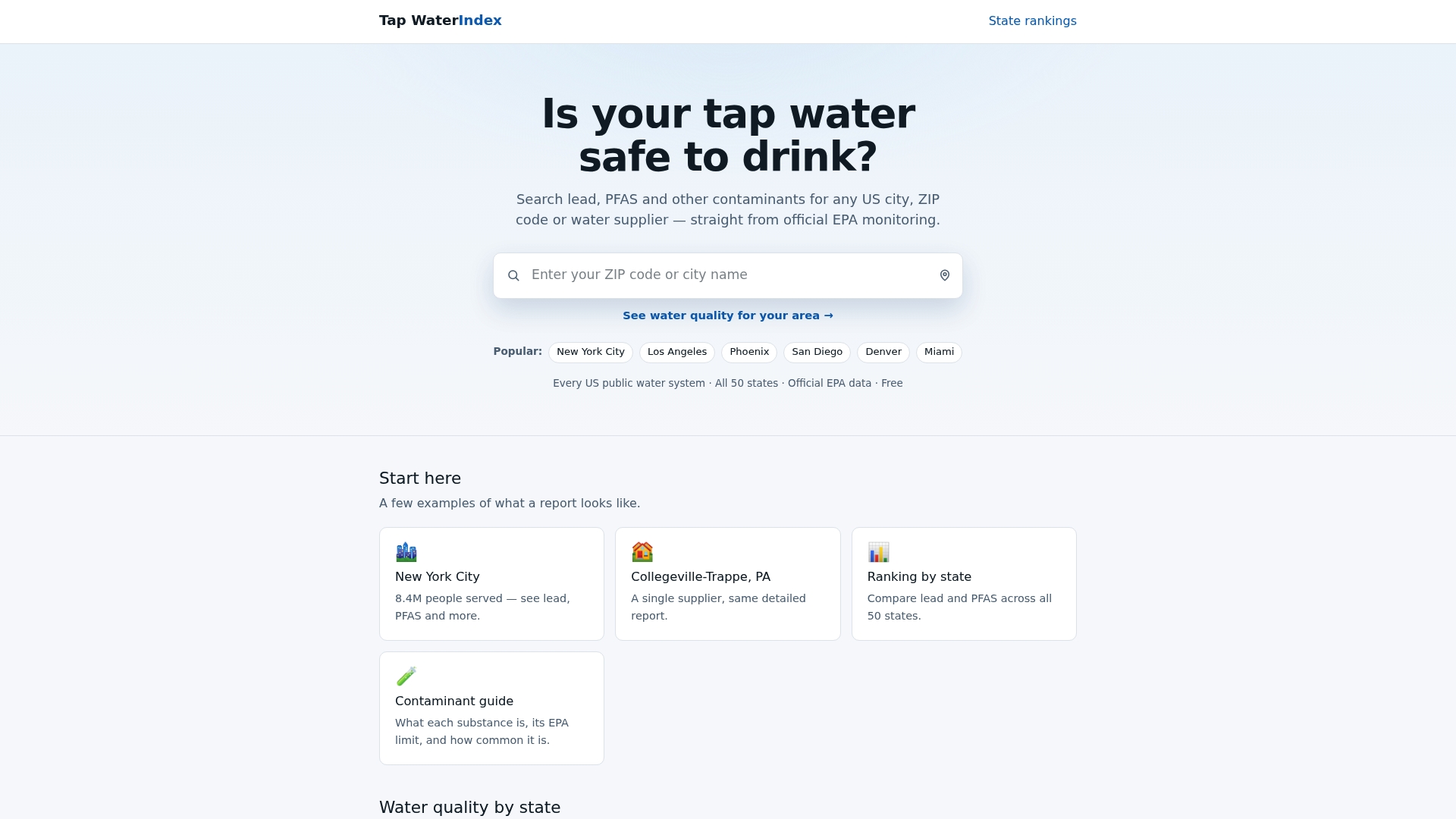
Some sites pull directly from EPA monitoring data and organize it into contaminant pages, state comparisons, and utility rankings, so users can see where a supplier stands next to neighboring systems. If you’ve read this far wondering how your own tap measures up, start with the state-by-state water quality rankings and look up your utility now.
This article is general information, not a substitute for advice from a qualified doctor. Consult a qualified healthcare professional about your own circumstances before acting on anything here.