Check Water Quality by ZIP Code in Minutes
Enter your ZIP code into an EPA-data-backed lookup tool like TapWaterIndex and you’ll see your local water supplier’s contaminant results in about the time it takes to read this sentence. That’s the fastest way to check water quality by ZIP code, full stop.
The result page shows contaminant names, the last tested values, how those numbers compare to EPA health benchmarks, and the sample date. That last detail matters more than most people realize.
- Contaminant names and measured levels for your specific supplier
- Sample dates so you know how current the data actually is
- A clear flag if anything sits above the legal or advisory limit
If your report flags lead or PFAS above advisory levels, don’t wait for a callback from your utility. Switch to bottled water for infants and pregnant household members, and run your cold tap for a minute before drinking or cooking with it while you sort out next steps.
Key Takeaways
Checking water quality by ZIP code works best when you pair a fast EPA-backed lookup with a quick supplier confirmation and a look at the sample date.
| Point | Details |
|---|---|
| Start with a ZIP lookup | Enter your ZIP on an EPA-data-backed tool to see detected contaminants and any flags immediately. |
| Confirm your actual supplier | Multiple utilities can share one ZIP code, so check a water bill if more than one appears. |
| Check the sample date | Monitoring data lags behind publication, so an old test date doesn’t guarantee current safety. |
| Match your response to the flag | Lead or PFAS above advisory levels calls for immediate precautions and a certified filter. |
| Use TapWaterIndex for ongoing checks | TapWaterIndex pulls EPA monitoring data into ZIP, city, and supplier reports focused on lead and PFAS. |
Table of Contents
- How Do You Check Water Quality by ZIP Code?
- What Shows Up in a ZIP-Code Water Report?
- What Do MCLs and Health Benchmarks Actually Mean?
- What Should You Do After Checking Your Water Quality?
- Where ZIP-Code Lookups Fall Short
- Run Your ZIP Through TapWaterIndex Next
- Sources
How Do You Check Water Quality by ZIP Code?
Checking water quality by ZIP code takes three steps and about five minutes, assuming your area has a single water supplier. Here’s the exact sequence.
- Enter your ZIP code (or city and street address, if the tool asks) into TapWaterIndex or an official EPA lookup tool. Most ZIP-based tools, including ZipCheckup-style aggregators, pull from the same underlying EPA public records but present them differently.
- Confirm your supplier. Many ZIP codes sit inside a single utility’s service area, but plenty don’t. If the tool lists more than one supplier for your area, check a recent water bill or your utility’s website to see which one actually serves your address.
- Read the headline flags first. Look for detected contaminants, any exceedance warnings, and the sample date at the top of the report. If something looks concerning, open the full report for the measured value, the EPA limit it’s compared against, and the sample type.
If you’re on a private well, skip the ZIP lookup entirely for your own water. Public water quality databases almost never cover private wells, since no state agency mandates that testing. You’ll need a county extension office or a certified private lab instead, which the later section on private testing covers in more detail.
Pro Tip: Keep a screenshot or PDF of your ZIP lookup result the first time you run it. Utilities update their public data on their own schedule, and having a dated baseline makes it easy to spot changes the next time you check.
What Shows Up in a ZIP-Code Water Report?
A typical ZIP-code water report isn’t a single number. It’s a table of contaminants, each with its own measured value, legal or advisory threshold, and sample date, pulled from the same monitoring records utilities submit to their state regulators.
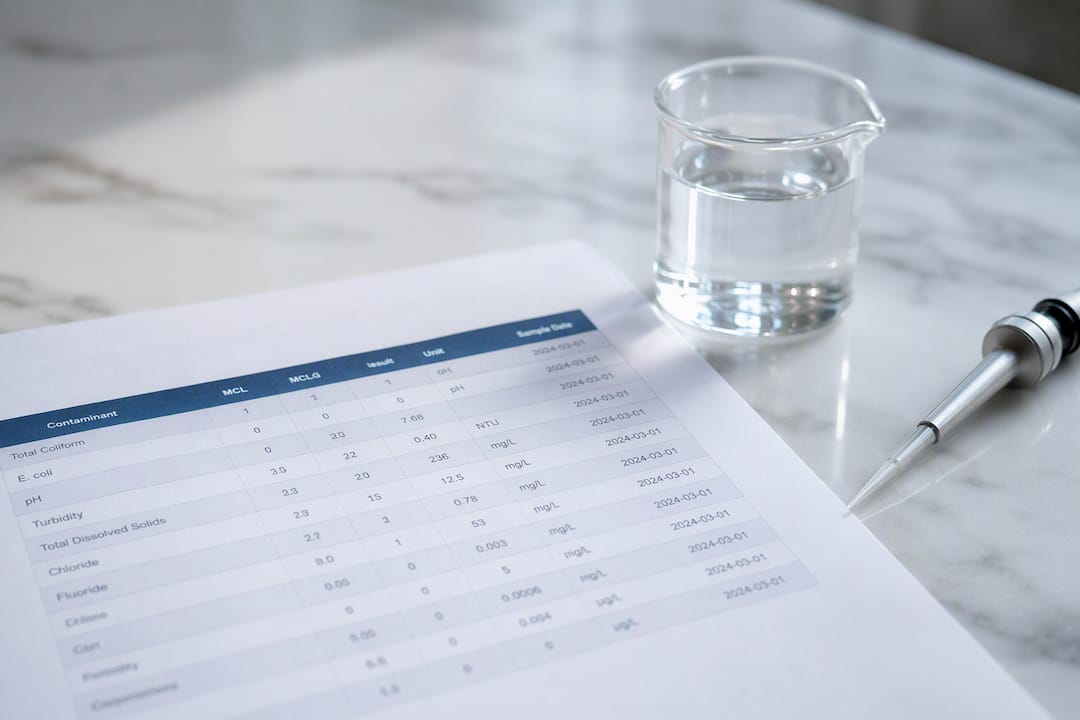
The contaminants that show up most consistently across US systems include lead, PFAS (per and polyfluoroalkyl substances), nitrates, arsenic, total coliform and E. coli indicators, and disinfection byproducts like trihalomethanes. PFAS and lead tend to dominate the headlines because both have seen significant advisory activity in recent years, and both carry health risks even at low concentrations.
Each entry on a well built report includes five data points worth understanding:
- Measured value: the actual concentration found in a sample, usually in parts per billion or milligrams per liter
- MCL or advisory level: the EPA’s Maximum Contaminant Level or a health-based advisory for unregulated substances
- Detection status: whether the contaminant showed up at all, and whether it crossed the limit
- Sample date: when the water was actually tested, not when the report was published
- Sample type: entry point (leaving the treatment plant) versus tap water (from a household fixture), which changes what the result actually tells you about lead risk specifically
A Consumer Confidence Report, or CCR, gives you the plain-English summary version. Raw monitoring tables, the kind TapWaterIndex pulls from directly, show the granular sample-by-sample data underneath.
What Do MCLs and Health Benchmarks Actually Mean?
An MCL is the highest concentration of a contaminant the EPA legally allows in public drinking water, and it’s enforceable. A health advisory, by contrast, is a non-enforceable benchmark the EPA issues when the science on a substance, like certain PFAS compounds, is still evolving but the risk looks serious enough to flag.
A single detected value above a benchmark is worth noting, but a repeat exceedance across multiple sampling periods is the real warning sign. One elevated reading can reflect a temporary plumbing issue or a sampling fluke. A pattern across quarters points to something systemic in the treatment process or distribution system.
Some households should treat any detection more seriously than others. Pregnant people, infants, and anyone immunocompromised face higher risk from contaminants like lead and nitrates, since their margin for exposure is thinner than a healthy adult’s.
Watch for these red flags in your own report:
- Lead detected in tap samples, especially in homes built before 1986
- PFAS levels above the EPA’s current advisory guidance
- Multiple contaminants flagged in the same reporting period
- A documented history of repeat violations at your specific supplier
Pro Tip: If your report shows a violation notice, check whether it’s a monitoring violation (the utility missed a testing deadline) or a health-based violation (they actually exceeded a limit). Utility notices often bury this distinction in fine print, and it changes how urgently you should act.
What Should You Do After Checking Your Water Quality?
What you do next depends entirely on what your ZIP lookup turned up. Here’s how to prioritize it.
- Take immediate precautions if lead or PFAS is flagged. Use bottled or filtered water for infant formula and cooking until you’ve addressed the source, and run your cold tap for 30 to 60 seconds before drawing water if lead is a concern in your plumbing.
- Choose a certified filter. Look for NSF/ANSI Standard 53 certification for lead reduction or NSF/ANSI 58/53 for PFAS, and stick to point-of-use units (pitcher, faucet-mount, or under-sink) for anything you’ll drink or cook with. The CDC’s guidance on household water treatment walks through when home treatment actually makes sense versus when it’s overkill.
- Order a private test if you want confirmation. Request a certified lab test for the specific contaminant flagged, and ask for a chain-of-custody document plus a written lab report you can share with your utility or a doctor.
If your utility’s own explanation doesn’t add up, or the violation notice is vague, contact your state’s primacy agency, which oversees drinking water compliance in place of the EPA at the state level, or your local health department directly.
Where ZIP-Code Lookups Fall Short
ZIP-code tools are a strong starting point, not a live feed. Public monitoring runs on scheduled sampling windows and a publication lag behind it, so a report showing “no detections” from eight months ago isn’t the same as a clean bill of health today.
ZIP codes also don’t map neatly to a single utility everywhere. When a ZIP overlaps multiple public water systems, your water bill is the most reliable way to confirm exactly which supplier serves your address. Private wells sit outside nearly all of this entirely, so well owners need an independent certified lab test rather than any ZIP tool.
Pro Tip: Get a confirmatory private test any time results feel ambiguous, a vulnerable person lives in your home, or your utility’s response to a flagged violation doesn’t satisfy you.
Common mistakes and a quick verification checklist
The two mistakes I see most often: trusting a sample date that’s a year old as if it reflects today’s water, and assuming a ZIP code means one supplier when plenty of ZIPs straddle two or three systems.
Run through this before you act on any result: confirm your actual supplier, check the sample date, note every detected contaminant, then pick a next step that matches the severity. Skip a step and you’re guessing.
Run Your ZIP Through TapWaterIndex Next
Most ZIP lookup tools stop at “detected” or “not detected.” Tapwaterindex goes further, pairing your ZIP, city, or supplier search with EPA monitoring data specifically built around the two contaminants people worry about most: lead and PFAS.
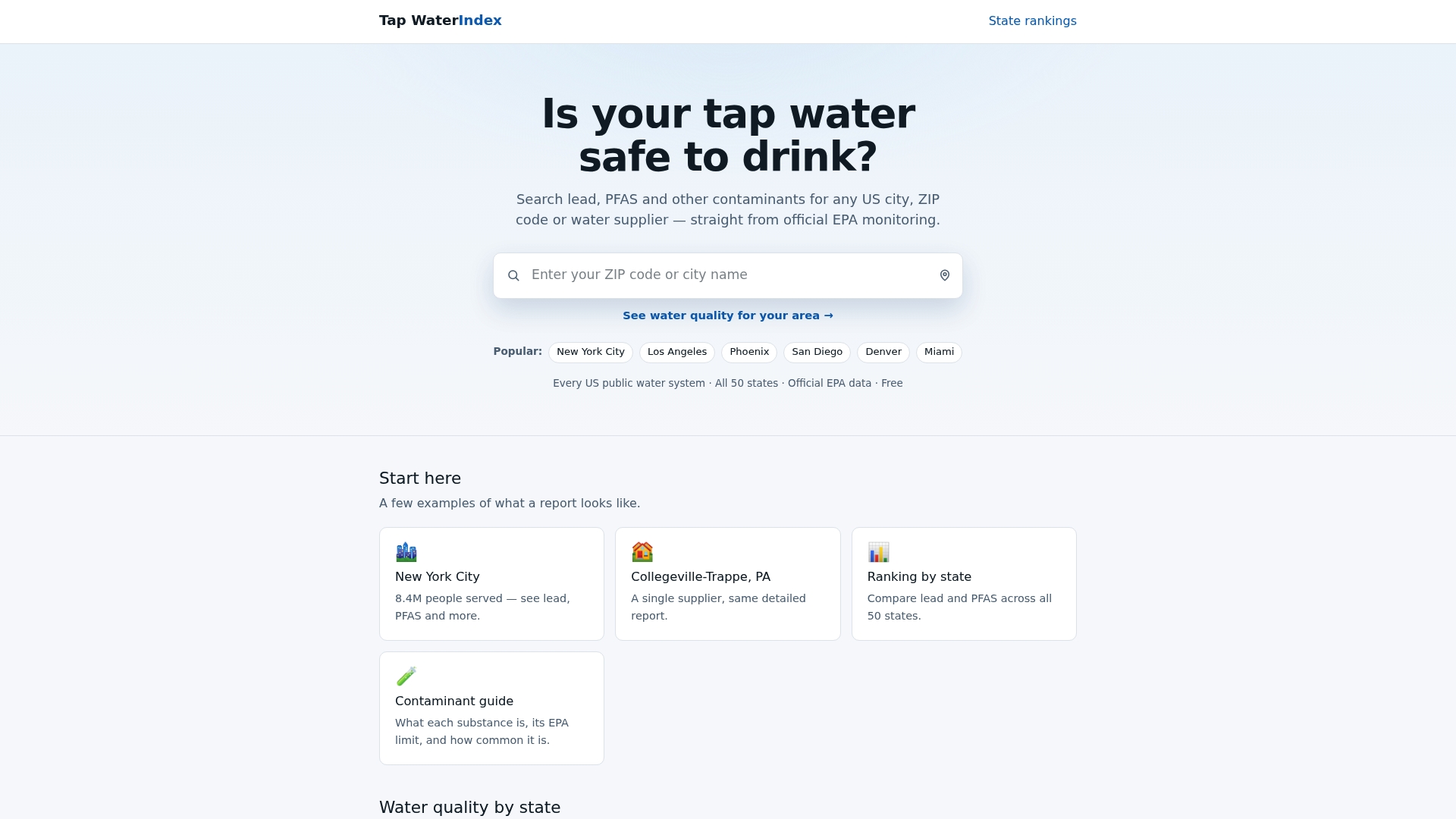
The site covers every public water system in the country, so whether you’re checking a single address or comparing lead data across Florida suppliers, you’re working from the same official EPA dataset every time. Reports link directly back to CCR pages and explain exactly what an MCL or advisory means for the number you’re looking at, instead of leaving you to decode a government PDF on your own.
Start by running your ZIP code to see your supplier’s current contaminant flags. If you want broader context, the state-by-state ranking page shows how your state compares on lead and PFAS overall.
Sources
For the legal definitions and current rules, go straight to the source rather than a summary.