Flint Residents: Verify Your Tap Water With TapWaterIndex

Flint’s tap water meets both federal and Michigan lead standards, with the most recent six-month test showing lead at 3 parts per billion, well under the state’s 12 ppb action level. The city has logged many consecutive compliance periods and finished replacing its lead service lines. That does not erase the risk from old household plumbing, so testing and filtering at home still matter.
TL;DR:
- Flint’s lead levels remain well below both federal and Michigan standards, with recent tests showing a 90th percentile of 3 ppb.
- The city has replaced over 11,600 lead service lines and confirmed no active lead service lines remain as of August 2026.
- Fluctuations in lead test results are influenced by sampling site selection, with lower-use homes and non-residential sites yielding variable data.
- Household plumbing materials, such as solder and fixtures in homes built before 1986, continue to pose lead risks despite city compliance.
- Residents should conduct individual water tests, use certified filters, and be aware that public data alone cannot guarantee their tap water’s safety.
Table of Contents
- Flint Tap Water Status: What the Latest Monitoring Shows
- How to Read Flint’s Lead Numbers Without Getting Misled
- What Changed in Flint’s Water System Since the Crisis
- Health Risks From Lead Exposure You Should Still Take Seriously
- How to Test Your Water, Use Filters, and Get Free Help
- Checking Your Own Address Against Official Flint Water Data
- Where Flint Recovery Funding Went and How to Get Help Now
- What the Data Doesn’t Capture About Flint’s Recovery
- Check Your Own Water Data Beyond the Citywide Average
- Where to Verify Every Claim in This Article
- Sources
Flint Tap Water Status: What the Latest Monitoring Shows
Flint’s most recent six-month monitoring cycle put the 90th percentile lead result at 3 ppb, a fraction of the federal Lead and Copper Rule threshold of 15 ppb and below Michigan’s tighter 12 ppb standard. As of September 2026, the city has now met both standards for many consecutive testing periods, a streak that started back in mid-2016 and hasn’t broken since.
That consistency is why the EPA lifted its 2016 emergency order on Flint’s drinking water in May 2025. The emergency order had kept Flint under direct federal oversight for nearly a decade, requiring the city to report testing data, replace infrastructure, and answer to EPA inspectors on a fixed schedule. Lifting it doesn’t mean the EPA stopped caring about Flint. It means the city met the legal bar the Safe Drinking Water Act sets for every public water system in the country, and federal regulators no longer need extraordinary powers to enforce compliance here.
Michigan’s Department of Environment, Great Lakes, and Energy (EGLE) has echoed that assessment in its own reporting, most recently in a February 2026 update marking Flint’s tenth year of lead testing compliance. State officials point to the completed service line replacement program as the structural reason lead levels have stayed low, not just a lucky testing cycle.
Here’s how recent results have trended:
| Monitoring period | 90th percentile lead result |
|---|---|
| Early 2025 | 3 ppb |
| Late 2025 | 6 ppb |
| Early 2026 (most recent) | 3 ppb |
The bump to 6 ppb in late 2025 didn’t reflect worse water citywide. Michigan’s own reporting attributes swings like that to which properties get sampled in a given period, a point worth understanding before you read too much into any single number.
A few things worth knowing about where this data comes from and how it’s verified:
- All six-month lead and copper results are posted publicly on Michigan’s FlintWater monitoring page, broken down by sampling period.
- The EPA maintains its own advice and resource page for Flint residents, separate from the state’s reporting.
- Tapwaterindex pulls from the same underlying EPA monitoring framework and lets you check lead data for any Michigan supplier, not just Flint, if you want to compare.
None of this means every glass of water from every tap in Flint is guaranteed lead-free. It means the system, measured the way federal law requires, has passed its test consistently for years. What happens between the water main and your kitchen faucet is a separate question, and one worth its own explanation.
How to Read Flint’s Lead Numbers Without Getting Misled
The number that matters in Flint’s compliance reports is the “90th percentile” result, and it’s not the average. Regulators chose this method because it weights the picture toward the worst-performing homes in the sample rather than letting a few good outliers hide a problem in one part of town.
Two different action levels apply here, and mixing them up leads to confusion. The federal Lead and Copper Rule sets its trigger at 15 ppb. Michigan, after Flint, tightened its own standard to 12 ppb, one of the strictest in the country. Flint’s recent 3 ppb result clears both thresholds with room to spare, but it’s the tighter Michigan number that actually governs compliance here.
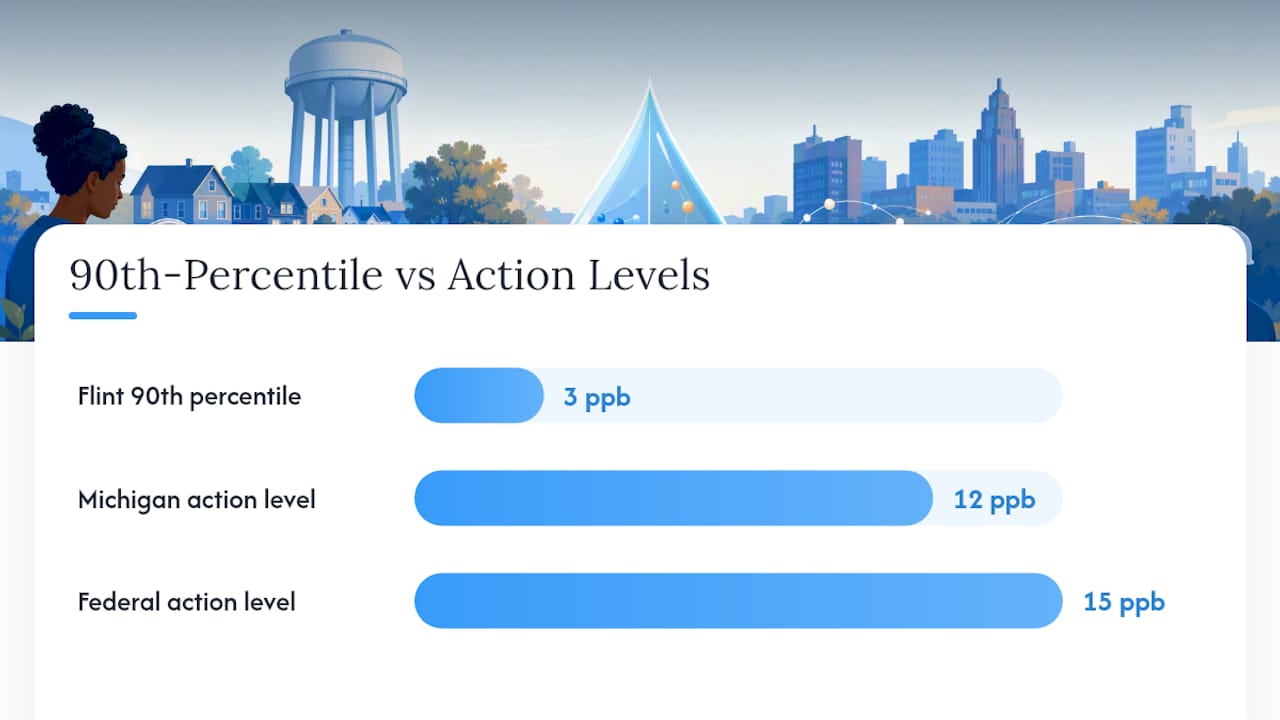
Statistic to remember: Flint’s most recent 90th percentile reading of 3 ppb sits at one quarter of Michigan’s 12 ppb action level and one fifth of the federal 15 ppb threshold.
Sampling site selection explains most of the period-to-period wobble you’ll see in these reports. As homes with lead service lines got replaced and dropped out of the required testing pool, the properties left in that pool shifted toward businesses, multi-family buildings, and other Tier 2 sites, some of which use water infrequently enough that lead can sit in stagnant pipes longer between draws. Michigan’s own reporting acknowledges this dynamic directly when explaining the late 2025 uptick to 6 ppb. A low-use commercial tap sampled after a weekend of no flow behaves differently than a family kitchen faucet run every morning.
A few practical notes for reading any monitoring table, in Flint or elsewhere:
- Look at the trend across several periods, not just the newest number.
- Check whether the sampling pool description mentions Tier 1 (single-family homes) versus Tier 2 or non-residential sites.
- A single elevated result doesn’t necessarily mean system-wide failure. A consistent upward trend across periods does.
- Compare the reported 90th percentile against both the 15 ppb federal and 12 ppb Michigan lines, since a result can clear one and miss the other.
None of this changes the fact that Flint’s own numbers currently read well. It just means you’re better equipped to judge the next report when it comes out, instead of reacting to a single figure out of context.
What Changed in Flint’s Water System Since the Crisis
Flint’s recovery rests on one specific, finished project: taking every lead service line out of the ground. As of August 2026, the city and state confirmed that no active lead service lines remain connected to Flint’s municipal water system. Crews inspected more than 31,000 service lines and replaced roughly 11,600 of them with lead. Local reporting from MLive confirmed the milestone independently, which matters given how much skepticism Flint residents have earned the right to hold toward official announcements.
That figure of 11,600 replaced lines represents roughly a decade of excavation, one street and one property at a time. Some homes weren’t straightforward. According to reporting on the final phase of replacement work, a number of properties never granted crews access to inspect or replace their lines. In those holdout cases, the city disconnected the properties from the system rather than leave an unverified lead line in place indefinitely. It’s a blunt solution, but it closed a loophole that could have kept the “zero active lead lines” claim from being technically true.
The infrastructure fix runs deeper than just pipes in the ground. Flint switched its water source and treatment approach after 2015, and the city has maintained corrosion control treatment ever since, the chemical process that keeps water from eating into pipe walls and pulling lead into the flow in the first place. That treatment consistency, paired with the physical removal of lead lines, is why the compliance numbers have held steady rather than spiking again.
Here’s a quick rundown of what’s actually been completed:
- Over 31,000 service lines inspected across the city.
- Approximately 11,600 confirmed lead lines excavated and replaced.
- Zero active lead service lines remaining as of the August 2026 announcement.
- Continuous corrosion control treatment maintained at the water plant since the post crisis source change.
- Properties that refused inspection access disconnected from the municipal system.
Pro Tip: A replaced service line stops lead from entering at the street, but it does nothing for lead solder or brass fixtures inside an older home. If your house was built before 1986, when Congress restricted lead in plumbing materials, run your tap and use a certified filter regardless of what the city-level numbers say.
That last point is the one residents most often miss. The service line is the pipe connecting your house to the water main, and Flint has replaced essentially all of them containing lead. Your kitchen faucet, your indoor supply lines, and any solder joints inside your walls are a completely different piece of plumbing, one the city’s replacement program never touched and never could. If your home predates the 1986 federal restriction on lead solder, you’re carrying a risk that no municipal fix resolves. This is the single biggest reason health officials still recommend household-level testing even in a system that’s meeting every regulatory benchmark.
Health Risks From Lead Exposure You Should Still Take Seriously
No level of lead exposure is considered safe, a point public health researchers have made directly about Flint’s current compliance status even as the system passes its regulatory tests. Compliance with the Lead and Copper Rule means the system meets a legal threshold designed to trigger corrective action, not a scientific finding that anything below it is risk-free. That distinction matters most for children, whose developing nervous systems are far more sensitive to lead than adults’.
Lead exposure in children has been linked to lowered IQ, attention and behavioral problems, and slowed development, effects that can show up years after the exposure itself and are difficult to reverse. Pregnant people face elevated risk too, since lead crosses the placenta and can affect fetal brain development. Adults exposed to elevated lead over time face higher risks of kidney damage and cardiovascular problems, though the developmental harm to children remains the primary public health concern driving Flint’s continued monitoring.
Statistic worth sitting with: researchers studying Flint’s crisis years have documented measurable increases in blood lead levels among children during the peak contamination period, and the long-term developmental effects of that exposure window remain an active area of public health study rather than a closed question.
If you have children in the household, or if you were pregnant during the 2014 to 2019 window while drinking Flint water, a blood lead test is the only way to know your actual exposure history. Blood testing directly measures how much lead is circulating in the body, unlike a tap water test, which only tells you what’s currently coming out of your faucet.
A few concrete steps worth taking if you’re weighing your own risk:
- Ask your child’s pediatrician for a blood lead test at ages 1 and 2, standard practice in high-risk areas, and request one at any age if you have specific concern about past exposure.
- Genesee County Health Department and local clinics have historically offered free or low-cost lead screening tied to the crisis response; ask your provider whether that’s still available.
- If a blood test comes back elevated, ask for a referral to a pediatric environmental health specialist rather than relying on general guidance alone.
- Keep records of any past test results, since tracking levels over time tells a doctor more than a single reading.
What we still don’t fully know is the complete long-term picture for the cohort of Flint children exposed during the worst years of the crisis. Studies are ongoing, and researchers are candid that effects on learning, behavior, and health outcomes may take years more to fully characterize. That uncertainty is itself a reason to stay engaged with screening programs rather than assuming the current compliant water numbers close the book on the crisis’s health legacy. For a broader look at how the crisis unfolded and what residents reported living through it, Tapwaterindex’s detailed history of the Flint water crisis covers the timeline in more depth.
How to Test Your Water, Use Filters, and Get Free Help
The single most useful thing a Flint resident can do this week is request a free test kit rather than guess based on citywide averages. The state continues to run testing kit and filter distribution programs specifically for Flint residents, and the process is more straightforward than most people expect.
- Request a kit. Contact the resources listed on Michigan’s FlintWater assistance page or your local health department to request a free lead testing kit mailed or made available for pickup.
- Collect a first-draw sample correctly. Don’t run the tap before sampling. A first-draw sample, water that’s sat in the pipes for at least six hours, usually overnight, captures the worst-case lead level your plumbing can produce. Running water first flushes out exactly what you’re trying to measure.
- Note which tap you tested. Kitchen taps used for drinking and cooking matter most. If you have an older home, consider testing more than one fixture, since lead solder joints can vary from pipe to pipe.
- Return the sample to the specified lab. Follow the kit’s instructions exactly. Most kits specify a drop-off location or mail-in address, and results typically post to your account or arrive by mail within a few weeks.
- Cross-check your result against both action levels. Compare what comes back against the 15 ppb federal and 12 ppb Michigan thresholds discussed earlier, not just a pass or fail label from the lab.
While you wait on lab results, or as an ongoing safeguard, a properly certified filter closes most of the gap between city-level compliance and your specific kitchen tap. Look for filters certified under NSF/ANSI Standard 53 for lead reduction specifically, not just general filtration standards like NSF/ANSI 42, which only addresses taste and odor. The certification label should say lead reduction explicitly.
Pro Tip: Filters only work if you maintain them. The EPA specifically recommends cleaning faucet aerators weekly in Flint, since sediment and lead particles can accumulate there even with a certified filter installed downstream. A filter with a clogged aerator upstream of it is only doing half its job.
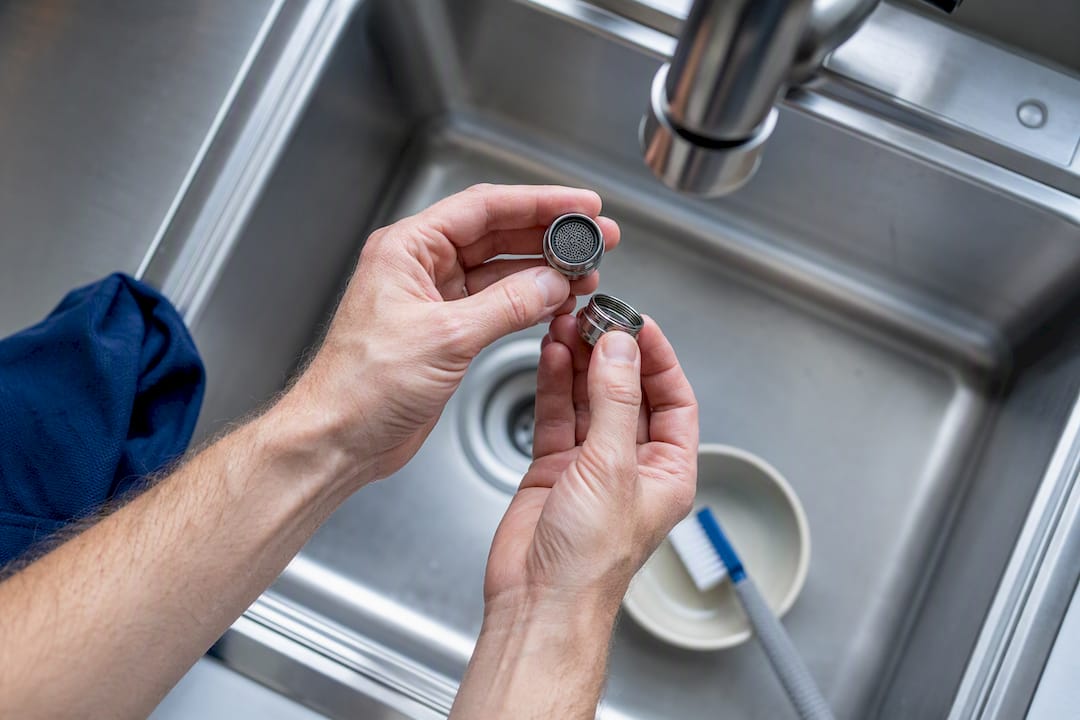
Flushing matters even without a filter installed. If a tap hasn’t been used for six hours or more, run the cold water for a full minute before drinking or cooking with it, particularly if your home has any lead solder or was built before 1986. This single habit, more than almost any other individual action, reduces the lead exposure risk from aging interior plumbing that the city’s service line project never touched.
If a plumbing inspection turns up old solder, corroded fixtures, or you’re simply unsure what’s inside your walls, contact the city’s water department or a licensed plumber familiar with lead remediation before assuming a filter alone solves the problem. For a deeper walkthrough of the testing process itself, including how to interpret the lab report you get back, Tapwaterindex’s guide to testing tap water for lead using EPA data breaks down what each field on a results sheet actually means.
Checking Your Own Address Against Official Flint Water Data
Citywide compliance numbers tell you how the system performs on average. They don’t tell you what’s coming out of your specific tap, and that gap is exactly why cross-checking multiple data sources matters.
Start with Tapwaterindex, where you can search by city, ZIP code, or water supplier to pull up contaminant data built from official EPA monitoring records. For a Flint address, you’d search either “Flint, MI” directly or your ZIP code, which surfaces the reporting supplier and its most recent lead and PFAS results side by side. The report format shows the contaminant name, the result, the EPA limit it’s measured against, and the monitoring period the data covers, so you’re not just seeing a number in isolation.
Once you have that report, cross-reference it against Michigan’s own FlintWater monitoring tables, which post the raw six-month lead and copper testing data directly from the state’s compliance program. The two sources should align, since both trace back to the same underlying EPA reporting framework, but checking both gives you a second confirmation rather than relying on a single dataset.
A few gaps worth knowing about before you rely on any public water dataset:
- Tier categories matter. A report drawing from Tier 2 or non-residential sampling sites may not reflect what a typical single-family home tap would show.
- Monitoring periods aren’t continuous. Data reflects a snapshot from a specific six-month window, not a live feed, so check the reporting date before assuming it’s current.
- Non-residential samples get mixed into system-wide averages. A commercial building with infrequent water use can pull the citywide number in a direction that doesn’t match a typical household.
- Public datasets report by supplier, not by individual address. No public tool can tell you the exact lead level at your specific faucet. Only a household test kit can do that.
| What you want to know | Where to check it |
|---|---|
| Citywide lead compliance trend | Michigan FlintWater monitoring page |
| Your supplier’s contaminant report, searchable by ZIP | Tapwaterindex |
| Statewide Michigan lead comparisons by supplier | Tapwaterindex Michigan lead data |
| Your specific kitchen tap | Household test kit, not a public database |
Treat every public monitoring tool, including Tapwaterindex, as a way to verify system-level trends and hold your utility accountable, not as a substitute for testing your own water when you have specific health concerns.
Where Flint Recovery Funding Went and How to Get Help Now
Flint’s recovery wasn’t funded by good intentions alone. Legal settlements and dedicated state and federal appropriations paid for the infrastructure work, the ongoing monitoring program, and the resource distribution that’s still active today. The state has been explicit that rebuilding resident trust required sustained transparency, not just a finished pipe replacement project, a point Michigan’s own FlintWater program materials emphasize directly.
If you need help today, beyond just checking whether the citywide numbers look reassuring, these are the concrete places to start:
- Free filters and testing kits: available through Michigan’s FlintWater resources page, which lists current distribution points and request procedures.
- EPA resident guidance: the EPA’s Flint advice page covers faucet maintenance, filter use, and what to do if your water looks or smells off.
- Local health screening: Genesee County Health Department has historically coordinated blood lead testing programs tied to crisis response; contact them directly for current program status.
None of these resources require you to prove anything or navigate a complicated application. They exist because the scale of what happened in Flint demanded a response bigger than a one-time settlement check, and the state has kept most of that infrastructure running years after the initial crisis faded from national headlines.
What the Data Doesn’t Capture About Flint’s Recovery
The compliance numbers are real, and they represent genuine engineering work: over 11,000 lead lines physically removed from the ground, a corrosion control program that’s held steady for years, and a testing streak that’s outlasted a decade. None of that is spin. But numbers alone don’t rebuild trust in a community that was told its water was safe right up until it wasn’t.
What I’d push back on is the framing some coverage still uses, treating Flint’s recovery as a finished story with a tidy ending. It’s more accurate to call it an ongoing verification process. The system passes its tests. That’s worth taking seriously. It’s also worth residents continuing to check their own results rather than accepting a citywide average as a personal guarantee, especially in a city where trust was broken by officials who once did exactly that.
The most useful habit for any Flint resident right now is treating public data the way you’d treat a doctor’s second opinion: helpful, worth cross-referencing, but not a replacement for checking your own specific situation. Pull the state’s monitoring tables. Check a tool like Tapwaterindex against them. Get your water tested if you haven’t in a while, particularly if you have young kids or an older home. The infrastructure fix is done. The habit of verifying it yourself shouldn’t be.
— Sergey
Check Your Own Water Data Beyond the Citywide Average
Citywide compliance numbers are a starting point, not the full picture for your specific address. Tapwaterindex pulls the same EPA monitoring data referenced throughout this article and lets you search it by city, ZIP code, or water supplier, so you can see your utility’s most recent lead result, PFAS levels, and how it compares to other suppliers in Michigan, without digging through state PDF reports yourself.
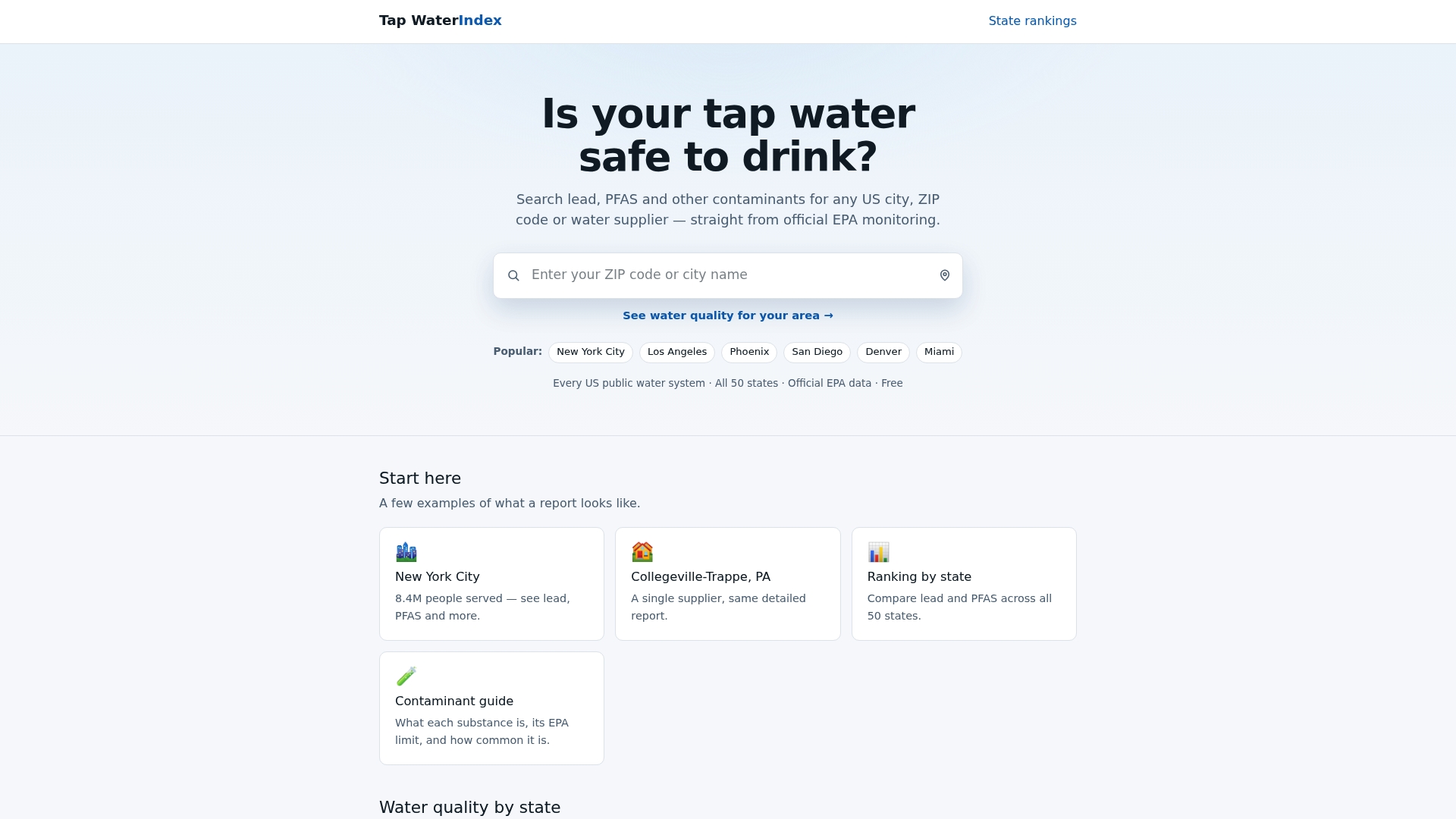
For Flint residents specifically, that means you can pull up your supplier’s latest 90th percentile lead figure and see it presented alongside the EPA limit it’s measured against, rather than hunting for it in a separate state monitoring page. If you’re also wondering about PFAS or other contaminants your household test kit doesn’t cover, the same lookup surfaces those results too. Curious how Michigan suppliers compare statewide, or how your state ranks against the rest of the country? Check the US tap water quality rankings by state and search your ZIP code to pull up your own supplier’s full contaminant report right now.
Where to Verify Every Claim in This Article
Every figure and status update above traces back to a public agency source, and checking them directly takes only a few minutes.
- The EPA’s announcement lifting the 2016 emergency order explains the federal regulatory reasoning behind Flint’s current status.
- Michigan’s service line replacement milestone announcement documents the completed infrastructure work in detail.
- The EPA’s advice page for Flint residents covers practical household guidance beyond what’s summarized above.
- Michigan Public’s reporting on ongoing compliance adds independent public health context to the state’s own announcements.
Bookmark the monitoring page specifically. New six-month results post on a predictable schedule, and it remains the fastest way to confirm whether Flint’s compliance streak is still intact the next time you check.
This article is general information, not a substitute for advice from a qualified doctor. Consult a qualified healthcare professional about your own circumstances before acting on anything here.
Sources
- EPA lifts 2016 emergency order on drinking water in Flint, Michigan
- ICYMI: Whitmer, mayor Sheldon mark milestone — completed lead service line replacement in Flint
- Taking action on Flint water / resources