U.S. Homeowners: Test Your Tap for Copper, Check TapWaterIndex
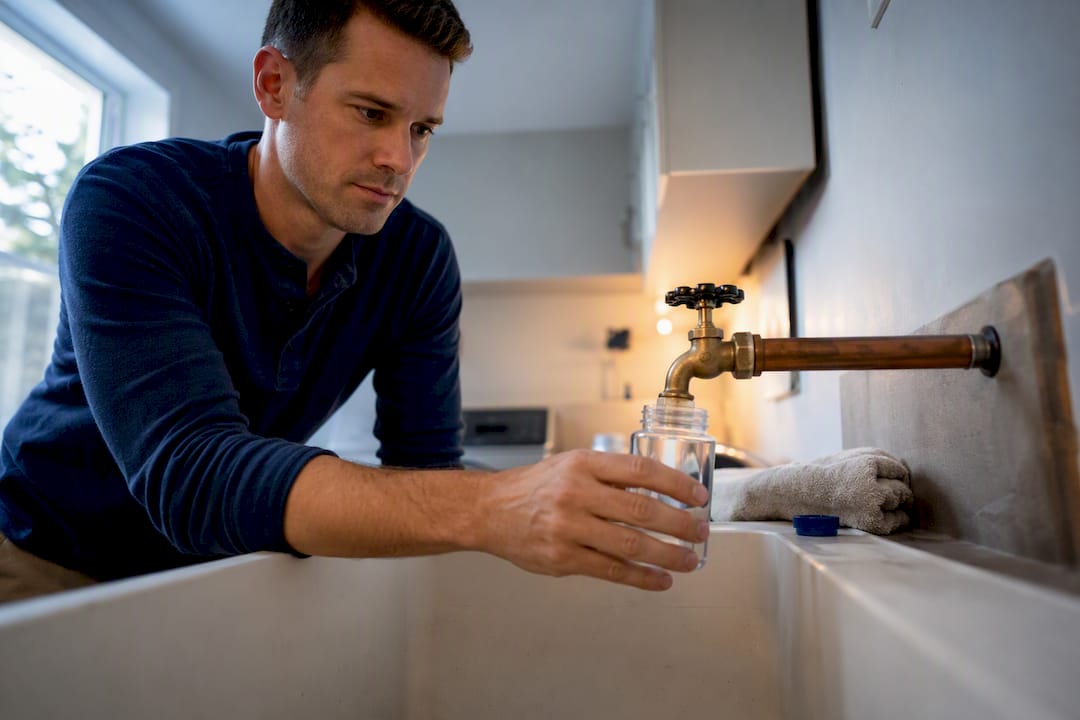
The EPA caps copper at 1.3 ppm (1,300 ppb) in tap water, but that number describes system-wide compliance, not what’s coming out of your faucet. Test your own tap to know your real exposure. Until you do, run cold water for a minute or more before drinking or cooking, skip hot tap water for food or formula, and take extra care if you’re caring for an infant or living with liver disease or Wilson’s disease.
TL;DR:
- Testing your tap water is the only way to determine actual copper exposure, as system-wide EPA compliance does not reflect individual faucet levels.
- Copper levels can reach above 1,000 ppb in homes with aggressive corrosion, especially after water has sat overnight in pipes.
- Flushing the cold tap for one to two minutes before use and using filtered water for infants can significantly reduce copper intake.
- Installing point-of-use filters or reverse osmosis systems is recommended if household copper levels remain high despite flushing.
- Utility reports may not indicate your specific exposure risks, making household testing and filtration essential, especially if 90th-percentile utility levels are near the action limit.
Table of Contents
- What the EPA Copper Action Level Actually Means
- Where Copper in Tap Water Actually Comes From
- Copper’s Health Effects and Who Should Worry Most
- How to Test Your Tap for Copper
- If Your Test Comes Back High
- The Lead and Copper Rule and What It Requires of Your Utility
- Checking Your Local Copper Data With Tapwaterindex
- A Homeowner’s Priority List
- Check Your Water Supplier’s Copper Data Free
- Where to Learn More
- Sources
What the EPA Copper Action Level Actually Means
The EPA sets copper’s Action Level at 1.3 ppm, or 1,300 ppb. That’s an Action Level, not a Maximum Contaminant Level Goal (MCLG). The distinction matters: copper corrodes into water from pipes after it leaves the treatment plant, so the EPA can’t just cap it at the source. Instead it requires a treatment technique, corrosion control, triggered when monitoring shows a problem.
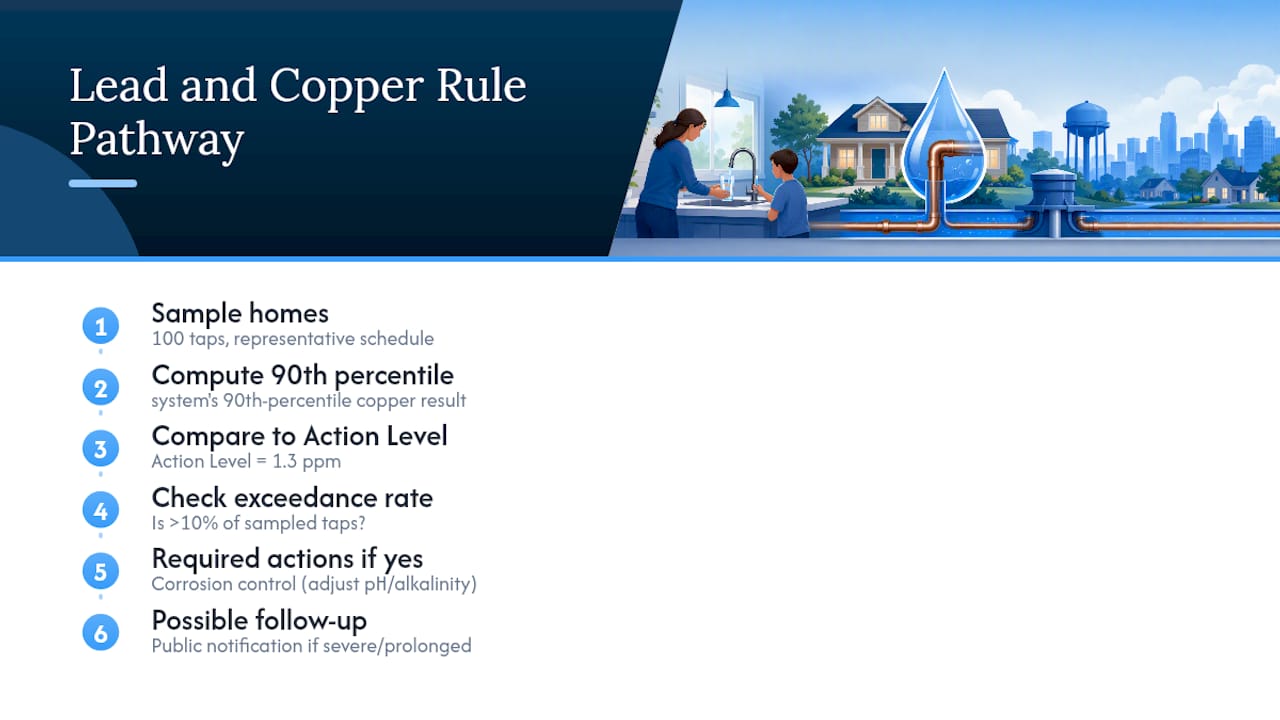
Compliance is measured using the 90th percentile of samples collected at customer taps across a water system, not a single household reading. If a utility tests 100 homes and 90 of them come back below 1.3 ppm, the system passes, even if the tenth home is well above it.
That’s the part homeowners miss. Your utility can be fully compliant while your own kitchen faucet runs hot. The Action Level tells you whether your water system as a whole has a corrosion problem. It doesn’t tell you what’s happening in the 50 feet of copper pipe between the street and your sink.
Where Copper in Tap Water Actually Comes From
Copper rarely starts in the source water. It gets into your glass by dissolving off the metal it traveled through, which is why household plumbing is the dominant source, not the reservoir or treatment plant.
A few conditions accelerate that corrosion:
- Stagnation. Water sitting overnight in copper pipes or brass fixtures picks up more metal the longer it sits still.
- Water chemistry. Low pH or soft, corrosive water eats away at pipe walls faster than neutral or hard water.
- Temperature. Hot water dissolves copper more readily than cold, which is why boiling or running the hot tap for cooking backfires.
- Fixture age and type. Older brass fittings and newer copper solder joints both leach measurable amounts, especially in the first few years after installation.
Source-water copper contamination does happen, usually tied to algae treatment in reservoirs or an industrial discharge event, but it’s the exception. For most households, the fix starts at the tap, not the treatment plant.
Copper’s Health Effects and Who Should Worry Most
Copper is an essential nutrient. Your body needs small amounts for enzyme function and iron metabolism. The health concern shows up only at elevated levels, and the symptoms are fairly predictable.
Short-term: High acute copper ingestion causes gastrointestinal distress, nausea, vomiting, and diarrhea, usually within a few hours of drinking heavily contaminated water. Most healthy adults recover without lasting harm once exposure stops.
Long-term: Sustained exposure at elevated levels has been linked to liver and kidney effects in more sensitive individuals.
Copper’s Action Level sits at 1.3 ppm (1,300 ppb), but everyday household taps can range from 20–75 ppb on average, and some homes with aggressive corrosion have tested above 1,000 ppb after standing water sat overnight.
Certain groups carry more risk. People with Wilson’s disease, a genetic disorder that prevents the body from clearing excess copper, and anyone with existing liver disease should be more cautious about elevated levels. Infants are the other priority group: their smaller body weight means the same copper concentration delivers a proportionally larger dose, and formula mixed with hot tap water compounds the problem twice over, once from the heat pulling copper out of the plumbing, and again from concentrated exposure in a small body. Always mix formula with cold water that’s been run for a minute first, then heat it separately on the stove or in a bottle warmer.
How to Test Your Tap for Copper
Utility-wide reports tell you almost nothing about your specific faucet. Testing your own tap is the only way to know your actual exposure, since copper levels swing based on how long water sat in your particular pipes before you turned the handle.
Here’s how to do it right:
- Don’t run any water for at least six hours before sampling. Overnight is easiest, since morning stagnation gives you the worst-case reading.
- Collect a first-draw sample directly from the cold tap you drink from most often, following the bottle and instructions your lab provides.
- Use a state-certified laboratory, not a big-box test strip kit, if you want a result you can act on with confidence.
- Expect to pay $20 to $40 for a standard copper analysis, sometimes bundled with a lead test since both share plumbing-corrosion causes.
- Consider professional sample collection if you’re testing for a real-estate transaction or a legal dispute, where chain-of-custody matters.
Your state health department maintains a directory of certified labs, and most will mail you a sample kit rather than requiring an in-person visit.
Pro Tip: Test twice, once as a worst-case first-draw sample after overnight stagnation, and once after flushing for two minutes. Comparing the two numbers tells you whether your plumbing is the problem or something upstream.
If Your Test Comes Back High
A result above 1.3 ppm doesn’t mean you need to panic, but it does mean you should act.
Do this immediately:
- Switch to cold water only for drinking, cooking, and formula prep. Boiling doesn’t remove copper; it can actually concentrate it as water evaporates off.
- Flush your cold tap for one to two minutes before use, especially first thing in the morning. Shorter 15 to 30-second flushes help but often don’t clear the full standing volume in longer pipe runs.
- Use bottled or filtered water for infant formula until you’ve confirmed your levels are back down.
| Situation | What to do | Why it works |
|---|---|---|
| High first-draw reading, low flushed reading | Flush 1–2 minutes before each use | Confirms the problem is stagnation, not a permanent contamination source |
| Elevated levels even after flushing | Install a point-of-use filter or reverse osmosis system | Removes dissolved copper regardless of stagnation time |
| Persistent high readings across the house | Have a plumber inspect for aging copper pipe or brass fixtures | Addresses the corrosion source directly |
For ongoing treatment, look for carbon-block filters carrying NSF certification for copper reduction, and replace cartridges on the manufacturer’s schedule since a spent filter stops removing anything. Reverse osmosis systems tend to be the more reliable option for consistently high readings, since they reduce dissolved copper regardless of how long water sat in your pipes.
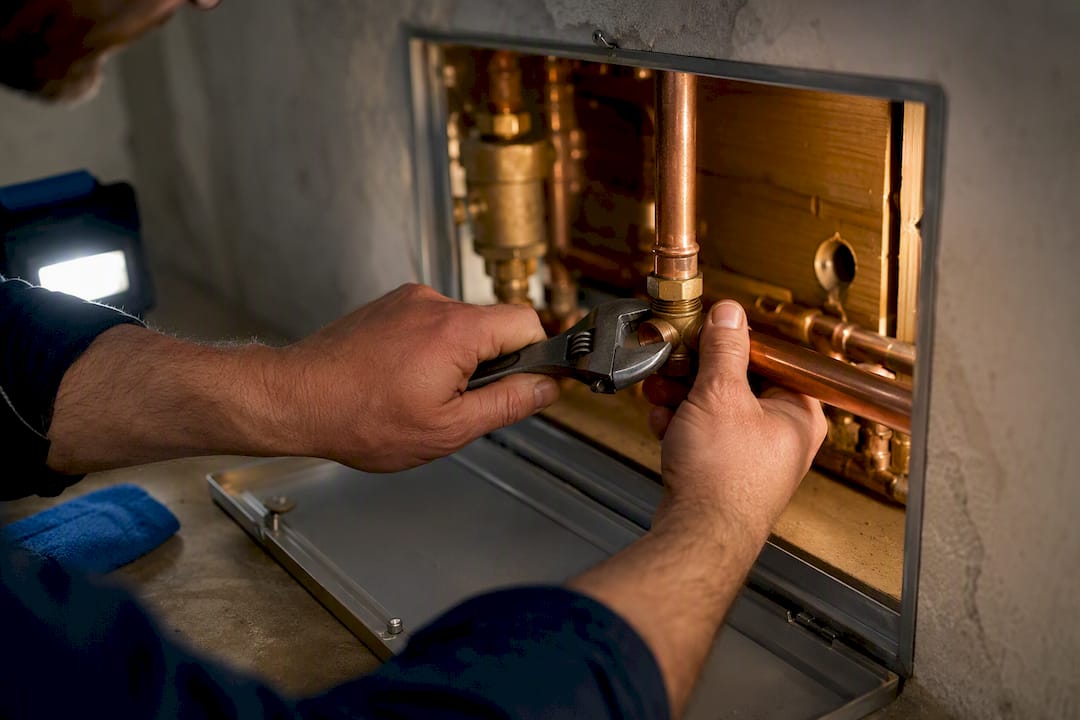
If flushing and filtering don’t bring your numbers down, the underlying fix is plumbing repair or replacement, and that’s a conversation for a licensed plumber. If you suspect the problem extends beyond your own house, contact your water supplier or state health department directly.
The Lead and Copper Rule and What It Requires of Your Utility
The Lead and Copper Rule is the federal regulation that forces utilities to monitor for copper at customer taps in the first place. It sets the 1.3 ppm Action Level and requires systems to sample a representative set of homes on a regular schedule.
If more than 10% of those sampled taps exceed 1.3 ppm, the utility can’t just note it and move on. It must implement corrosion control treatment, typically adjusting water pH or alkalinity to make it less aggressive toward pipes, and may face additional public-notification requirements depending on the severity and duration of the exceedance.
Your utility’s Consumer Confidence Report, issued annually, will show whether your system’s 90th-percentile copper result exceeded the Action Level. If it did and you haven’t heard from your utility about corrosion control steps, that’s worth a call to your state drinking water program.
Checking Your Local Copper Data With Tapwaterindex
Utility-wide 90th-percentile figures only tell part of the story, which is why pairing that data with a household test matters. Tapwaterindex pulls official EPA monitoring data and organizes it by city, ZIP code, and individual water supplier, so you can see your utility’s reported copper results without digging through a PDF report.
Search your supplier’s name or ZIP code to see how their most recent 90th-percentile copper reading compares to the 1.3 ppm Action Level. If your water sometimes tastes metallic, the metallic-taste diagnostic guide walks through the likely causes step by step, which is often the first clue that plumbing corrosion, rather than the source water, is behind an elevated reading.
A Homeowner’s Priority List
If you’re worried right now, here’s the order of operations: test your first-draw sample this week, start flushing your cold tap for a minute or two every morning in the meantime, switch to cold or filtered water for any formula prep, and call a doctor if anyone in the house has had unexplained GI symptoms. Write down your test results and the date. If a second test months later still shows elevated copper, that’s your cue to loop in your water supplier or state health department rather than assuming it will resolve on its own.
— Sergey
Check Your Water Supplier’s Copper Data Free
Testing your own tap gives you a precise number, but it helps to know what your utility has already reported before you spend money on a lab. Tapwaterindex is built for exactly that first step: search by city, ZIP code, or supplier name and see your system’s official EPA copper results without wading through a Consumer Confidence Report PDF.
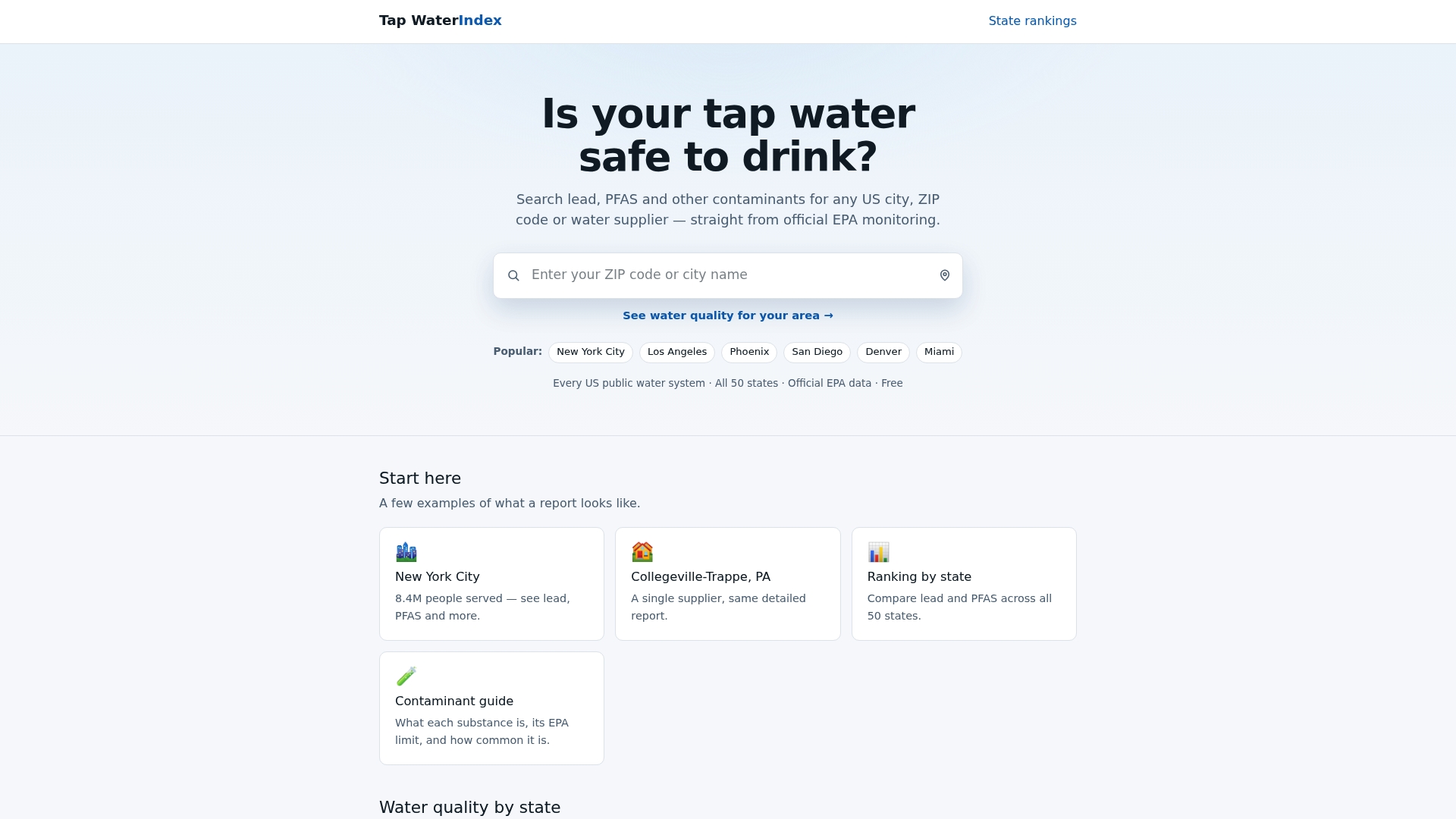
You’ll also find comparisons across other regulated contaminants, so if copper turns out clean but you’re curious about lead or PFAS, the same search covers those too. Start with the state-by-state water quality rankings to see how your area stacks up, then drill into your specific supplier’s numbers. If your utility’s 90th-percentile reading is close to the Action Level, that’s your signal to test your own tap and consider a filter while you wait on results.
Where to Learn More
- EPA Lead and Copper Rule, for the full regulatory framework and utility obligations
- Your state health department’s drinking water program, for certified lab directories and local fact sheets
- NCBI Bookshelf on copper in drinking water, for deeper health-effects research and toxicology context
This article is general information, not a substitute for advice from a qualified doctor. Consult a qualified healthcare professional about your own circumstances before acting on anything here.
Sources
- National Primary Drinking Water Regulations | US EPA
- Drinking Water: Copper (G1360) — UNL Extension
- Mass
- Lead and Copper Rule | US EPA