Washington, D.C. Tap Water: Is It Safe to Drink?
Yes. Washington, D.C. tap water meets EPA drinking water standards, and DC Water’s own testing confirms compliance across thousands of samples collected each year. The bigger question for most residents isn’t what leaves the treatment plant. It’s what happens between the water main and your kitchen faucet, especially in homes built before the 1980s where lead service lines or lead solder may still be in place.
Two facts matter here. DC Water’s Consumer Confidence Report shows the utility’s finished water complies with federal limits, but the EPA is clear that lead cannot be seen, tasted, or smelled — testing your own tap is the only way to know what’s actually coming out of it.
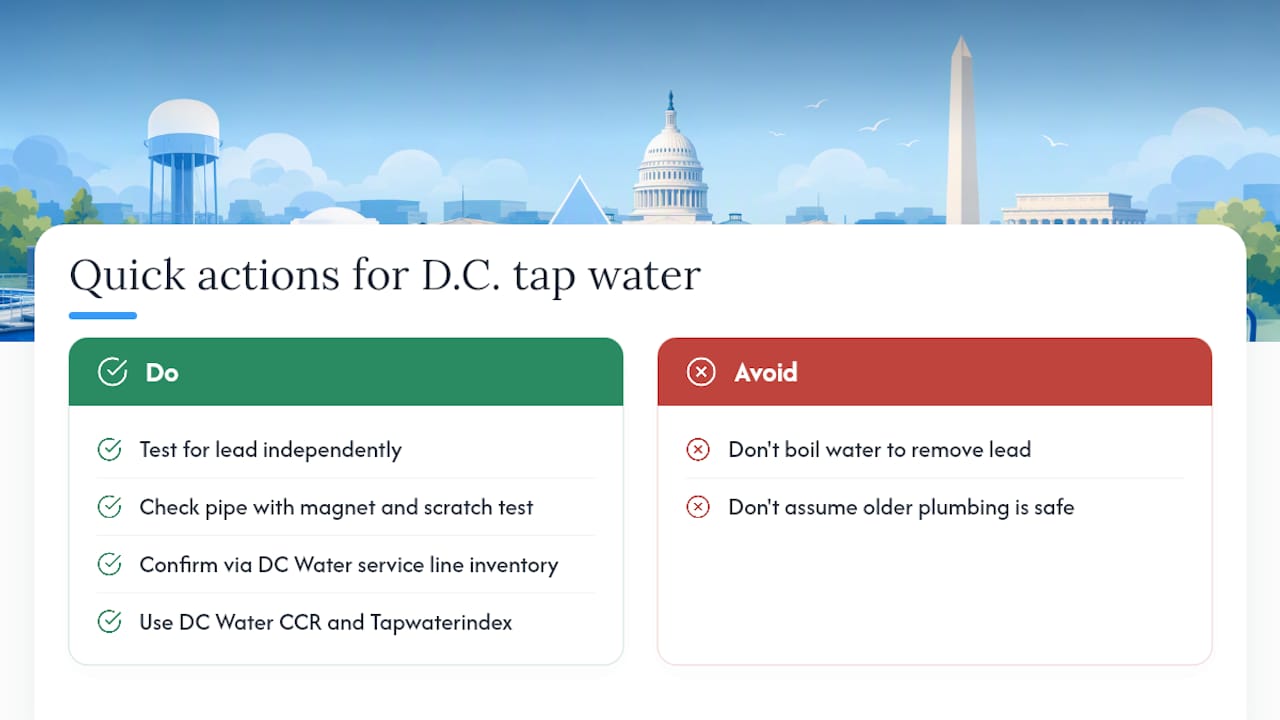
Do this now:
- Run cold water for a few minutes before drinking or cooking, especially first thing in the morning.
- Use only cold water for drinking, cooking, and infant formula. Never cook with hot tap water.
- Order a water test or check your service line material before assuming your water is fine.
If you notice discoloration, odor, or pressure problems that don’t clear after flushing, contact DC Water’s Drinking Water Division at (202) 354-3600.
Key Takeaways
Washington, D.C. tap water meets EPA standards at the treatment level, but lead risk depends on your home’s plumbing, not the utility’s compliance record.
| Point | Details |
|---|---|
| Overall safety verdict | DC Water’s treated water complies with EPA standards, but private-side plumbing can still introduce lead. |
| Test, don’t guess | Lead has no taste, smell, or color, so a certified lab test is the only reliable way to confirm it’s absent. |
| Check both plumbing sides | The utility owns the public service line; you own the private line, and materials can differ between the two. |
| Filter smart | Choose NSF/ANSI 53 certified filters for lead, or NSF/ANSI 58 for PFAS removal via reverse osmosis. |
| Use local data | Tapwaterindex’s D.C. lead report lets you compare your ZIP code against statewide and national rankings. |
Table of Contents
- What Contaminants Show Up in Washington, D.C. Water?
- Where D.C.'s Water Comes From and How It’s Treated
- How to Tell If You Have Lead Pipes
- How to Reduce Lead and Contaminant Exposure at Home
- Reading Your Water Test Results
- Where to Check Local Water Quality Data
- Find Your Neighborhood’s Water Quality Data
- Frequently Asked Questions
- Sources
What Contaminants Show Up in Washington, D.C. Water?
Lead is the contaminant that drives most of the concern in D.C., and for good reason. The city has a documented history with lead in its water system, going back to a well-known contamination episode in the early 2000s that reshaped how the utility monitors and reports results. That history is exactly why testing culture here is more rigorous today, and why D.C. residents tend to ask sharper questions than the average American homeowner.
Beyond lead, monitoring data typically picks up a handful of other issues:
- Lead — almost never present in water leaving the treatment plant, but can leach from old service lines, solder, or brass fixtures inside individual homes.
- PFAS — “forever chemicals” now tracked under expanding federal monitoring requirements.
- Disinfection byproducts (DBPs) — trihalomethanes and haloacetic acids that form when chlorine or chloramine reacts with organic matter in the source water.
- Iron and manganese — usually a cosmetic issue (brownish tint, metallic taste) tied to aging pipes rather than a health risk at typical levels.
DC Water’s report states that samples collected indicate compliance with EPA drinking water standards, and the utility runs a testing program built on many thousands of samples annually. Compliance at the system level, though, doesn’t guarantee a lead-free result at every tap. Peer-reviewed research on lead exposure links even low-level, chronic exposure to irreversible cognitive and behavioral effects in children, which is why pregnant people, infants, and households with kids under six should treat lead differently than an aesthetic issue like hard water. For everyone else, most detections call for monitoring and basic filtration rather than emergency action.
Where D.C.'s Water Comes From and How It’s Treated
Nearly all of Washington’s drinking water starts as Potomac River water, pulled in through intakes at Great Falls and Little Falls and processed by the Washington Aqueduct before DC Water distributes it citywide. The Aqueduct is one of the oldest continuously operating water treatment systems in the country, and it runs several distinct treatment stages before water reaches your street:
- Filtration removes sediment and organic material from raw river water.
- Disinfection uses chlorine, followed by chloramine for longer-lasting protection through the distribution system.
- Corrosion control adds orthophosphate, a coating agent that reduces how much lead and copper leach from old pipes into water.
- Fluoridation and pH adjustment round out treatment for dental health and pipe protection.
D.C.'s distribution network spans hundreds of miles of water mains, and that complexity matters more than people expect. A nearby main break or construction project can dislodge iron scale inside old pipes and send temporary brownish water through your tap for a day or two. Moderate water hardness, generally in the 70 to 120 ppm range, can also leave spots on glassware, though it poses no safety concern.
How to Tell If You Have Lead Pipes
Roughly half of the plumbing puzzle belongs to DC Water, and half belongs to you. The utility owns and maintains the public-side service line running from the water main to your property boundary; you own the private-side line from that boundary into your home. DC Water’s household water quality guide notes these two sides are often different materials, which means a home can have a lead-free public line and a lead private line, or vice versa.
Here’s how to check both:
- Find where the water line enters your basement or crawl space, usually near the water meter.
- Look at the pipe before it splits off to other fixtures. Lead is a dull gray color, often with a slight sheen.
- Try a magnet. Lead is not magnetic; galvanized steel is.
- Scratch the surface gently with a key or coin. Lead scratches easily and reveals shiny, silver metal underneath. Copper stays copper colored, and galvanized steel resists scratching.
- If you’re still unsure, check DC Water’s service line inventory map or call the Drinking Water Division directly.
Once you’ve done a visual check, EPA’s Protect Your Tap guide walks through the same process step by step and recommends testing anytime lead is possible. A home test kit can give you a rough read, but a certified lab delivers a defensible, precise result.
Pro Tip: When you collect a sample for lab testing, use cold water straight from a tap that hasn’t run in at least six hours, and skip cleaning the faucet aerator beforehand. Aerator debris sometimes traps lead particles, and a proper “first draw” sample is supposed to capture that.
How to Reduce Lead and Contaminant Exposure at Home
Filtering and flushing solve most of what a D.C. household will ever deal with. Start simple: run the cold tap for a couple of minutes anytime it’s been sitting for hours, use only cold water for drinking and cooking, and clean faucet aerators periodically if you notice grit or reduced flow.
Filter choice matters more than filter price. Look specifically for NSF/ANSI Standard 53 certification for lead removal, or NSF/ANSI 58 for reverse osmosis systems that also handle PFAS. A basic pitcher filter with the right certification handles most household needs; under-sink units offer higher volume and less frequent maintenance; whole-house systems make sense mainly for homes with confirmed lead service lines or particularly bad iron staining.
- Replace pitcher filter cartridges every 2 to 3 months, or sooner if flow slows noticeably.
- Check under-sink filter cartridges on the manufacturer’s schedule, typically every 6 to 12 months.
- If you confirm a lead service line, prioritize replacing the private-side portion; DC Water may offer partial-cost programs for the public side.
Do not boil water to remove lead. Boiling concentrates lead rather than eliminating it, since only the water evaporates. If you’re weighing a larger plumbing overhaul, a licensed contractor like Sandison Plumbing Heating can evaluate whether aging pipes or fixtures need replacement alongside any water heater work.
Reading Your Water Test Results
Lab reports use a specific vocabulary, and misreading it is easy. The MCL (Maximum Contaminant Level) is the legally enforceable limit the EPA sets for a given contaminant. The MCLG (Maximum Contaminant Level Goal) is the level EPA considers ideally safe, sometimes set at zero for contaminants like lead where no exposure is considered risk-free. Results are usually reported in ppb (parts per billion) or the equivalent µg/L.
Here’s where it gets confusing for a lot of people: EPA’s regulatory limits and third-party health guidelines, like those published in the EWG Tap Water Database, don’t always agree. EWG’s guidelines are often stricter, built around long-term health research rather than what’s currently enforceable or achievable at scale. A result below the MCL isn’t automatically “no action needed” if you’re pregnant or have a baby drinking formula mixed with tap water.
If a test comes back positive for lead at any level, take these steps:
- Retest with a fresh first-draw sample to rule out a fluke.
- Install an NSF-certified filter immediately, especially for drinking and cooking water.
- Have your plumber assess whether the private-side line needs replacement.
Where to Check Local Water Quality Data
Start with DC Water’s Consumer Confidence Report for the utility’s official annual results, and cross-reference it against DC Water’s service line inventory for your specific address. For a broader, searchable view, Tapwaterindex’s local lead report for D.C. pulls EPA monitoring data into a format you can search by ZIP code or supplier, and it’s worth comparing against the CCR for the same utility to see how the numbers line up.
A resident’s perspective on managing the risk
Utility compliance and household risk are two different conversations, and treating them as one is where people get it wrong. DC Water’s numbers are solid. What matters more for families with young kids is running one targeted lead test and pairing it with local data from a tool like Tapwaterindex, rather than assuming a clean CCR means a clean pipe.
Find Your Neighborhood’s Water Quality Data
Tapwaterindex turns the exact kind of utility and EPA testing data covered in this guide into a searchable report for your address instead of a citywide average.
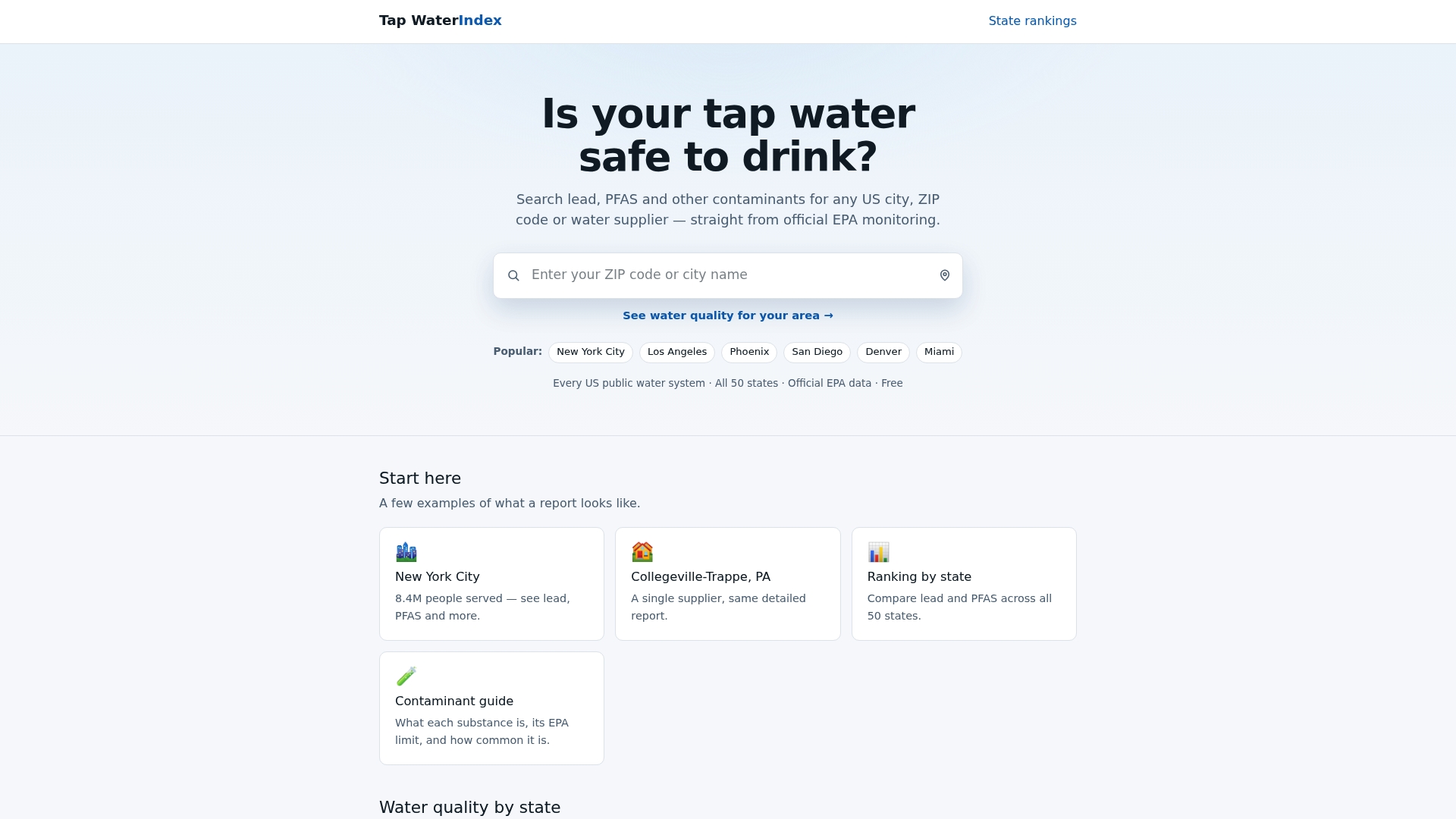
You can look up lead, PFAS, and other contaminant levels by city, ZIP code, or water supplier, then compare your results against state rankings to see how D.C. stacks up nationally. That comparison matters, because a citywide compliance report can hide neighborhood-level variation caused entirely by older private plumbing. Search your ZIP on the Tapwaterindex rankings page to pull a detailed local report, or start at Tapwaterindex’s main search if you’re not sure which supplier serves your address. If your results raise questions about specific contaminants, the contaminants and EPA limits guide breaks down what each number actually means for your health.
Frequently Asked Questions
Is Washington, D.C. tap water safe to drink in 2026? Yes, based on DC Water’s compliance with EPA standards, though households with older plumbing should still test for lead independently.
How do I know if I have lead pipes in D.C.? Check the pipe entering your home near the water meter using a magnet and scratch test, then confirm with DC Water’s service line inventory or an EPA-certified lab test.
Does boiling water remove lead? No. Boiling concentrates lead rather than removing it, since only the water itself evaporates.
What’s the difference between an MCL and an EWG health guideline? The MCL is the EPA’s legally enforceable limit, while EWG guidelines are often stricter, health-based benchmarks that aren’t legally binding.
Where can I find water quality data specific to my D.C. neighborhood? Check DC Water’s Consumer Confidence Report alongside a searchable tool like Tapwaterindex, which breaks down lead and PFAS data by ZIP code and supplier.
This article is general information, not a substitute for advice from a qualified doctor. Consult a qualified healthcare professional about your own circumstances before acting on anything here.
Sources
- Basic information about lead in drinking water | US EPA
- 2026 Drinking Water Quality Report | DC Water