U.S. Utilities: Replace Lead Lines and Meet 0.010 mg/L Rule

The lead and copper rule caps the lead action level at 0.010 mg/L and requires most water systems to fully replace lead and galvanized requiring replacement lines under their control. Utilities must complete and publish a service line inventory, and compliance dates stretch into 2027 under the Lead and Copper Rule Improvements. The EPA remains the authoritative source, and its implementation tools spell out exactly what utilities and regulators need to file.
TL;DR:
- Most utilities need to complete and publish a detailed service line inventory by 2027, prioritizing older neighborhoods, schools, and known lead sites.
- The new rule requires replacing nearly all lead and galvanized lines under utility control, with strict compliance deadlines that depend on system size and complexity.
- Sampling protocols now mandate collecting both first-liter and fifth-liter water samples, with the higher value used for compliance to better detect lead leaching.
- Utility managers should focus on rapid inventory verification, early procurement, and transparent communication to meet deadlines and maintain public trust.
- Public EPA platforms allow consumers to check their local lead levels and compare results against the regulatory threshold of 0.010 mg/L.
Table of Contents
- What Is the Lead and Copper Rule, and What Does It Cover?
- The LCRR and LCRI: What Changed and When
- What Water Systems Must Actually Do to Comply
- Building a Service Line Inventory That Holds Up
- Sampling Rules and the 90th Percentile Explained
- Where to Find EPA’s Compliance Templates and Guidance
- How to Check Your Local Lead Results Right Now
- What Regulators and Utility Managers Should Prioritize Now
- Check Your Own Water Supplier’s Lead Record
- Primary Sources Worth Bookmarking
- Sources
- FAQ
What Is the Lead and Copper Rule, and What Does It Cover?
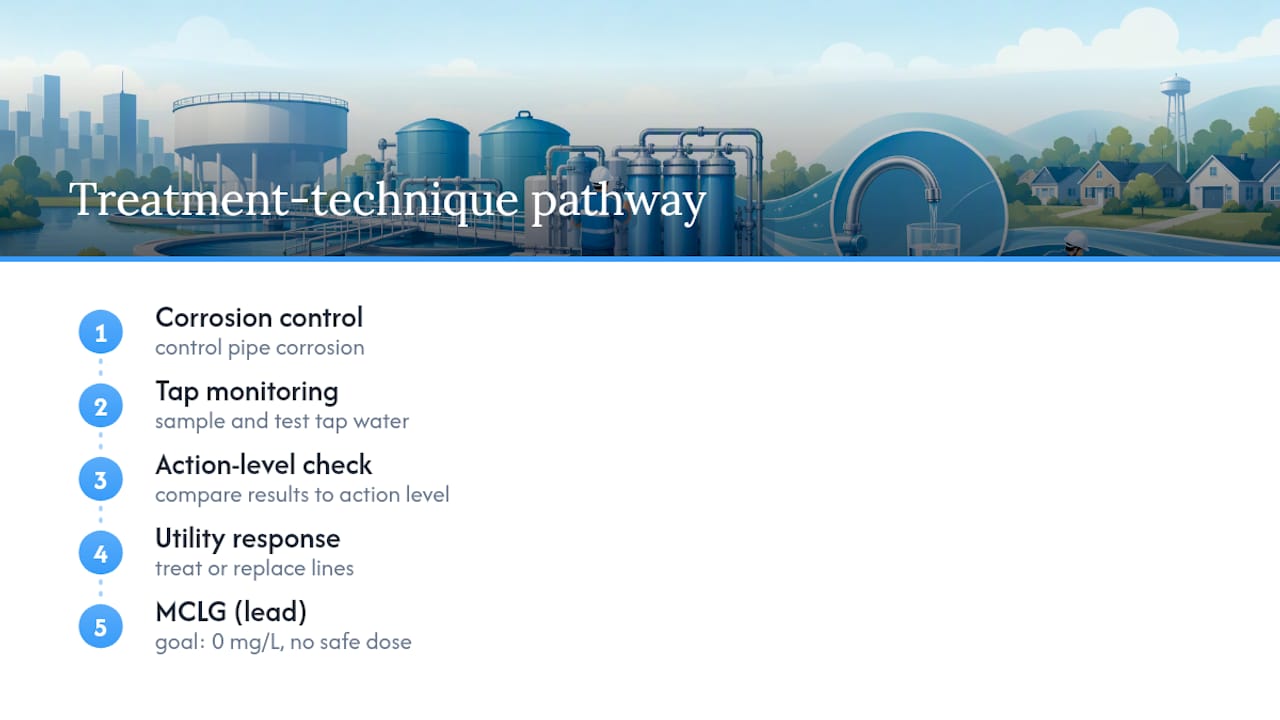
The lead and copper rule is a federal drinking water regulation under 40 CFR part 141, subpart I, issued through the authority Congress gave EPA in the Safe Drinking Water Act. It doesn’t set a numeric limit for lead the way it does for other contaminants. Instead it uses a treatment technique approach: utilities must control corrosion, monitor tap water, and act when results exceed the action level, because the maximum contaminant level goal for lead is zero. There’s no biologically safe threshold, so the rule is built around minimizing exposure rather than permitting a “safe” dose.
The rule applies to every community water system and non-transient non-community water system in the country, meaning schools, hospitals, and factories with their own water supply fall under it just as much as your city utility does. Copper gets a parallel action level of 1.3 mg/L, though lead draws most of the regulatory attention because it poses the sharper developmental risk.
The LCRR and LCRI: What Changed and When
EPA revised the original 1991 rule twice in recent years. The 2021 Lead and Copper Rule Revisions (LCRR) introduced service line inventories and stronger sampling at schools and child care facilities. The 2024 Lead and Copper Rule Improvements (LCRI) went further, cutting the action level to 0.010 mg/L, eliminating the old “trigger level” concept, and mandating that systems replace essentially all lead and galvanized requiring replacement lines under their control, not just a fraction each year.
The final rule was published in the Federal Register on October 30, 2024, with compliance dates staggered into 2027 depending on system size and task. EPA’s stated rationale is straightforward: there is no safe level of lead exposure, and lead exposure has landed disproportionately on lower-income communities and communities of color served by older infrastructure.
What Water Systems Must Actually Do to Comply
Meeting the lead and copper rule’s current requirements means juggling four separate obligations at once, and missing one doesn’t excuse the others.
- Inventory: every system must build and publicly post a service line inventory identifying lead, galvanized requiring replacement, and unknown material lines.
- Replacement: systems must replace lines under their control on the compliance schedule, with limited deferred deadlines available only when a state primacy agency documents approval.
- Corrosion control treatment: systems exceeding the action level must install or re-optimize optimal corrosion control treatment, and medium-sized systems need an approved water quality parameter plan.
- Public notification: an action level exceedance triggers Tier 1 public notice within 24 hours, plus ongoing annual outreach and reporting under 40 CFR §141.80.
Any lead connector or fitting a utility encounters during routine work has to be replaced too, even outside a scheduled project.
Building a Service Line Inventory That Holds Up
Most utilities build inventories through a three-step process: records review of permits and tap cards, targeted field verification, and predictive modeling to fill gaps where records don’t exist. Smaller systems with limited staff often start with the highest-risk zones, older neighborhoods and pre-1986 construction, then verify predictive results in the field rather than trying to inspect every service line at once, a practical approach EPA’s own small-entity guidance supports.
Prioritization should follow risk, not convenience:
- Schools and child care facilities, where sampling requirements are strictest.
- Households already flagged in past monitoring rounds.
- Neighborhoods with pre-1986 housing stock, where lead solder and lead service lines are far more common.
- Any line still classified “unknown” after records review.
Pro Tip: Don’t let a line sit classified as “unknown” past your first verification round. Regulators increasingly treat unverified unknowns the same as confirmed lead lines for replacement scheduling purposes, so an unresolved inventory can accelerate your deadline pressure rather than buy you time.
Sampling Rules and the 90th Percentile Explained
Sampling at homes with a known or suspected lead service line now requires collecting both a first-liter and a fifth-liter sample, then using whichever value is higher for compliance purposes. That combined approach catches lead from the service line itself, not just from household plumbing, and reduces false negatives compared to the old single-sample method.
To find the 90th percentile, a system ranks all its compliance samples from lowest to highest and identifies the value at the 90th percentile position. If that number exceeds 0.010 mg/L, the system has exceeded the action level and must act.
- Standard monitoring applies on a routine schedule tied to system size and prior compliance history.
- Triggered monitoring kicks in after specific events, like a system-wide treatment change.
- A single exceedance requires corrosion control review and expanded public notification.
- Repeated exceedances escalate toward mandatory corrosion control treatment installation and accelerated replacement timelines.
Where to Find EPA’s Compliance Templates and Guidance
EPA maintains a dedicated set of implementation resources so utilities aren’t building compliance paperwork from scratch.
- The service line inventory guidance walks systems through classification categories and public posting requirements.
- A small-entity compliance guide translates the rule into plain language for systems without dedicated regulatory staff.
- Tier 1 and Tier 2 public notice templates give utilities pre-formatted language for exceedance notifications.
- Service line replacement guidance covers sequencing, contractor coordination, and documentation.
EPA released updated inventory and access “Tips” and opened a public comment window in 2026 to refine these tools further, a sign that implementation guidance is still evolving. For the full legal text and exact dates, the Federal Register docket is the definitive record, and state primacy agencies handle jurisdiction-specific questions.
How to Check Your Local Lead Results Right Now
You don’t need to wait for a utility’s annual water quality report to see where your system stands. Users can search by city, ZIP code, or utility name on public EPA data platforms to view reported contaminant levels, including lead.
- Search your ZIP code or utility name on Tapwaterindex.
- Pull up the lead results for your system’s most recent monitoring period.
- Compare the reported 90th percentile value against the 0.010 mg/L action level.
- Flag anything above that threshold as worth following up on with your utility directly.
One caveat matters here: cross-check the monitoring period dates before drawing conclusions, since a single elevated result from an older reporting cycle isn’t the same as an active, ongoing exceedance. For a state-by-state view, the lead in Texas drinking water and lead in California drinking water pages show how results vary by supplier even within one state.
What Regulators and Utility Managers Should Prioritize Now
Finish the service line inventory first, then aim sampling resources at the highest-risk sites, schools, child care centers, and pre-1986 neighborhoods. Start procurement and budget planning for replacement work now, because contractor capacity and material lead times are the real bottleneck, not paperwork. Treat deferred deadlines as a documented exception, not a default plan. And communicate early: publishing a clear replacement timeline builds more public trust than waiting until a deadline forces disclosure.
— Sergey
Check Your Own Water Supplier’s Lead Record
Reading about the lead and copper rule’s requirements is one thing. Knowing whether your own utility has ever posted an exceedance is another, and that’s the gap Tapwaterindex closes. Reports on the site draw from official EPA monitoring data, covering public water systems, searchable by city, ZIP code, or supplier name.
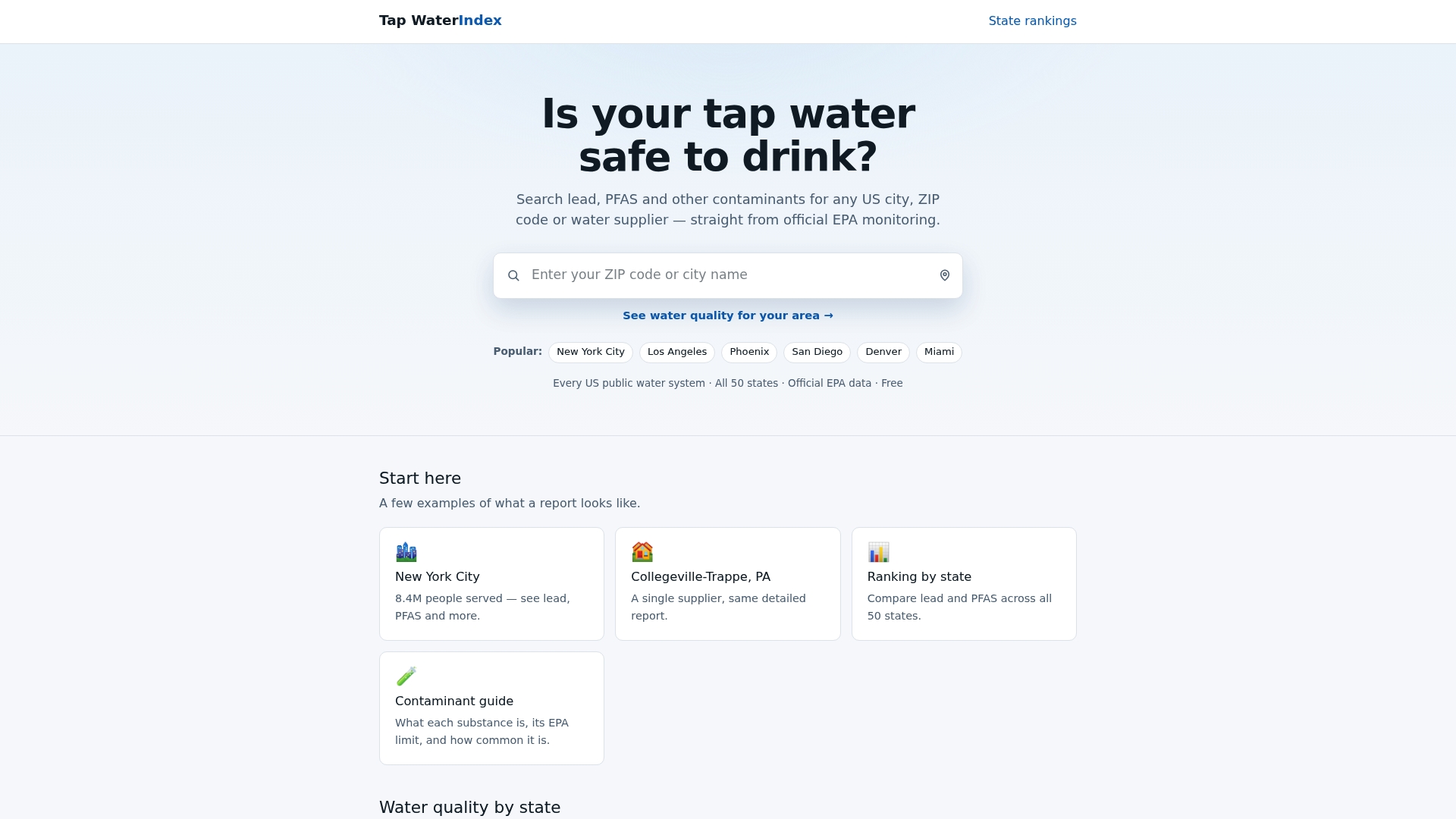
Start with the US tap water quality ranking by state to see how your state compares on lead risk relative to others, or go straight to the lead in drinking water page to understand what the EPA limit means and where lead contamination typically originates. If you’re dealing with an older home and want to understand what a service line replacement actually involves on the ground, Foundation Plumbing offers practical context on infrastructure repair costs and logistics. For a direct local check, search your address on Tapwaterindex and see your utility’s most recent reported results in minutes.
Primary Sources Worth Bookmarking
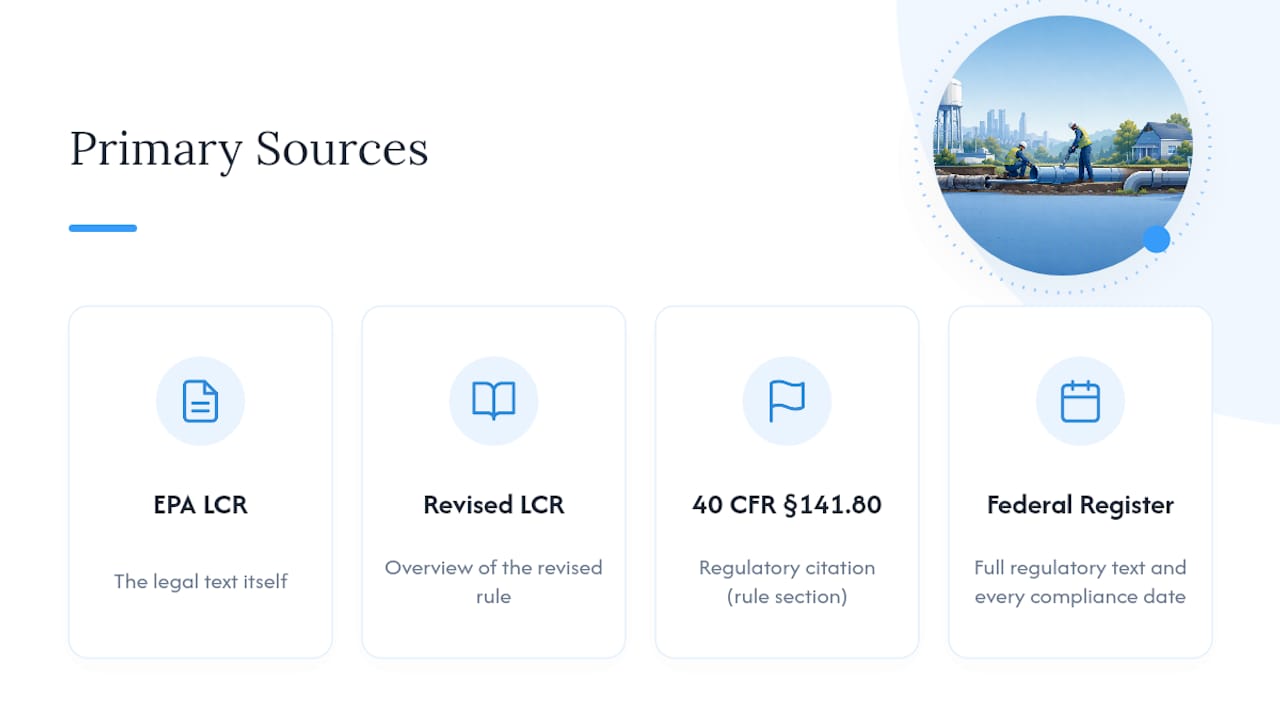
For the legal text itself, go to the EPA’s Lead and Copper Rule page, the Revised Lead and Copper Rule overview, and 40 CFR §141.80. The Federal Register docket carries the full regulatory text and every compliance date.
Sources
- National Primary Drinking Water Regulations: Final Lead and Copper Rule Improvements (Federal Register)
- Lead and Copper Rule | US EPA
FAQ
What Is the EPA Lead and Copper Rule?
It’s a federal drinking water regulation requiring water systems to control lead and copper through corrosion control treatment, tap sampling, and, since the 2024 update, mandatory replacement of lead service lines, all governed under 40 CFR part 141, subpart I.
What Are the Latest Updates to the Lead and Copper Rule?
The 2024 Lead and Copper Rule Improvements lowered the lead action level to 0.010 mg/L, eliminated the trigger level, mandated near-total lead service line replacement, and updated sampling to use the higher of first-liter or fifth-liter results, with compliance dates running into 2027.
Which US State Has the Safest Tap Water?
Safety varies by contaminant and by individual utility rather than by state as a whole, so the most reliable approach is checking your own supplier’s results directly on a resource like the state tap water quality rankings rather than relying on a single state-wide label.
What Happens if You Mix Copper and Lead Plumbing?
Mixing copper and lead plumbing materials can accelerate galvanic corrosion at the junction point, which may increase lead leaching into water at that connection, one reason the rule requires replacing lead connectors whenever utilities encounter them during other work.
Does “Lead Free” Plumbing Mean Zero Lead?
No. EPA’s “lead free” certification standard permits trace amounts of lead within defined weighted-average limits, and plumbing installed before 1986 is far more likely to contain meaningfully higher lead content than newer certified fixtures.