Is Houston Tap Water Safe to Drink Right Now?
Houston tap water meets federal and state drinking water standards, according to the city’s most recent Houston Water Quality Report and EPA facility data filed under PWS ID TX1010013. That means the water leaving the treatment plants and reaching your tap passes every legally required test. It does not mean every independent health group agrees the numbers are ideal. The EWG Tap Water Database flags several substances in Houston’s supply that fall under EPA’s legal limits but above the stricter, health-based benchmarks some scientists recommend. The contaminants worth knowing by name:
- Lead — usually from old service lines and household plumbing, not the treatment plant
- PFAS (“forever chemicals”) — resistant to standard treatment
- Arsenic — naturally occurring, tied to groundwater sources
- Chromium-6 — an unregulated but monitored industrial byproduct
- TTHMs and haloacetic acids — disinfection byproducts formed during chlorination
TL;DR:
- Houston tap water complies with EPA and TCEQ standards but may contain lead, PFAS, arsenic, and disinfection byproducts above stricter health guidelines.
- Lead primarily enters through household plumbing, especially in homes built before 1986, warranting direct testing rather than relying solely on municipal compliance.
- PFAS molecules resist standard treatment, making reverse osmosis systems or PFAS-certified carbon filters necessary for effective removal.
- Drinking water quality can vary based on source, with surface water and groundwater treatment affecting contaminant levels differently.
- Home testing and cross-checking with EPA and TapWaterIndex data allow residents to assess actual local risks beyond official reports.
Table of Contents
- Houston Water Quality: What’s Actually in the Reports
- Where Houston’s Water Comes From and How It’s Treated
- Recent Monitoring, Violations, and How to Check Current Status
- How to Test Your Home’s Water and Read the Results
- Which Water Filters Actually Remove Houston’s Contaminants
- What to Do About Houston Water Today
- Look Up Your Own Houston Water Data
- Key Takeaways
- What Houston Residents Get Wrong About Their Water
- Sources
Houston Water Quality: What’s Actually in the Reports
Every Houston Consumer Confidence Report lists dozens of tested substances, but only a handful show up consistently enough to matter for everyday decisions. The list residents actually need to track is short: PFAS, lead, arsenic, chromium-6, and the disinfection byproducts TTHMs and haloacetic acids (HAA5).
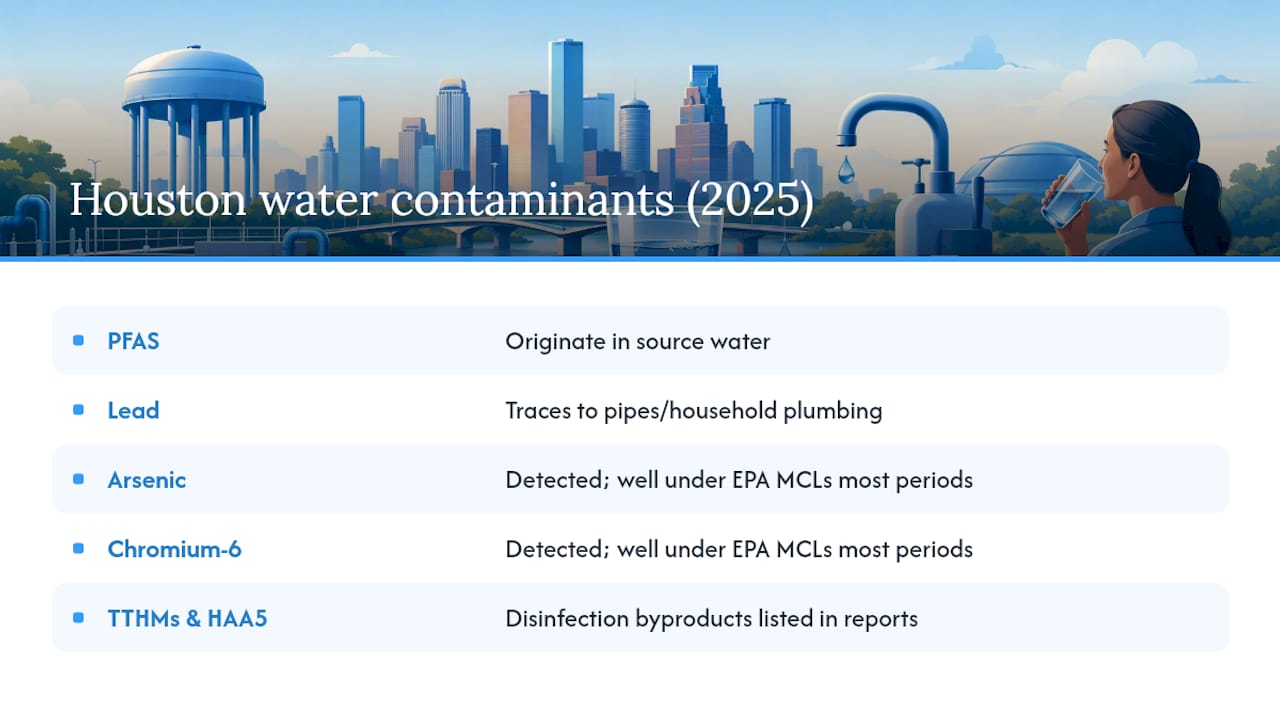
Here’s the distinction that trips people up: detection is not the same as exceedance. A contaminant showing up in a test means the lab’s equipment found trace amounts. An exceedance means the level crossed the EPA’s legal Maximum Contaminant Level (MCL). Houston’s reports show detections of arsenic and chromium-6 well under their MCLs in most testing periods, based on the city’s 2025 water quality report. Third-party trackers like EWG apply different, often stricter, health-guideline thresholds, which is why a contaminant can look concerning on one site and compliant on another. Both framings are accurate. They’re just measuring against different yardsticks.
The source matters too. Lead almost always traces back to the distribution system or a home’s own pipes and fixtures, not Houston’s reservoirs. PFAS and arsenic, by contrast, tend to originate upstream, in the source water itself, which is a harder problem to engineer around at the plant level.
Where Houston’s Water Comes From and How It’s Treated
Houston draws from two very different sources, and knowing which one feeds your neighborhood helps explain what shows up in your glass.
- Surface water reservoirs — Lake Houston and Lake Conroe on the San Jacinto River, plus Lake Livingston on the Trinity River, supply the majority of the system.
- Groundwater aquifers — the Evangeline and Chicot aquifers supplement surface supply, particularly in areas farther from the main treatment plants.
- Treatment and disinfection — water runs through purification plants for filtration, chlorination, and EPA-mandated 4-log virus treatment, plus corrosion control chemicals designed specifically to keep lead from leaching out of old pipes.
The city’s drinking water operations overview describes a system built around multiple surface plants and numerous groundwater facilities working in parallel. That scale explains why PFAS and lead get handled so differently: PFAS molecules resist standard chlorination and filtration, so they need to be addressed at the source or with specialized home filtration, while lead is almost entirely a plumbing issue the city manages through corrosion control rather than treatment-plant chemistry.
Recent Monitoring, Violations, and How to Check Current Status
Houston’s system, listed under EPA’s Safe Drinking Water Information System as PWS ID TX1010013, undergoes continuous monitoring for turbidity, lead and copper (under the Lead and Copper Rule), and disinfection byproducts. The EPA SDWIS federal report shows a compliance history that includes some returned-to-compliance entries for turbidity and LCR monitoring, meaning the system corrected an issue after a monitoring lapse or a targeted resampling event.
A “returned to compliance” note is worth reading carefully. It often reflects a fixed monitoring or reporting process rather than proof that every trace of an underlying issue, like aging lead service lines, has been physically removed. If your home was built before 1986, that distinction matters enough to justify testing your own water rather than assuming a compliance status covers you personally.
- Check current status: EPA ECHO facility report for TX1010013
- Report taste, odor, or pressure issues: call 311
- Sign up for city water alerts through Houston Public Works
Pro Tip: Bookmark the ECHO facility page for TX1010013 and check it seasonally. Compliance status updates faster there than in the annual printed report.
How to Test Your Home’s Water and Read the Results
Testing makes sense in specific situations, not as a blanket precaution for every household.
- Decide if you need it. Homes built before 1986, households with infants on formula, pregnant residents, and anyone with recent plumbing work should test. A sudden taste or odor change also warrants a check.
- Pick your method. State-certified labs (find one through TCEQ’s certified lab list) give the most reliable results. Houston Public Works also runs lead-testing programs; check the city’s drinking water quality report page for eligibility. Consumer test strips are convenient but far less precise for lead and PFAS specifically.
- Read the numbers correctly. Compare your result to the MCL for regulated substances, or the Action Level (AL) for lead and copper. Disinfection byproducts get measured as a Locational Running Annual Average (LRAA), not a single-day snapshot, so one high reading doesn’t necessarily mean a violation.
Which Water Filters Actually Remove Houston’s Contaminants
Not every filter handles every contaminant, and matching the technology to your specific concern matters more than brand loyalty.
- Activated carbon filters handle chlorine taste, odor, and most PFAS compounds reasonably well, though performance varies by certification.
- Reverse osmosis (RO) systems remove the broadest range, including PFAS, arsenic, and most dissolved solids, making them the strongest single option for households worried about multiple contaminants at once.
- Ion exchange systems target specific charged particles and work well for certain hardness and metal issues but aren’t a universal solution.
Look for NSF/ANSI 53 certification for lead reduction, NSF/ANSI 58 for reverse osmosis systems, and where available, NSF P473 or P474 guidance for PFAS-specific performance. A basic pitcher filter without PFAS-specific certification will not reliably strip PFAS from your water, according to EPA’s PFAS guidance, so don’t assume any carbon pitcher solves that particular problem.
Cost tracks capability. Pitcher filters run cheapest and handle taste and light contaminants. Faucet-mounted units add convenience for a similar contaminant range. Under-sink RO systems cost more upfront and need periodic membrane replacement, but they’re the most defensible choice if lead, PFAS, or arsenic are your actual concerns. Whole-house systems make sense mainly for well water or homes with widespread plumbing issues, not typical municipal service.

Pro Tip: Always draw drinking and cooking water from the cold tap. Hot water dissolves lead from plumbing faster, even if your filter is rated to remove it.
What to Do About Houston Water Today
A few small habits handle most day-to-day concerns without any equipment purchase.
- Flush the tap for one to two minutes if water has sat in pipes for several hours, especially first thing in the morning.
- Use cold water for drinking, cooking, and infant formula, never hot tap water.
- Address taste or odor by chilling the water or adding a slice of lemon. Houston Public Works confirms most taste and odor complaints trace back to geosmin or MIB, natural compounds from source water that affect smell, not safety, according to the city’s own guidance.
- Follow boil-water advisories exactly if one is issued. These are separate from routine contaminant reports and mean something has gone wrong with treatment or pressure.
- Call 311 to report ongoing taste, odor, or pressure problems, or check the city’s lead-testing survey for eligibility.
Look Up Your Own Houston Water Data
Reading a city-wide report only tells you so much. Your actual risk depends on your ZIP code, your neighborhood’s plumbing age, and which treatment plant serves your address, which is why a searchable lookup matters more than a PDF.
TapWaterIndex lets you search by city, ZIP code, or utility name to see flagged contaminants like PFAS and lead pulled directly from EPA monitoring data. A simple workflow works well here: search your ZIP or utility on TapWaterIndex, note anything flagged, then cross-check that finding against Houston’s own CCR or the EPA SDWIS/ECHO report using PWS ID TX1010013.
- TapWaterIndex draws from official EPA monitoring data, not marketing claims
- Comparisons let you see how Houston stacks up against other Texas utilities or other states nationally
- Contaminant explainers cover what each regulated substance and limit actually means for your household
Key Takeaways
Houston’s tap water is legally compliant under EPA and TCEQ standards, but lead risk depends on your home’s plumbing age and PFAS levels warrant filtration regardless of compliance status.
| Point | Details |
|---|---|
| Compliance isn’t the full picture | Houston meets EPA/TCEQ limits, but EWG’s stricter health guidelines flag some contaminants anyway. |
| Lead is a plumbing problem | Pre-1986 homes should test directly rather than rely on system-wide compliance status. |
| PFAS needs specific filtration | Reverse osmosis or PFAS-certified carbon works; basic pitcher filters often don’t. |
| Taste issues rarely mean danger | Geosmin and MIB cause odor complaints but aren’t a health violation. |
| Verify your own address | Cross-check TapWaterIndex results against EPA ECHO using PWS ID TX1010013. |
What Houston Residents Get Wrong About Their Water
The biggest misread on Houston tap water isn’t about the water itself, it’s about what “compliant” actually promises you. People treat an EPA pass as a guarantee of zero risk. It’s a guarantee of meeting a legal floor, set decades ago in some cases, not a health optimum. That gap is exactly where EWG’s stricter benchmarks and TapWaterIndex’s contaminant lookups earn their place: they show you the distance between “legal” and “ideal” for your specific address.
The conventional advice, “just use a pitcher filter,” undersells the problem for anyone worried about PFAS or lead specifically. A basic carbon pitcher solves taste. It does not solve either of those two contaminants reliably. If you take one thing from this guide, prioritize matching your filter to your actual risk, tested plumbing age for lead, certified RO or PFAS-rated carbon for forever chemicals, rather than buying whatever’s cheapest at the hardware store and assuming it covers everything.
— Sergey
This article is general information, not a substitute for advice from a qualified doctor. Consult a qualified healthcare professional about your own circumstances before acting on anything here.