2026 U.S. EPA PFAS Limits: What Changes and How to Check

The EPA currently enforces a 4.0 parts per trillion limit for both PFOA and PFOS, with a 10 ppt limit for PFHxS, PFNA, and HFPO-DA, plus a Hazard Index cap for chemical mixtures. But 2026 is a messy year for these numbers: EPA has proposed rescinding three of those limits and extending the PFOA/PFOS compliance deadline to 2031. Check your own utility’s actual results through TapWaterIndex rather than relying on national averages.
TL;DR:
- The EPA has proposed rescinding three existing PFAS limits and extending the PFOA and PFOS compliance deadline to 2031, with public comments still open.
- Utilities must complete baseline PFAS monitoring by 2027, and enforceable limits based on annual averages take effect starting in 2029, unless the extension is finalized.
- Testing relies on EPA Methods 533 and 537.1, with certification required since June 2024, and violations depend on sustained average levels rather than individual high results.
- States can set stricter local standards, and residents should check their utility’s actual PFAS levels through TapWaterIndex rather than relying solely on national averages.
- Short-term mitigation strategies are required for utilities exceeding 12 ppt of PFOA or PFOS during interim periods before full compliance.
Table of Contents
- EPA PFAS Numeric Limits, Trigger Levels, and Lab Detection Thresholds
- What Water Systems Must Do, and By When
- How Labs Actually Test for PFAS
- The 2026 Proposals That Could Rewrite the Rules
- Checking Your Own Tap Water and Cutting Exposure Now
- Where This Regulatory Fight Actually Goes From Here
- Find Your Local PFAS Results in Under a Minute
- Primary Sources for the Rule Text Itself
- Sources
EPA PFAS Numeric Limits, Trigger Levels, and Lab Detection Thresholds
Here’s the full numeric picture, straight from the national PFAS rule:
The MCL and MCLG numbers aren’t the same thing, and the gap matters. The MCLG is a health-based target set with zero regard for treatment cost. EPA set it at zero for PFOA and PFOS because there’s no known safe exposure threshold. The MCL, by contrast, is the legally enforceable number, adjusted for what treatment technology can actually achieve and what utilities can reasonably afford. That’s why the MCLG for PFOA sits at zero ppt while the enforceable MCL sits at 4.—.
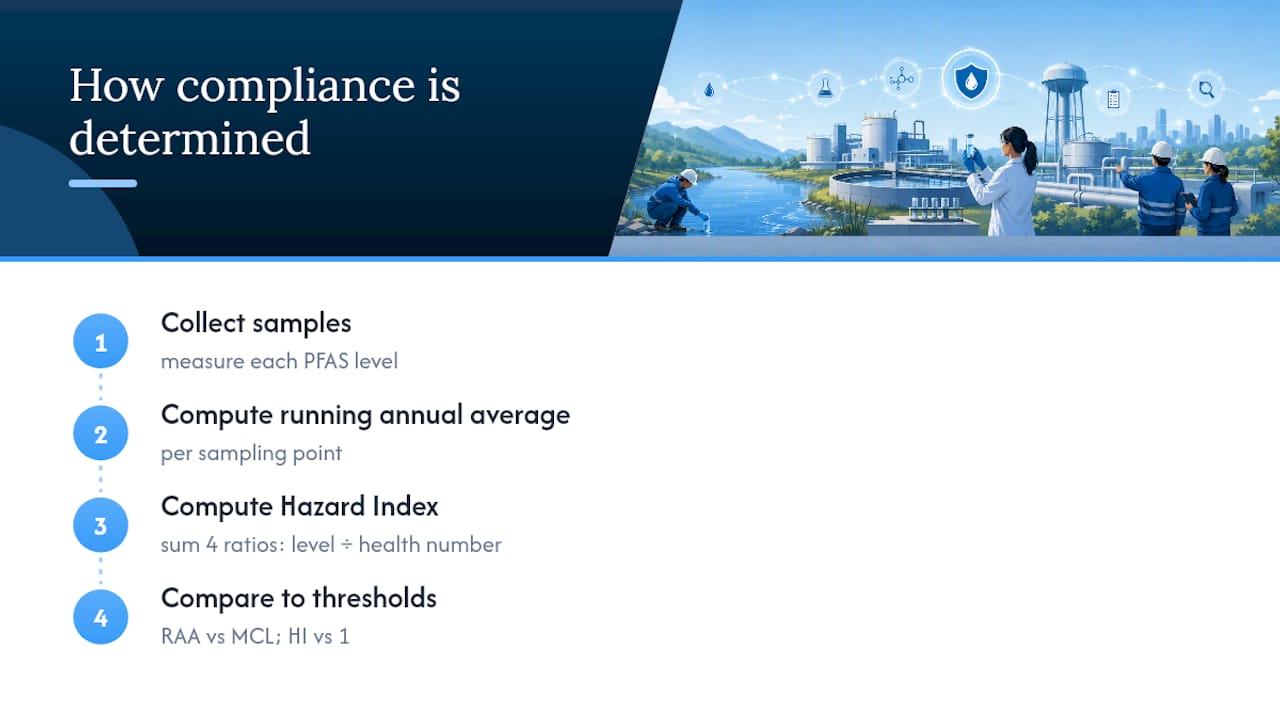
Compliance isn’t judged on a single water sample. Utilities calculate a running annual average at each sampling point, and that average, not any one test result, determines whether a system is in violation. The Hazard Index works differently: instead of one chemical’s concentration, utilities divide each of the four mixture chemicals’ level by its own health-based number, add the four ratios together, and check if the sum exceeds 1.
What Water Systems Must Do, and By When
Every public water system in the country is working against a specific compliance calendar, and the dates carry real legal weight.
- Initial monitoring completion by 2027. Systems must finish baseline PFAS sampling to establish whether they exceed trigger levels.
- Monitoring and reporting violations become enforceable April 26, 2027. Miss your sampling or reporting obligations after this date, and it’s a violation regardless of what your PFAS numbers actually show.
- MCL compliance enforcement begins April 26, 2029. This is when the actual 4.— and 10 ppt numbers become legally binding, based on running annual averages.
- A proposed two-year extension could push PFOA/PFOS compliance to 2031. EPA’s May 2026 proposal would let systems formally request this extension rather than face immediate enforcement.
- Interim mitigation kicks in above 12 ppt. Systems granted an exemption but posting results at or above 12 ppt for PFOA or PFOS have to implement short-term mitigation while they work toward full compliance.
How Labs Actually Test for PFAS
Two EPA-approved methods handle the vast majority of PFAS compliance testing: EPA Method 533 and EPA Method 537.1 (version 2.0). Both detect the six regulated PFAS compounds at the parts-per-trillion level, which is roughly equivalent to finding one drop in twenty Olympic swimming pools.
A few mechanics matter for anyone reading a utility’s PFAS report:
- Labs running these tests must carry EPA or state primacy-agency certification, a requirement that’s been mandatory since June 25, 2024.
- The trigger level, set at half the MCL, isn’t a compliance line on its own. It’s a monitoring switch: cross it, and a utility shifts to quarterly sampling instead of annual or triennial.
- Practical quantitation limits vary by compound and lab, but they generally sit low enough to detect concentrations well under the enforceable MCLs.
- A single high sample doesn’t automatically trigger a violation. The running annual average has to confirm the exceedance over time before enforcement applies.
That last point trips people up constantly. A spike in one quarterly sample looks alarming on a report, but it takes a sustained pattern across the annual average to cross into violation territory.
The 2026 Proposals That Could Rewrite the Rules
EPA is moving in two directions at once this year, and both proposals matter for anyone tracking compliance.
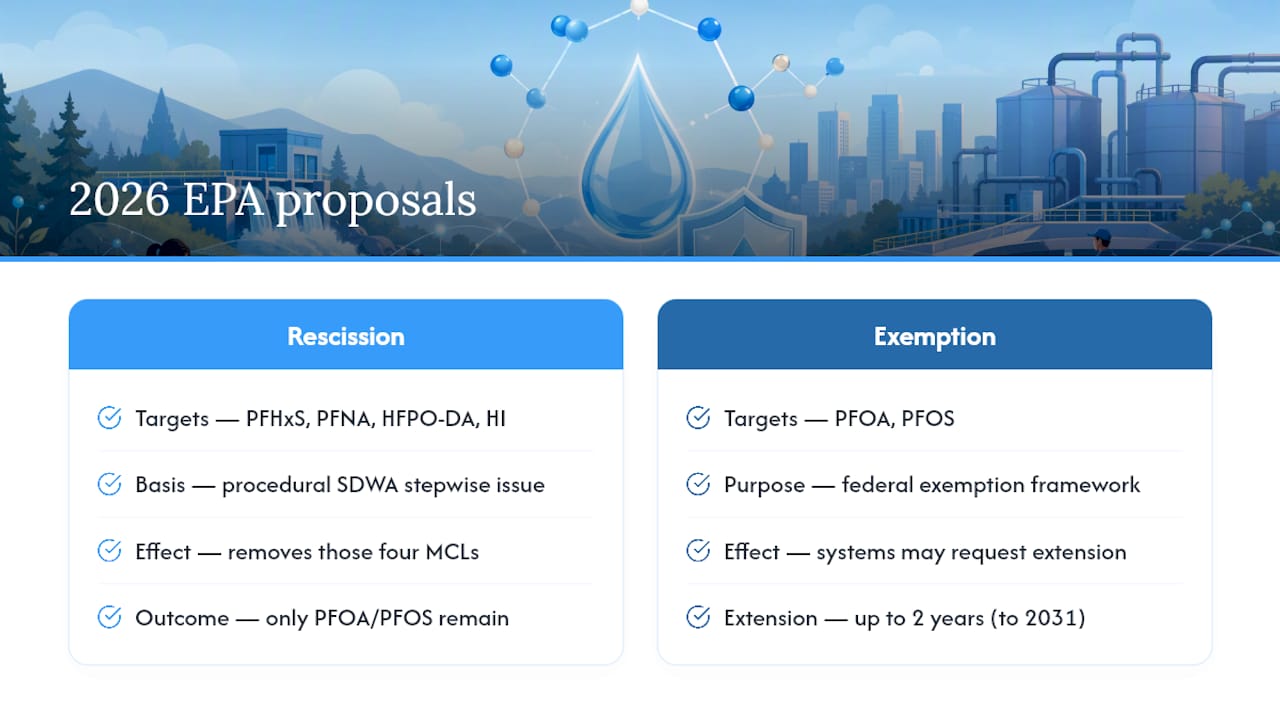
The first is a proposed rescission of the MCLs and regulatory determinations for PFHxS, PFNA, HFPO-DA, and the Hazard Index mixture. EPA’s stated basis isn’t new health data. It’s procedural: the agency has concluded that its original 2024 rulemaking didn’t follow the stepwise process the Safe Drinking Water Act requires for adding new contaminants. If finalized, those four MCLs would simply disappear, leaving only PFOA and PFOS with binding numeric limits.
The second is a proposed federal exemption framework for PFOA and PFOS, letting systems request the two-year extension to 2031 described above.
Pro Tip: Both proposals are still open for public comment. Search the docket numbers on regulations.gov, and set a calendar reminder to check the Federal Register in the coming months. Final rule text, not draft proposals, is what actually governs your water system’s obligations.
Checking Your Own Tap Water and Cutting Exposure Now
None of these national numbers tell you what’s coming out of your own faucet. Your utility’s annual Consumer Confidence Report lists actual test results, and your state’s primacy agency page often has more granular history than the CCR alone.
- Search your city, ZIP code, or supplier name directly on TapWaterIndex to pull EPA monitoring data without digging through PDFs.
- Compare your state’s results against others using the state-by-state rankings to see if your area runs above or below regional norms.
- If your utility reports a confirmed exceedance, a point-of-use filter rated for PFAS reduction is a reasonable short-term step, and bottled water is a fallback during acute concerns.
- For any personal or medical worry about past exposure, talk to a healthcare provider rather than trying to interpret blood-level guidance yourself.
EPA has estimated meaningful national public health benefits from the PFAS drinking water rule, including reduced cancer risk and other chronic health outcomes projected over the rule’s implementation. Those benefits only materialize if utilities actually hit the numeric limits, which is exactly why the 2026 rescission and extension proposals carry so much weight for public health advocates watching this space.
Where This Regulatory Fight Actually Goes From Here
Utilities and states shouldn’t wait for final rule text before acting. Monitoring deadlines are fixed regardless of how the rescission proposal shakes out, and systems that delay testing now risk scrambling later. States retain the authority to set stricter standards than whatever survives at the federal level, so primacy decisions in the next year matter as much as anything EPA does in Washington.
For residents, the practical move is simple: pull your CCR, check TapWaterIndex, and don’t assume “the EPA handled it” means your specific utility is compliant today. Track the docket, plan for staged capital investment if you’re on a utility board, and keep customer communication honest about what’s confirmed versus proposed.
— Sergey
Find Your Local PFAS Results in Under a Minute
Reading regulatory text tells you what the rules say. It doesn’t tell you what’s actually in your glass. Tapwaterindex closes that gap by pulling official EPA monitoring data down to the individual utility, so you’re looking at your supplier’s actual PFAS readings instead of a national average that may not reflect your ZIP code at all.
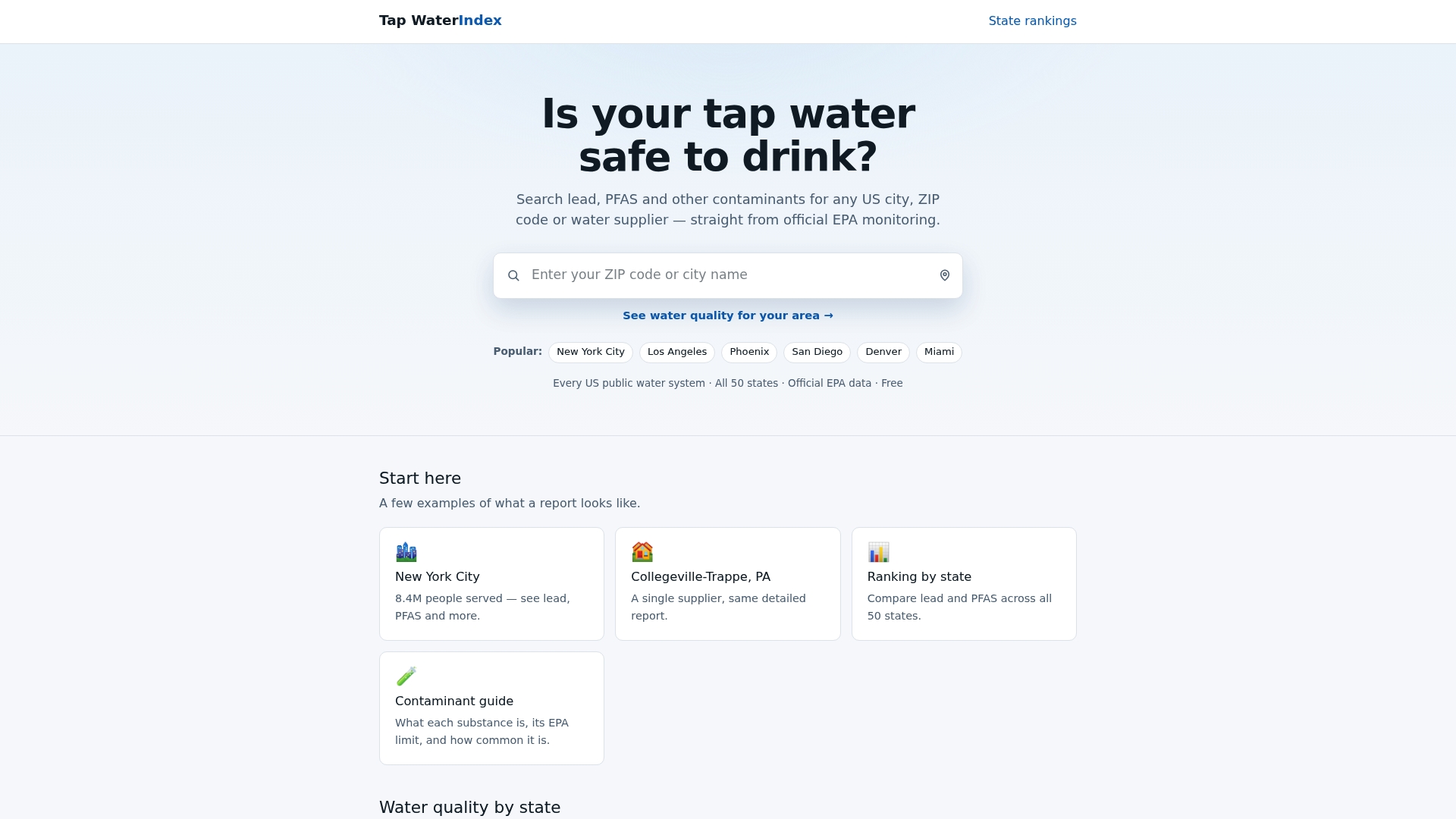
A search on Tapwaterindex returns the specific PFAS compounds detected at your utility, how those numbers compare to the enforceable MCLs, and how your state ranks against the rest of the country. Residents in states with active PFAS monitoring can check supplier-level pages directly, including Pennsylvania, Florida, Massachusetts, and Oregon. Head to Tapwaterindex now and search your city, ZIP code, or water supplier to see exactly where your tap water stands against current EPA thresholds.
Primary Sources for the Rule Text Itself
- EPA’s PFAS program page covers current MCLs and the 2026 extension proposal.
- The PFAS Overview Quick Reference Guide details monitoring methods and PQLs.
- The Federal Register final rule holds the full legal preamble.
- Track and comment on active proposals through regulations.gov docket search.
This article is general information, not a substitute for advice from a qualified doctor. Consult a qualified healthcare professional about your own circumstances before acting on anything here.
Sources
- Per- and Polyfluoroalkyl Substances (PFAS) | US EPA
- Control of Per- and Polyfluoroalkyl Substances (PFAS) Overview: A Quick Reference Guide (QRG)
- PFAS National Primary Drinking Water Regulation — Federal Register