Is Dallas Water Quality Safe to Drink Right Now?
Short answer: yes. Dallas Water Utilities (DWU) meets federal and state drinking water standards, and the City of Dallas Water Quality Report shows the system carries a “Superior” rating from the Texas Commission on Environmental Quality (TCEQ). That’s the state’s top rating for a water system.
Here’s what backs that up:
- The 90th percentile lead result citywide sits at a low level, well under the EPA action level.
- Chlorine residual runs at a level consistent with effective disinfection throughout the distribution system.
- DWU says it meets or exceeds every federal and state requirement tracked in its annual report.
None of that means zero risk. Unregulated contaminants like PFAS still get monitored without an enforceable limit in most testing cycles, and older homes with lead service lines carry their own separate risk regardless of what the citywide average shows. Check your specific address on TapWaterIndex before assuming the citywide numbers apply to your kitchen tap.
Key Takeaways
Dallas tap water meets federal and state standards under a TCEQ “Superior” rating, but residents with older plumbing or specific health concerns should verify their own address rather than rely on citywide averages alone.
| Point | Details |
|---|---|
| Citywide compliance confirmed | DWU holds a TCEQ “Superior” rating and reports full compliance with federal and state standards. |
| Lead levels stay low | The 90th percentile lead result is low, well under the EPA action level. |
| PFAS lacks a full enforceable limit yet | Federal standards are new, so track updates and check your ZIP code for local PFAS data. |
| Address-level testing matters most | Citywide averages can mask high readings at individual taps in older homes. |
| Match filters to actual test results | Choose NSF 53 certified filters for lead, activated carbon for organics, RO for broad-spectrum removal. |
Official Reports and Tools Worth Bookmarking
For raw data tables, read the City of Dallas Water Quality Report directly. For federal standard updates, check the EPA’s PFAS drinking water page. For address-specific lookups, use TapWaterIndex’s Dallas search.
Table of Contents
- Where Dallas Water Quality Comes From and How It’s Treated
- Contaminants Detected in Dallas Tap Water: What Recent Reports Show
- How DWU’s Compliance Record and TCEQ Rating Actually Work
- Who Should Worry About Dallas Water Quality and Who Shouldn’t
- How to Check and Test Your Dallas Tap Water: A Step-by-Step Guide
- Do You Need a Water Filter in Dallas?
- Cross-Checking City Reports With TapWaterIndex
- What Dallas Residents Get Wrong About Their Tap Water
- Sources
Where Dallas Water Quality Comes From and How It’s Treated
Dallas draws from seven surface water sources rather than groundwater wells: the Elm Fork of the Trinity River, Lake Ray Hubbard, Lake Lewisville, Lake Grapevine, Lake Ray Roberts, Lake Tawakoni, and Lake Fork. That matters because surface water behaves differently than groundwater. It picks up more organic material, sediment, and seasonal runoff, which shapes the entire treatment process downstream.
DWU treats that raw water through a multi-stage process:
- Coagulation and settling to pull out suspended particles.
- Filtration to remove what settling misses.
- Disinfection using chloramine, a chlorine-ammonia combination that’s more stable in long pipe runs than chlorine alone, plus ozone at some points.
- Corrosion control to reduce lead and copper leaching from old plumbing.
- Activated carbon and fluoride treatment for taste, odor, and dental health.
Chloramine holds up better than straight chlorine over Dallas’s sprawling distribution network, but it also reacts with organic matter to form disinfection byproducts, which is why the city tracks those levels closely.
Contaminants Detected in Dallas Tap Water: What Recent Reports Show
Dallas water quality reports track several contaminant categories, and the 2023 to 2025 data shows a system operating comfortably within legal limits, with a few items worth watching.
Disinfection byproducts are the headline metric. The 2024 report puts the total trihalomethanes (TTHM) locational running annual average at roughly 19.1 ppb against an 80 ppb limit, and haloacetic acids (HAA5) at about 17.0 ppb against a 60 ppb limit. Both sit well under half the allowed threshold.
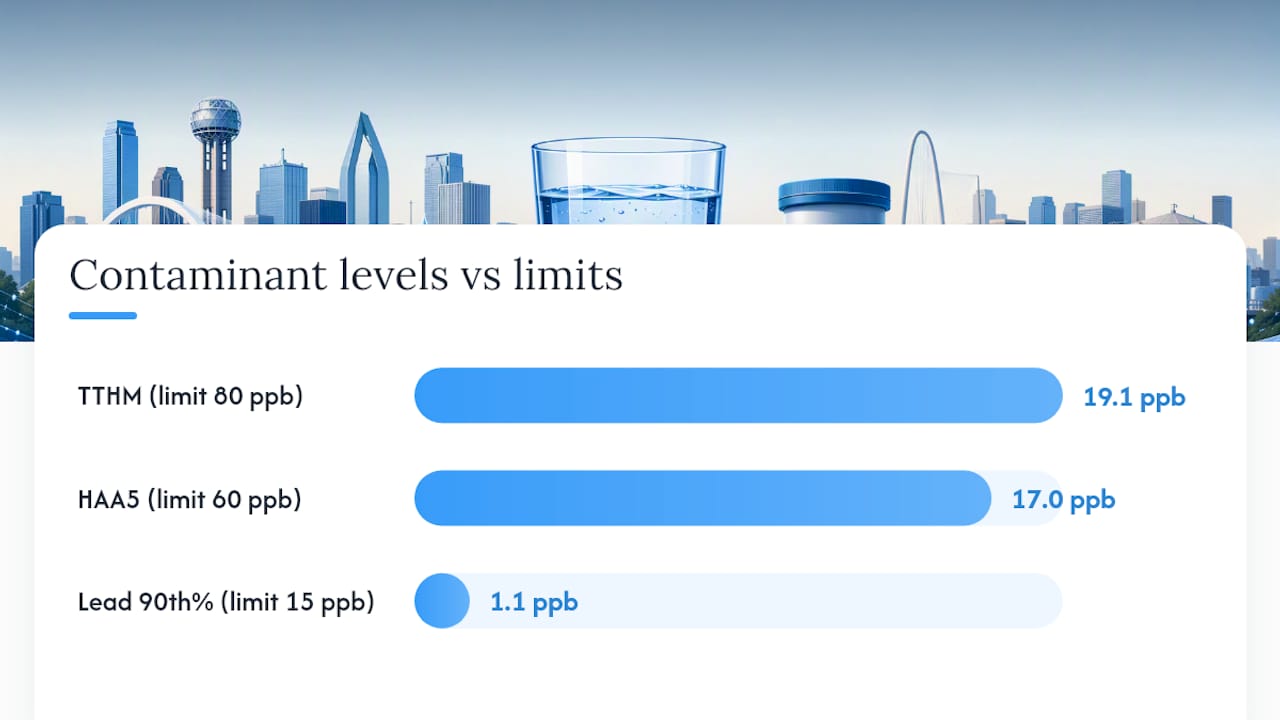
Lead and copper get measured through the 90th percentile method, landing at 1.1 ppb for lead citywide, far below the 15 ppb action level.
Microbial monitoring for cryptosporidium has run since 1993. The 2023 report notes detections only in untreated source water, never in treated water delivered to homes.
Nitrates and PFAS round out the list. PFAS falls under unregulated contaminant monitoring, meaning the EPA now has a final national drinking water standard but many local detections predate enforceable limits. A “detection” isn’t the same as an “exceedance.” Detection means the lab found a trace amount; exceedance means that amount broke a legal limit. Advocacy groups like the Environmental Working Group publish stricter guideline numbers than the EPA’s enforceable standards, which is useful context but not a regulatory benchmark.
How DWU’s Compliance Record and TCEQ Rating Actually Work
DWU reports full compliance with federal and state requirements, and TCEQ’s “Superior” rating reflects sustained performance across water treatment, distribution, and monitoring categories, not a one-time snapshot.
Reading the water quality report gets easier once you know three terms:
- 90th percentile (used for lead): 90% of tested homes came back at or below this number, meaning some individual taps could read higher.
- LRAA, locational running annual average, used for disinfection byproducts, smooths out seasonal swings so one bad month doesn’t skew the picture.
- MRDL, maximum residual disinfectant level, caps how much chloramine or chlorine can remain in the water without becoming its own health concern.
DWU also reports running 40,000 to 50,000 tests per month across the system, a sampling volume that catches problems fast rather than waiting for an annual snapshot to reveal them.
Pro Tip: Skip the summary page and go straight to the lead and copper table in the annual report. That’s the row most likely to vary by neighborhood, since it depends on how old the service lines are on your specific street, not the citywide average.
Who Should Worry About Dallas Water Quality and Who Shouldn’t
A contaminant showing up in a test doesn’t automatically mean it’s a health threat. Context and dose matter more than the word “detected” implies.
That said, some residents carry more risk than others:
- Infants and pregnant people are more vulnerable to lead exposure, since even low levels can affect developing nervous systems.
- Immunocompromised individuals face higher risk from microbial contaminants like cryptosporidium, even at levels healthy adults tolerate without symptoms.
- Anyone in a home built before 1986 should assume older service lines until proven otherwise, since that’s when lead pipe use was banned nationally.
If you’re in one of these groups and see any unusual taste, color, or smell from your tap, don’t wait it out. Call your doctor if you notice symptoms, and call 3-1-1 or DWU directly if you suspect a supply issue rather than a plumbing problem in your own home.
How to Check and Test Your Dallas Tap Water: A Step-by-Step Guide
-
Look up your specific address first. The citywide averages in DWU’s report are useful, but they blend results from thousands of homes. Search your ZIP code or supplier name on TapWaterIndex to see EPA-sourced data localized to your area rather than a system-wide blend.
-
Order a certified test if you suspect lead or PFAS. An EPA-certified lab gives you a legally defensible result; a reputable at-home kit works as a first screen but isn’t a substitute for lab analysis. Run the tap cold for at least five minutes before your first sample if you’re testing for lead, since standing water in the pipe overnight concentrates it.
-
Report anything abnormal. Contact 3-1-1 for suspected supply-side issues, or the EPA Safe Drinking Water Hotline for questions about federal standards. If a lab test comes back high for lead and your home has old plumbing, call a licensed plumber to inspect your service line before anything else.
Pro Tip: If a household test comes back elevated but the citywide 90th percentile is low, don’t assume the lab made an error. The 90th percentile method can mask isolated high readings at individual taps, so your result and the city’s average can both be accurate at the same time.
Do You Need a Water Filter in Dallas?
Test before you buy. A filter chosen without knowing what you are filtering for is a guess dressed up as a solution.
- Activated carbon filters handle organic compounds, chlorine taste, and some PFAS reduction, though results vary by cartridge and contact time.
- NSF/ANSI 53 certified filters are the standard to look for if lead is your concern; check the box or spec sheet for that exact certification number.
- Reverse osmosis (RO) systems remove the broadest range of contaminants, including nitrates and most PFAS compounds, but cost more and waste water in the process.
Point-of-use filters (pitcher or faucet-mounted) work fine for drinking and cooking water. Point-of-entry systems, installed where water enters the home, make more sense if you’re addressing whole-house concerns like corrosion control or hard water. Either way, replace cartridges on the manufacturer’s schedule. A saturated filter can leach contaminants back into your water instead of removing them.
Pro Tip: Check the EPA’s contaminant limit guide before buying anything. Matching the filter to your actual test result beats buying whatever’s marketed as “comprehensive” on the shelf.
Cross-Checking City Reports With TapWaterIndex
The DWU annual report gives you the citywide picture: compliance status, treatment methods, and system-wide averages. TapWaterIndex fills the gap the city report can’t: searchable, EPA-sourced data by ZIP code and supplier name, so you’re not stuck guessing whether the city’s aggregate numbers reflect your block.
Search your ZIP or “Dallas Water Utilities” directly on TapWaterIndex, and you’ll see contaminant-by-contaminant data pulled from official EPA monitoring records, the same underlying dataset DWU draws from for its own report. Cross-referencing both sources gives you the full picture: the city’s context on treatment and compliance, plus a localized lookup you control.
Pro Tip: Search by supplier name, not just city name, if you’re near a Dallas suburb. Several nearby municipalities buy treated water from DWU but report under their own utility name.

What Dallas Residents Get Wrong About Their Tap Water
The conventional advice on Dallas water quality treats the annual report as the whole story. It isn’t. A citywide 90th percentile lead figure of 1.1 ppb tells you almost nothing about the house built in 1962 with a lead service line still in the ground. That gap between aggregate compliance and household-level risk is where most residents’ assumptions break down.
The other overlooked point: infrastructure age matters as much as source-water quality. The Infrastructure Leakage Index cited in DWU’s own report signals that a meaningful share of water-quality risk in any older city comes from aging distribution pipes and leaks, not contamination at the reservoir. Dallas can treat water perfectly and still have a resident dealing with a lead pipe between the street and the tap.
Prioritize your own address before trusting the citywide number. Search your ZIP code, order a real test if you have any doubt, and treat the annual report as context, not a verdict on your specific home.
— Sergey
This article is general information, not a substitute for advice from a qualified doctor. Consult a qualified healthcare professional about your own circumstances before acting on anything here.
Sources
- City of Dallas Water Quality Report 2024 (DWU consumer confidence / water quality report)
- EPA news release — Finalizes first-ever national drinking water standard