Is Austin Tap Water Safe to Drink in 2026?

Short answer: yes. Austin’s tap water currently meets every federal and state health-based drinking water standard, and Austin Water’s 2024 Water Quality Report confirms testing across the system meets or exceeds both EPA and Texas Commission on Environmental Quality (TCEQ) thresholds. That verdict holds for lead, PFAS, arsenic, and disinfection byproducts, the four contaminants Austin residents ask about most.
The system isn’t spotless in every household, though. Compliance at the treatment plant doesn’t guarantee what comes out of a 1960s kitchen faucet, which is why the smartest move isn’t to just trust the utility’s paperwork, it’s to check your specific address.
Here’s where to start today:
- Pull the current Consumer Confidence Report from Austin Water’s site to see contaminant levels by category, not just a pass/fail stamp.
- Cross-check your ZIP code on TapWaterIndex, which pulls EPA monitoring data into a searchable format so you’re not decoding a 40-page PDF.
- Request Austin Water’s free lead test if your home was built before 1986, when lead solder was still common in plumbing.
Austin Water’s own field investigations found no lead service lines in the utility’s distribution system, a status few major U.S. cities can claim. The risk, when it exists, sits inside private homes, not in the pipes under the street.
Key Takeaways
Austin’s tap water meets federal and state health standards system-wide, but household-level safety depends on your home’s plumbing age and materials, not just the utility’s compliance record.
| Point | Details |
|---|---|
| System-wide compliance confirmed | Austin Water’s 2024 report shows testing meets EPA and TCEQ standards for all regulated contaminants. |
| No lead service lines citywide | Utility-level lead risk is effectively zero; household risk depends on pre-1986 plumbing and GRR lines. |
| PFAS levels low to non-detectable | No additional PFAS treatment is currently required based on 2024 testing results. |
| Hardness is cosmetic, not hazardous | Lime softening protects pipes from corrosion but also causes the mineral buildup residents notice. |
| Check your specific address | Use TapWaterIndex to search Austin’s ZIP-level contaminant data before choosing a filter or requesting a lab test. |
Table of Contents
- Austin Tap Water Quality: What’s Actually in It Right Now
- Where Austin’s Water Comes From and How Treatment Plants Clean It
- How Austin Tests Its Water and Where to Verify the Results Yourself
- Why Some Austin Homes Still Have Water Quality Problems
- How to Check Your Own Water: Free Testing, Labs, and Local Data Tools
- Filter Options for Austin Tap Water: What Actually Removes Contaminants
- The 2022 Ullrich Turbidity Event and What Changed Afterward
- Has Austin’s Water Quality Changed Over the Years?
- How Does Austin Compare to Other Cities and National Averages?
- A Data-First Approach to Local Water Safety
- Check Your Exact Address on TapWaterIndex
- Sources
Austin Tap Water Quality: What’s Actually in It Right Now
Austin’s water isn’t uniform across every measurement, and treating it as a single pass/fail number misses what actually matters to your health.
Lead is effectively absent at the source. Austin Water has prohibited lead in plumbing materials since 1967, decades ahead of the 1986 federal ban, and its distribution system contains no lead service lines. Detections that do occur trace back to household fixtures or solder, not the utility.
PFAS, the “forever chemicals” tied to industrial runoff and firefighting foam, showed little to no detectable presence in Austin’s water through testing conducted in 2024. Austin Water states that no additional PFAS-specific treatment is currently required based on those results, a meaningfully different position than cities like Newark or parts of North Carolina, where PFAS contamination has forced expensive filtration retrofits.
Chromium-6, the contaminant made famous by Erin Brockovich, has no federal maximum contaminant level of its own; it’s regulated as part of total chromium. Austin’s testing has not flagged it as a concern, though it remains an unregulated contaminant nationally, meaning the EPA hasn’t set a health-based limit specific to that chemical form.
Arsenic and disinfection byproducts (trihalomethanes and haloacetic acids, formed when chlorine reacts with organic matter) both test within EPA limits in Austin’s system. These byproducts are worth watching nationally because they’re a tradeoff of disinfection itself: kill the pathogens, accept trace chemical formation, then keep that formation under the regulated ceiling.
Water hardness is the one issue almost every Austin resident notices firsthand. Central Texas water is naturally hard, loaded with dissolved calcium and magnesium from limestone aquifers and the Highland Lakes watershed. Hardness isn’t a health issue. The EPA doesn’t regulate it at all. But it’s why:
- Soap doesn’t lather easily in Austin tap water.
- Coffee makers, kettles, and shower heads build up scale faster than in cities with softer supply.
- Some residents install water softeners purely for comfort and appliance longevity, not safety.
That last point matters: a softener solves a nuisance, not a contaminant. Confusing the two leads people to buy the wrong equipment, which comes up again in the filtration section below. The compliance/health-based distinction matters too. Meeting a regulatory limit means Austin Water stayed under the EPA’s legal ceiling. It doesn’t mean zero detection. Trace amounts of many substances are present in virtually all treated water; the standards exist because toxicologists have determined what threshold is safe over a lifetime of consumption, not because anything above zero is dangerous.
Where Austin’s Water Comes From and How Treatment Plants Clean It
Every gallon flowing into Austin homes starts as surface water from the Lower Colorado River, stored in Lake Travis and released downstream into Lake Austin before intake. That’s a different exposure profile than groundwater cities face. Surface water carries more organic material and is more vulnerable to runoff and turbidity spikes after heavy rain, but it’s also easier to treat at scale with conventional filtration.

Three treatment plants handle the load: the Ullrich, Davis, and Handcox water treatment plants, positioned along the lake system to pull raw water and process it before it enters the distribution network. Each plant runs the same core sequence, though capacity and specific configurations vary.
The treatment steps that matter most to your glass of water:
- Coagulation and flocculation — chemicals cause suspended particles to clump together so they settle out.
- Lime softening — this is Austin’s signature move, and it’s been standard practice since the 1920s. Adding lime raises pH and creates a slightly scale-forming water chemistry that coats pipe interiors and prevents lead and copper from leaching out of old solder or fixtures.
- Filtration — removes remaining particulates, cysts, and much of the organic material that would otherwise react with disinfectant.
- Disinfection — chlorine or chloramine kills bacteria, viruses, and parasites before water leaves the plant.
Pro Tip: That slightly chalky taste some longtime residents describe isn’t contamination, it’s the lime softening at work. It’s the same chemistry protecting your pipes from corrosion, so the tradeoff is a feature, not a flaw.
The lime softening choice deserves more credit than it usually gets. Corrosive water, the kind with low pH and no protective mineral buildup, is what causes lead and copper to dissolve out of old plumbing in the first place. Cities that skip this step, or that switched disinfectants without adjusting corrosion control, have triggered lead spikes even with lead-free source water. Flint’s crisis wasn’t about lead in the river, it was about corrosive water attacking old pipes. Austin’s approach is a direct, decades-old hedge against that exact failure mode.
How Austin Tests Its Water and Where to Verify the Results Yourself
Compliance claims are only as good as the testing behind them, and Austin Water’s testing schedule is more frequent than most residents assume. Treatment plants run water quality checks on an hourly or daily basis for core parameters like turbidity, chlorine residual, and pH, with additional distribution-system sampling on a rotating schedule that covers dozens of locations across the city each month.
One number stands out: Austin Water holds itself to a turbidity goal of 0.1 NTU (nephelometric turbidity units), three times stricter than the TCEQ’s 0.3 NTU regulatory limit. Turbidity measures water cloudiness, and it matters because cloudy water can shield pathogens from disinfection. Setting an internal bar well below the state minimum is the kind of operational detail that doesn’t show up in a marketing brochure but does show up in the data.
| Verification tool | What it shows | How often it updates |
|---|---|---|
| Consumer Confidence Report | Annual summary of every regulated contaminant tested, with detected levels vs. legal limits | Once per year |
| Austin Water quality reports page | Ongoing testing summaries and plant-level performance notes | Periodic throughout the year |
| EPA ECHO database | Compliance history and any violations tied to the utility | Continuously updated |
| TapWaterIndex | Searchable EPA-based contaminant data by city or ZIP code | Reflects current EPA monitoring records |
The Consumer Confidence Report, published annually, is the single most useful document a resident can read. It lists every regulated contaminant Austin Water tested for, the range detected, the legal limit, and the likely source (naturally occurring, industrial runoff, corrosion of household plumbing, and so on). Most people skim past it. Reading the actual detected ranges, not just the “in compliance” summary line, tells you how close any given contaminant came to its limit.
For the regulatory backdrop, the EPA sets nationwide health-based limits called Maximum Contaminant Levels, and the TCEQ enforces those limits within Texas plus any additional state-specific requirements. The EPA’s ECHO compliance database tracks violation history for any public water system in the country, useful if you want to see whether Austin Water has ever been cited, and when.
Why Some Austin Homes Still Have Water Quality Problems
Here’s the distinction that resolves most confusion: Austin Water is responsible for water quality up to the meter at your property line. Everything past that point, the pipes inside your walls, your fixtures, your water heater, is yours.
That line matters because it’s where almost every household-level lead complaint originates.
- Older homes with lead solder or fixtures. Homes built before the 1986 federal lead ban may still have lead solder joining copper pipes, or brass fixtures containing trace lead, even though the utility’s distribution system itself is lead-free.
- Galvanized requiring replacement (GRR) lines. These are galvanized iron or steel pipes that were historically installed downstream of lead pipes. The zinc coating on galvanized pipe can absorb lead particles over years, then slowly release them back into the water, a phenomenon plumbing engineers call a lead reservoir effect. Austin Water is actively inventorying and replacing these GRR lines as part of a broader modernization push.
- Stagnant water sitting in pipes overnight. Water that sits motionless in contact with older fixtures for six hours or more picks up more trace metals than water that’s flowing regularly.
The interim fixes are simple and cost nothing:
- Run cold water for 30 to 60 seconds before drinking or cooking if the tap hasn’t been used in several hours.
- Use cold water for cooking and formula preparation. Hot water dissolves lead and other metals from plumbing faster than cold.
- Never try to boil water to remove lead. Boiling concentrates lead rather than eliminating it, since only the water evaporates.
Pro Tip: If your home was built before 1986 and you’ve never flushed your first-draw water before your morning coffee, that’s the single highest-value habit change available to you, and it’s free.
How to Check Your Own Water: Free Testing, Labs, and Local Data Tools
You have three practical paths to verify what’s actually coming out of your tap, ranging from free to a modest lab fee.
Option 1: Request Austin Water’s free lead testing program.
- Contact Austin Water directly to request a lead testing kit for your property, a service the utility offers to residents at no charge.
- Follow the sampling instructions exactly, first-draw samples after a period of non-use are what reveal plumbing-related lead, not flowing water.
- Return the sample and wait for results, which typically arrive within a few weeks and include an explanation of what any detected level means.
This is the right first move if you live in a pre-1986 home, have GRR plumbing, or just want a documented baseline.
Option 2: Hire a certified independent lab for broader testing.
If you want results covering bacteria, nitrates, or a wider contaminant panel beyond lead, an EPA-certified lab can run a comprehensive test. Costs vary by scope, from roughly $20 for a basic lead-only test to several hundred dollars for a full panel covering biological and chemical contaminants. Turnaround is usually one to two weeks. This route makes sense if you have a private well feeding any portion of your property, or if you’ve had unexplained taste or health complaints a basic test won’t explain.
Option 3: Search your city or ZIP code on TapWaterIndex.
Rather than downloading and parsing a lengthy PDF, TapWaterIndex compiles EPA monitoring data into a searchable format organized by city, ZIP code, or specific water supplier. For Austin residents, that means:
- Checking PFAS and lead results without hunting through the Consumer Confidence Report’s dense tables.
- Comparing Austin’s numbers against other Texas utilities or national benchmarks in a few clicks.
- Seeing which contaminants are actually being tested for versus which ones simply haven’t been flagged.
It won’t replace a physical sample from your own kitchen faucet, nothing does that, but it’s the fastest way to understand what the utility-level data actually says before you decide whether premise testing is worth pursuing.
Filter Options for Austin Tap Water: What Actually Removes Contaminants
Given Austin’s hard water and the specific contaminants that concern residents, filter choice should follow function, not price.
For lead: Look for filters certified to NSF/ANSI Standard 53, which specifically tests for health-related contaminant reduction including lead. Many pitcher filters and faucet-mounted units carry this certification. Reverse osmosis systems also remove lead effectively, generally to a higher degree than carbon filtration alone, because the membrane filters at a molecular level rather than relying on adsorption.
For PFAS: Since Austin’s PFAS levels already test low to non-detectable, most residents don’t need PFAS-specific filtration. If you want a hedge anyway, look for certification to NSF/ANSI P473 (single contaminant PFOA/PFOS reduction) or NSF/ANSI 58 for reverse osmosis systems that include PFAS reduction claims. Standard carbon filters offer inconsistent PFAS reduction; the molecule’s chain length affects how well activated carbon binds it.
For hardness: This is where a water softener enters the picture, and it’s worth repeating: a softener addresses scale and soap performance, not contaminants. Softeners work through ion exchange, swapping calcium and magnesium for sodium, and they do nothing for lead, PFAS, or bacteria. Pairing a softener with a separate point-of-use filter for drinking water is the setup that actually covers both problems.
Here’s how the main technologies stack up for an Austin household:
- Activated carbon (pitcher or faucet-mounted): Good for chlorine taste and odor, moderate lead reduction if NSF/ANSI 53 certified, weak on PFAS unless specifically rated. Lowest cost, easiest maintenance, filters typically need replacement every two to three months.
- Reverse osmosis (under-sink): Strong performance on lead, PFAS, arsenic, and most dissolved solids. Tradeoff is water waste, older RO systems can discard three to four gallons for every gallon produced, though newer models have improved that ratio significantly. Requires periodic membrane replacement, usually every one to two years.
- Whole-house filtration: Treats water at the point it enters the home rather than at a single tap. Useful if you’re worried about skin exposure during showers or want filtered water at every fixture, but it’s the most expensive option and doesn’t always reach the same contaminant-reduction specificity as a dedicated under-sink RO unit.
- Water softener (ion exchange): Solves hardness and scale exclusively. Not a substitute for lead or PFAS filtration under any circumstance.
Pro Tip: Check the NSF certification number printed on any filter box against NSF’s own database before buying. Marketing language like “reduces contaminants” without a specific standard number listed is a red flag, it usually means the claim hasn’t been independently verified for that specific contaminant.
Maintenance discipline matters as much as the initial purchase. A carbon filter running past its rated capacity doesn’t just stop helping, it can become a breeding ground for bacteria as organic material accumulates on the spent media. Set a calendar reminder tied to the manufacturer’s stated capacity, not a rough guess.
The 2022 Ullrich Turbidity Event and What Changed Afterward
In February 2022, a treatment disruption at the Ullrich Water Treatment Plant pushed turbidity levels high enough that Austin Water issued a precautionary boil-water notice affecting a large portion of the city, driven by winter storm runoff overwhelming treatment capacity at a moment when demand was already strained.
The response that followed set a useful precedent. Austin Water commissioned an external review by the University of Texas Center for Water and the Environment, rather than relying solely on an internal assessment, a decision that gave the findings more independent credibility. The review examined what went wrong operationally and recommended specific process and infrastructure changes.
What residents should take from this:
- Boil-water notices in Austin are rare and tied to specific operational events, not a recurring pattern.
- Austin Water’s post-event response included bringing in outside academic experts rather than self-certifying its own fix, a step not every utility takes after a similar incident.
- The stricter internal turbidity target discussed earlier (0.1 NTU versus the state’s 0.3 NTU) reflects lessons carried forward from this event.
- Residents can sign up for Austin Water’s alert notifications to get direct notice of any future advisory rather than relying on word of mouth or news coverage.
The incident is worth knowing about specifically because it demonstrates how the system responds under stress, not because it signals an ongoing risk.
Has Austin’s Water Quality Changed Over the Years?
Long-term, the trajectory points toward tighter controls rather than looser ones. Austin’s lead prohibition in plumbing materials dates back to 1967, nearly two decades ahead of the federal ban, and that early local policy is a big part of why the utility’s distribution system shows no lead service lines today. Lime softening has been standard practice since the 1920s, meaning the corrosion-control chemistry protecting modern pipes isn’t a recent fix, it’s close to a century of continuous practice.
What has changed more recently is the sophistication of what gets tested. PFAS testing, for instance, wasn’t a routine part of most municipal water programs a decade ago; it’s become standard only as analytical methods improved and public concern grew nationally. Austin’s PFAS results reflect current testing capability catching up with a contaminant class that likely existed at some low background level for years without anyone measuring it.
The population growth Austin has experienced adds a different kind of pressure, straining demand on the Highland Lakes system and the three treatment plants that serve it. That pressure is part of why the 2022 turbidity event mattered enough to warrant an external academic review, and why Austin Water has continued raising its own internal standards, like the 0.1 NTU turbidity goal, rather than simply holding at the state minimum.
How Does Austin Compare to Other Cities and National Averages?
Austin’s standout advantage is structural: no lead service lines in the distribution system. Many older Rust Belt and Northeastern cities, including parts of Chicago and Newark, still have tens or hundreds of thousands of lead service lines requiring replacement over the coming years under EPA’s lead in drinking water guidance. Austin’s early 1967 plumbing prohibition put the city ahead of that curve before it became a national crisis.
PFAS is where the comparison gets more interesting. Cities near military bases, airports, or industrial manufacturing sites (parts of Michigan, New Jersey, and North Carolina among them) have documented significant PFAS contamination requiring expensive treatment upgrades. Austin’s low-to-non-detectable PFAS readings put it in a considerably better position than those systems, largely a function of geography and upstream land use around the Highland Lakes rather than anything unique to the treatment process itself.
Where Austin doesn’t have a natural advantage is hardness. Central Texas limestone geology means harder water than cities drawing from softer groundwater or northern lake sources. That’s cosmetic, not a health comparison, but it’s the most noticeable day-to-day difference residents actually experience versus friends or family in other regions. For a broader sense of where Texas utilities land relative to other states, TapWaterIndex’s state rankings break down comparative contaminant data.
A Data-First Approach to Local Water Safety
Most people either trust their tap water blindly or distrust it blindly, and both instincts skip the step that actually matters: checking the specific data for your specific address. Austin’s system-wide numbers are genuinely good, no lead service lines, low PFAS, strict internal turbidity targets, but system-wide numbers don’t tell you what’s happening in a house built in 1975 with original solder joints.
The households that make the smartest decisions aren’t the ones with the strongest opinions about tap water. They’re the ones who actually pulled the Consumer Confidence Report, requested the free lead test, and looked up their ZIP code before deciding whether a $20 pitcher filter is enough or whether under-sink reverse osmosis is worth the investment. Data replaces anxiety with a specific answer, and a specific answer is what leads to a specific, correctly-sized fix instead of an expensive overreaction or a dangerous underreaction.
— Sergey
Check Your Exact Address on TapWaterIndex
Reading a Consumer Confidence Report cover to cover works, but it’s dense, and it doesn’t make comparing Austin against other Texas cities or national benchmarks easy. That’s the specific gap TapWaterIndex closes: searchable, EPA-based contaminant reports organized by city, ZIP code, or water supplier, built so you can pull PFAS and lead numbers for your exact area in under a minute instead of scrolling through a PDF looking for the one table that matters.
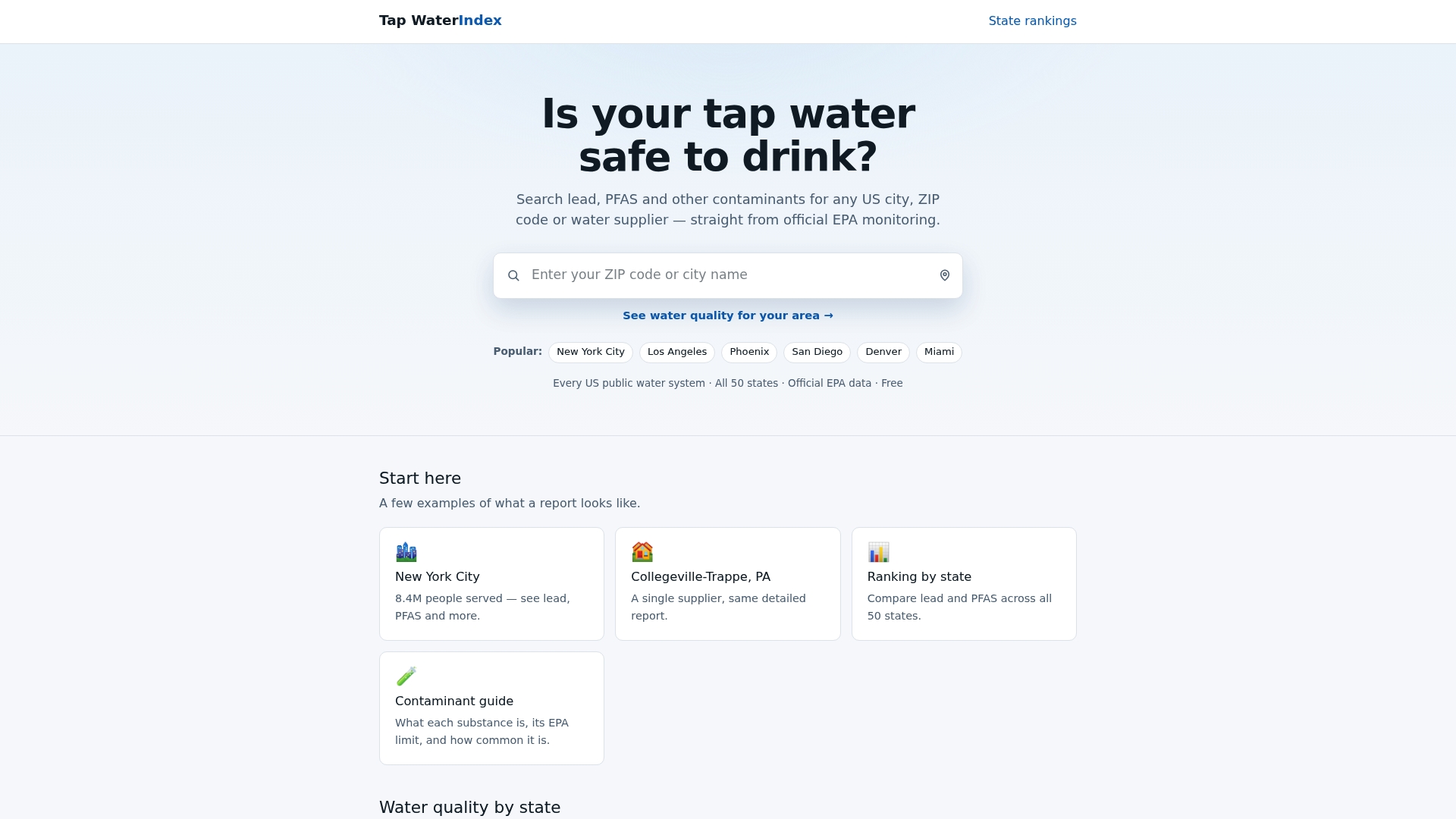
The site collates official EPA monitoring data into a format you can actually compare, contaminant by contaminant, state by state, without needing to know which government database to search first. If you want to see how Austin’s numbers stack up against other Texas utilities or check a family member’s water quality in another state, TapWaterIndex’s ranking tool is the fastest starting point. Search your ZIP code there now and see exactly what’s been detected in your water supply.